Every summer the Italian government sponsors outdoor music events as part of a broader cultural initiative. The Polo Museale del Lazio (Museum Center of Lazio) put together one hundred activities for this summer’s entertainment. See http://art-city.it
To date we have attended three concerts, one at Castle St Angelo and two at Piazza Venezia. The former is in Vatican territory and the latter overlooks the Roman forum and the ‘centro historico’ of Rome. Two more fabulous venues would be hard to find.
From the Castle you have a great view of St. Peter’s Cathedral as well as the River Tevere and it’s many summertime tents, where patrons sip cold beverages or have a plate of pasta while sitting on the banks of the river that divides Rome.
St Peter’s from Castle Sant’Angelo
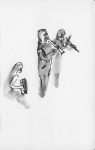
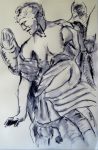
We were privileged to enjoy the Barcelona Gypsy balKan (sic) Orchestra seated on the upper levels of the monument, erected circa 139 as Hadrian’s tomb. You too can watch the performance we did, without the venue unfortunately:
Barcelona Gypsy balKan (sic) Orchestra, pen ink brish, mini done in audienceBarcelona Gipsy balKan Orchestra, pen ink brush, done in audience
Their lively performances fuse Roma and Klezmer. Klezmer is a musical genre created by Ashkenazi Jews of Eastern Europe. The groups are called klezmorim and originally it was largely dance tunes and instrumentals that they played for weddings and other celebrations. It is every bit as energetic as Roma music and likewise there are dances that go with some songs. When we were in Budapest one summer we watched a band and dance group performance, men in traditional black hats and suits dancing on an outdoor stage along the Danube. It was impressively athletic, including bottles balanced on heads.
The concerts at Piazza Venezia take place within the monument to Vittorio Emannuel II, made king of Italy at the time of unification in 1861. (You may recall that in 2000 Peg worked with the nephew of Lampedusa, who wrote the Leopard, a novel about Sicily at the time of reunification- Gigi was working on a novel). The monument overlooks Piazza Venezia on one side with great views of the historic center, and portions of the Roman forums on the others. You can easily see Trajan’s column.
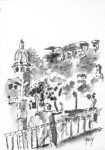
While waiting for the concert to begin, I sketched Trajan’s column. The column recounts the conquest of Dacia, in what we now call Romania. Romanian is a romance language, adopted as a result of the conquest depicted here. The sculptors who did these columns came to be called columnists, from which we get our use of the word.
Trajans Column from Vittorio Emanuelle, sketch
Romans are not fond of the monument, pejoratively calling it The Wedding Cake for its many layers. That you have to climb 260 stairs to get to the terraces does not make it any easier to like. They say it is two floors to the terrace, which is true I suppose, it’s just the ceiling height that kills you. There is an elevator to the highest level but you pay for those amazing views, but there is no stop on the level where they hold the concerts.
One evening there was a jazz band that whose offerings were too far from melodic for us. The second night was Bach. There were a flutist and a violinist, each accompanied by a virtuoso pianist, and a cellist who joined the rest for a third piece. Fortunately I am a Bach fan, but if I were not, there would have been far too many notes for comfort.
These concerts and other events continue until September. What a pleasure!
Doing time, just what Trump needs. Obstruction of justice, sexual harassment, collusion, perjury, blackmail, money laundering, emolument violations, abuse of power…
We landed in Rome’s Ciampino airport. We are barely on the ground and already Rome’s disarray hit us.
The last time we landed here there was only one bus to Termini, Rome’s central transit point. We presumed that was still the case when we bought our tickets from the vendor in Valencia’s airport, thinking what a good idea it was to sell tickets ahead of time. But then we walked out the front door, saw the bus platforms and four bus lines” names, but the name printed on our ticket was not there. I asked several staff and passengers to find which line was ours. We stood in that line for 15 minutes (at least we were shielded from the hot sun). The confusion was not over, however. as we were told to get in another line, whose placard was for another company. Indeed our bus appeared but as we waited we wondered if we had been mislead. Then there was getting on the bus. Italians do not stand in line, they crowd around the door, outflanking you. Eesh- I was already exhausted. And the struggle goes on and on. Why? Because Rome is chaotic like a turbulent fluid.
Traffic moves like a raging river one moment and a logjam in the next, herking and jerking until the wee hours. Yet like the fluid that finds its level, people get to where they are going, eventually, competing with each other and the buses and trams. The latter are what the drivers avoid using, but once in their cars they spend lots of time trying not to hit them and the other cars and the jillion darting scooters. Everything would work better if most everyone used mass transit, or the recently added bike lanes which they might do if there were enough buses, subways and bike lanes, but there aren’t since people spend money on cars instead.
The enormous trash bins are another sign of chaos. They are emptied daily yet each day overflow in an unsightly mess. Rome city government is getting advice on how to solve their trash mess from Palermo, of all places- that’s how bad it is. Even the upscale neighborhoods of the city have these problems, such as on Viale Giulio Cesare, which runs past the windows of our summer abode. Down a bit from our place tourists by the millions line up for St. Peter’s and the Vatican Museum. The back streets are lined with upscale stores, wine bars, restaurants and made to measure shops. But trash mars the area. The platforms upon which the containers nicely sit hold four dumpsters, one for household trash and three for recycling. They need perhaps two more but there’s no room on the platform and cars take up the room otherwise available.
Rome’s other issues contribute to the strain. Refugees, street people, tax avoidance, pollution, street trash. The list is seemingly without end- this is not an easy place to run, so no wonder there’s so much dysfunction. And yet people come, because Rome eternally beckons. Where else would you find an Eternal City, a city of such high art? There are countless richly decorated and appointed churches, public buildings and monuments, private palaces such as the Pamphili Palace, still occupied by the family but mostly a museum. There are Egyptian columns and Roman era ones such as Trajan’s which tells the story of the conquest of Dacia, modern day Romania. And there is ancient Rome. Every shovel full brings up a history lesson, it seems. This is why Metro Line C is not yet done after so many years, delaying one of the remedies for the chaos. There is plenty of cultural modernity to bring you in and keep you here. Wanted in Rome publishes huge lists of things to do- concerts, expositions, talks, walks, plays and of course opera. The Italians invented this high soap. Good grief, are they melodramatic or what? http://www.wantedinrome.com/whatson/.
Summer brings the Music Fest, starting June 21. Nighttime is filled with outdoor concerts and plays and acrobats and who knows what else, all free, and all the ones I have seen have been very good. My favorite venue is atop Castel San Angelo. Order a glass of wine and enjoy the music and the view of St Peter’s!! And of course any time of day or night have a cappuccino. Maybe you’ll find a delightful something to draw.
Then there’s the odd public service we ran across. At Ottaviano metro, where you exit the subway for the Vatican, there is a free water spot. Rome has had public drinking fountains, these little green creatures called ‘nasoni, for eons.’ They run constantly. But this fountain is different, like the old milk dispensing machines, standing some 2 meters/7′ tall. You put your bottle under the spout, press the button showing the size bottle you have and presto! You can get fizzy water as well, yet it is totally free! What?
Only in Rome would you get free carbonated water. How do they manage this and yet not be able to adequately handle the trash and sweep the streets? Or perhaps more importantly, why bother with this at all? Perhaps it has something to do with the trash. Millions of plastic bottles filled with water fill landfills and float in the Tevere that winds through the city. Can we help if we give away the sparkling water? I’d say so.
The government is trying. You can see that with this strange giveaway, with the trash platforms, another metro line. But you see the challenges everywhere you go, the trash strewn streets, the refugees, the homeless, the African street vendors.
We are back in the Eternal City. Eternal traffic jams, streams of friendly people and an endless supply of art. Check back here for lots of photos and updates!
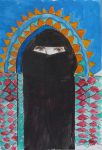
Many of the arches of Islamic architecture echo the shape of the upper body of the human form. Here I have placed a face on that arch with this sketch in acrylics. There is an example of an arch below the painting.
Woman in Hijab Arch, acrylics on paper, 13.5 x 21 cm/ 5.3 x 8.15″
Visits to the Casbah, the souks and the museums mentioned below, as well as the aromas and flavors of the cuisine, made me want to know more about the people of this land. The Berbers that founded the city of Marrakesh circa 1200 were members of that ancient ethnic nomadic group occupying many areas of North Africa. They were Christian under the Romans but converted to Islam with the Arab conquests. With the Arabs they formed what we came to call the Moors- thus not are not sub-Saharan Africans, contrary to some popular conceptions associated with the term ‘Moor.’ Today there are some 25 million Berber speakers in Morocco, Libya and Algeria, but the number of ethnic Berbers is greater as most now speak Arabic, constituting to this day the majority of the population of North Africa.
Moroccan Souk, pastel
Their occupation of Spain, headquartered in Granada’s Alambra but covering nearly the entire peninsula, was the most northern permanent excursion of Islamic culture into Europe and it was through this expansion that Europe received the advanced knowledge possessed by these peoples at the time. It is in that epoch that the glory of Morocco and Islam resides, a glory that contains the extent of their innovations.
Both guides we employed told us that the people of Morroco are very tolerant. I can not tell if this is a tolerance founded in the nomadic past, its interpretation of the Koran or the result of, say, French liberalism or other source of humanistic philosophy, but the claim does seem to bear up under what scrutiny I was able to bring to the task. As I noted in my first post, there are no visible tensions between tradition and modernity when it comes to dress. Some women walked around in jeans and other in the hijab without active confrontations or shunning- some even walked together chatting. Men wore kaftans or western dress with equal comfort. These days Jews are actively encouraged to immigrate- most left after the formation of Israel and the last of them after the ’67 war, but Jews have a long history in the country.
As an example of tolerance at the edge, a lesbian woman was jailed but later released after an international outcry, for open affection with another woman. Elton John is being permitted to perform at a spiritual fest, the king saying what Elton does in private is his business, according to the Fes guide.
The King, yes there is one and he is an active ruler. His family claims of direct descent from Mohammed puts the the Sunni side up in this country.
Jardin Majorelle
After our guided tour of the souks in Marrakesh we visited two of the few local museums. One is in the Jardin Majorelle. It was founded by Yves Saint Laurent, who bought the gardens with his partner Pierre Bergé in 1964, later gifting it to Marrakesh,. The original owner was the landscape painter Jacques Majorelle in the 1920’s. In the garden there are 300 species from five continents, along with various ponds laid out along the winding paths. The art deco style Musee Berbere that was Majorelle’s studio now contains an excellent collection of Berber arts and crafts. It is small but the collection is excellent. http://www.jardinmajorelle.com/. Note that vibrant blue paint on the exterior.
Also an excellent visit is the MACMA, a private museum that opened in February, 2016. The owner is Nabil El Mallouki. He dedicated the museum to Morocco’s artistic heritage with a 20th century focus on paintings, some by Moroccans, others by French or European painters. The museum captures what is exotic about Morocco, at least from a European viewpoint, with a collection of quality portraits, casual life and battle scenes.
Portrait of Guard in Tangier Palace
Marian Bertuchi, Le Cafe, 1941
The Heritage Museum
There are two other private museums worth a visit. The Heritage Museum is in the narrow alleys that define the Marrakesh souk. At the desk we were met by a woman who is the daughter of the owners, the second we met was her sister and upstairs we met their mother. It’s a family affair, They are happy to share their collection with visitors. The museum is in the riad – a house built around an open courtyard – previously owned by the daughters’ deceased uncle filled with the family collection. There are Berber, Arab and Jewish items. The jewelry (a specialty of the Jews), clothing and furniture are delightfully displayed in the beautiful surroundings.
Heritage Museum entrance
The rooftop cafe offers a fabulous view of the Medina, the souks hidden by the tall walls of the houses.
In a visit of about 10 days you can see what Marrakesh and Fez have to offer, including a side trip to Meknes, interesting enough if you have never seen Roman ruins before. The train between Marrakesh and Fez takes almost 8 hours. There is a sandwich cart in case you’ve not brought food with you, lots of desert countryside dotted with small structures and shepherds. Bring a book since you’ll probably want some diversion.
Morocco left me with eight main impressions. First, the contrasts in technology – delivery by donkey and by truck/motorcycle – and second, in cultures- modern dress next to traditional Berber next to conservative Islam. Third is the intricacy and extensiveness of the decorative architectural designs. Fourth is the daily prayer calls, a strange concoction of sound; perhaps more strangely is that people dis not seem to particularly notice. Fifth, the cuisine can reach impressive heights although it is mired in sameness on many levels. Sixth is the friendliness of the people we have met and the apparent tolerance. Seventh is the level of poverty and, finally, that its glory is largely in its past.
Contrasts in technology
As we walked in the souks (markets) and even in modern areas we would encounter donkeys hauling delivery carts and the modern version, which is a motorcycle rig with an integrated covered bed. There are men pushing delivery carts in the narrowest parts of the souks, or men carrying bundles. Sometimes loads would be strapped to the backs of a donkey for delivery. In larger areas you see large modern trucks transporting goods.
In the souks small stands are the norm, but in the modern areas you can see larger shops, super markets and international chains, some quite upscale.
Contrasts in Culture
Women are everywhere, and dressed in everything from a full covering hijab, only eyes peering out from black robes making for a mysterious appearance both intriguing and chilling simultaneously, to jeans and blouse. The only women not very modestly dressed might have been foreigners. I saw few women working but there were some. The manager of the Orange shop we went into in Fez is run by a woman, and in the modern areas there women working in shops, cafes and restaurants. In the souks almost everyone in the stalls and shops is male.
The intricacy and extensiveness of the design
Here are some examples of the design features you find in old buildings. Islamic art is noted for this design, of which the Moroccan is a variation.
Here’s a modern rendition:
The University in Marrakesh
As you can see above, in some buildings the decoration is from floor to ceiling.
arch at Museo de Mouassine, Marrakesh
Daily prayer calls
These happen 5 times per day and at odd hours- not say at the top of the hour but at say 522 am. Once these calls to prayer begin they rise to a crescendo, starting with a call from a single mosque but soon joined by the other mosques in the area. In Fez we stayed in a poor neighborhood, although the accommodations we stayed in were comfortable enough provided you can climb three flights of very steep short staircases. There were about a half dozen mosques in the area, and the sound echoes off the mason surfaces. It was eerie. Here’s a pretty good rendition:
No one seems to run to the mosque for all this praying. We could see groups of men in the mosques but not in large numbers. Both of the guides we employed talked about the religion. One explained the ritual washing you do before you go into a mosque and how it was not required to do your daily prayers in a mosque nor to assume the bowing posture unless you were in the mosque. But everything revolves around devotion to Allah.
This is a religious country but not fundamentalist as a whole. Islam is pervasive but other religions are tolerated and the king is encouraging the re-immigration of Jews, many of whom left for Israel after a long and prosperous history here. Homosexuality is illegal but violations are sporadically enforced. Two girls photographed kissing were arrested but release without trial after an international outcry. One of our guides said the king does not want bad publicity and prefers to overlook things of this sort. Elton John was invited to perform at a festival celebrating spirituality and after some protests the king said he writes and sings about spirituality, his private life is his own affair.
Alcohol is forbidden in Islam, but you can buy it here and they produce wine in the country.
In our interactions we had in restaurants, shops, hotels and on the streets we found the people to be universally friendly. I saw one conflict with foreigners and that was a metal worker objecting to being photoed by a tourist. The military waved us off when we tried to photo a wall that turned out to be part of a military installation, but entirely understandable from their point of view. Many people talked to us as we walked around, and some have tried to get us to visit a shop to ‘just browse.’ Sometimes they help us find our way just being considerate. A 10 year old boy guided us out of our neighborhood that first day in Fez and insisted on being paid but several adult men wanted nothing for pointing the way.
Poverty
This is definitely a third world country so it is obvious that money is in short supply. There are many old taxis, for instance, with broken seats and no window cranks, although there are some brand new ones. The public buses are in decent condition- we have used several in Marrakesh. The population is young, with an average life span of 73, ranking 80th in the world. Dental care is rare, judging by their teeth. The food is plentiful and of excellent quality, fruits and vegetables are part of the daily cuisine. They must not be coming from far away. The cuisine is tasty and reasonably varied. Alcohol is in short supply and expensive where available. There are huge vineyards near Meknes.
Glory is largely in its past
The glory of Morocco, as in all of North Africa and the Middle East in general, lies in its past, and of which they are proud. Don’t expect a balanced presentation from people you meet casually. It’s a ‘show me the good parts.’
The Moors who invaded Spain in 711. The name ‘Moors’ comes from the Berber tribe called the Mauri (do not confused with the country of Mauritnia). At that time the Islamic culture was a main source of knowledge for the Mediterranean countries and Europe. Medicine, astronomy agriculture and more were absorbed into European culture as a result of the take over of Spain. It is this of which they are perhaps most proud, but now the main product of these cultures is Islam, in which they seem to place a great deal of hope. Both of our guides witnessed their faith to us, and probably presumed we are Christians. At least we all have the same God, said one. The other suggested that there would be no modern medicine if it weren’t for the Moors and Arabic culture in general. There is something to be said for this, but on the other hand, what have they done since?
Their ancient markets are a huge attraction. Leather production is still done in the same way and at least in Fez in the same location since the 14th century. They use natural dyes only in the craft markets, and are prohibited from selling anything other than traditionally made items. In the leather area they still use pigeon droppings and other traditional processes to treat camel, cow, goat and sheep skins. Goat is the best, we were told, as it produces the softest and most water resistant product. Carpets and scarves are made from traditional materials in the traditional method, using hand looms. We bought some scarves made of agave, the cactus, that you would swear was silk. They preserve their past. What of their economic future?
Processing skins in Fes (photo by Peg)Traditional carpets in Fes
Moroccan Souk, pastel, alcohol blends
Cookie Consent
We use cookies to improve your experience on our site. By using our site, you consent to cookies.
Contains information related to marketing campaigns of the user. These are shared with Google AdWords / Google Ads when the Google Ads and Google Analytics accounts are linked together.
90 days
__utma
ID used to identify users and sessions
2 years after last activity
__utmt
Used to monitor number of Google Analytics server requests
10 minutes
__utmb
Used to distinguish new sessions and visits. This cookie is set when the GA.js javascript library is loaded and there is no existing __utmb cookie. The cookie is updated every time data is sent to the Google Analytics server.
30 minutes after last activity
__utmc
Used only with old Urchin versions of Google Analytics and not with GA.js. Was used to distinguish between new sessions and visits at the end of a session.
End of session (browser)
__utmz
Contains information about the traffic source or campaign that directed user to the website. The cookie is set when the GA.js javascript is loaded and updated when data is sent to the Google Anaytics server
6 months after last activity
__utmv
Contains custom information set by the web developer via the _setCustomVar method in Google Analytics. This cookie is updated every time new data is sent to the Google Analytics server.
2 years after last activity
__utmx
Used to determine whether a user is included in an A / B or Multivariate test.
18 months
_ga
ID used to identify users
2 years
_gali
Used by Google Analytics to determine which links on a page are being clicked
30 seconds
_ga_
ID used to identify users
2 years
_gid
ID used to identify users for 24 hours after last activity
24 hours
_gat
Used to monitor number of Google Analytics server requests when using Google Tag Manager
1 minute
Marketing cookies are used to follow visitors to websites. The intention is to show ads that are relevant and engaging to the individual user.
A video-sharing platform for users to upload, view, and share videos across various genres and topics.
Registers a unique ID on mobile devices to enable tracking based on geographical GPS location.
1 day
VISITOR_INFO1_LIVE
Tries to estimate the users' bandwidth on pages with integrated YouTube videos. Also used for marketing
179 days
PREF
This cookie stores your preferences and other information, in particular preferred language, how many search results you wish to be shown on your page, and whether or not you wish to have Google’s SafeSearch filter turned on.
10 years from set/ update
YSC
Registers a unique ID to keep statistics of what videos from YouTube the user has seen.
Session
DEVICE_INFO
Used to detect if the visitor has accepted the marketing category in the cookie banner. This cookie is necessary for GDPR-compliance of the website.
179 days
LOGIN_INFO
This cookie is used to play YouTube videos embedded on the website.