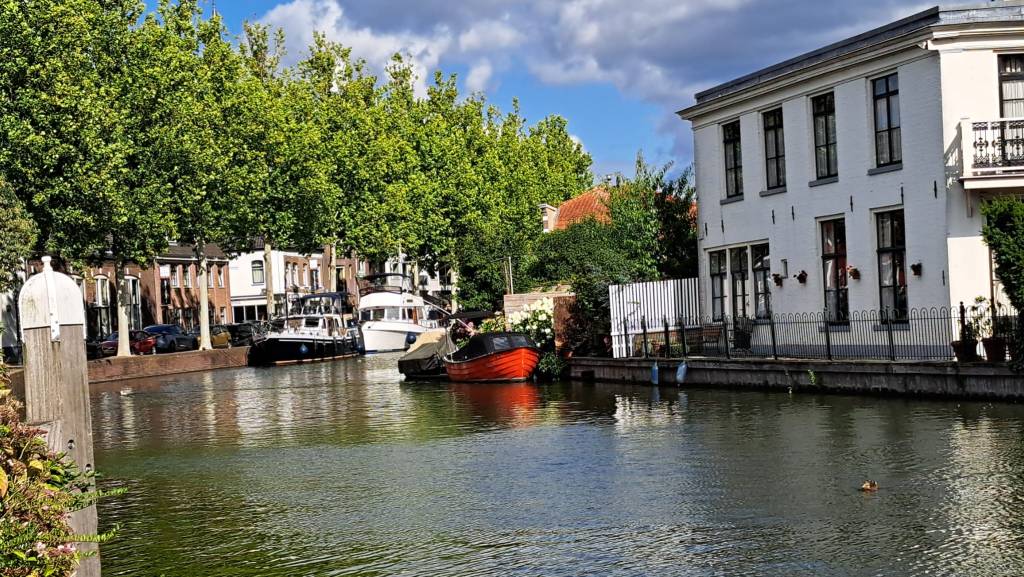
From deep in the heart of Friesland we set off early on a twenty hour journey to the tiny town of Weesp on the River Vecht. There we are joined by nephews for a legacy tour starting in Weesp, to Utrech, Rotterdam, den Haag, Haarlem and Amsterdam.
We stayed one night on the Eems River. Arriving around 6 p.m. meant that we would have a hard time finding a mooring at all. The first set of moorings were full, but as usual if the boaters eliminated unnecessary gaps we could have easily fit. We had to go 6 kilometers up the river before we found a mooring in a small park on a curve- that ook more than 30 minutes. Curves are harder to moor to since your bow is farther from the land, making it harder to tie to a bollard. The sailboat’s bowsprit stuck far out, giving us an extra obstacle. Fortunately there were posts to moor to – you never know until you get there. Sometimes there are just rings, meaning you have to get off the boat to attach to the shore. This can be difficult if the wind is pushing you away from the land Here we were able to lasso both the front and aft posts. With posts you have to go around twice, or the lines ride up and off.
There were several locks along the way, filled end to end with boats. It’s summer so the Dutch hit the waterways, even in the less than ideal weather on offer. The lock meister packs them in! You always wonder if some new boater, or a rental boats, will lose control of their vessel. All the experienced boats are on alert.
Looking ahead we could not be certain if the weather would hold. Already we had a problem getting off a mooring with strong winds pinning us to the dock, our bow thruster not there to give us a lateral boost. From the Eems we headed early in the morning into wind and rain, but fortunately everything calmed down once we entered the canal leading to the lock. This made entering the lock much easier, so we were able to gaze upon the beautiful old Muiden Castle.
Muiden, NL Castle, watercolors
Our next uncertainty is the availability moorings in Wessp. Just past the second bridged we found the only one available. Lady Luck overruled Sir Bad Luck us once again. The next morning everyone left so we moved farther from the bridge to avoid the fumes of the boats waiting for the bridge to open as they say just a meter away.
Moored in the center of Weesp
If you’ve not had the pleasure, include Weesp on a tour of small Dutch towns. It’s not far from Amsterdam and can be visited in just a few hours. There are restaurants along the river and a brewery located in a de-consecrated church, with lots of very Dutch architecture. In summer there are flowers galore.
Mepple: From Franneker we made our way to Meppel, a town of some 35,000. Meppel got its start in the 16th century, arising out of the peat trade. Its tiny central harbor is minutes to the main parts of the old town, sitting behind a small lock operated by friendly and helpful young guys. It is one of the most picturesque harbors in the country, especially at night. Walking around town treats the visitor to pleasant facades and quaint worker housing.
The inner harbor at Mepple
Windmill in Meppel
Groningen houses some 235,000, making it the country’s sixth largest cities. It has a small art museum whose main claim to fame is the permanent ceramics collection. When we visited there was a photo exhibit featuring the Rolling Stones, interesting enough if you care about this rock group. Fortunately the town itself is worth a visit. Aside from the all the wonderful traditional brick architecture there’s the super modern library. It’s a glass structure with a 10 story atrium crisscrossed by escalators. Near the stacks are coffee bars, and there is a cinema as well. From the top there’s a great view of the city.
Groningen was established more than 950 years ago. It was part of the Hanseatic trading league and an autonomous city-state until the French era cirrca 1700’s. Today it is home to the University of Groningen, the Netherlands’s second oldest university, and the Hanze University of Applied Sciences. One out of four residents is a student, so there’s a lively street scene. The bars are full day and night, bikes and scooters flying left and right in the central zone.
Goudkantoor (1635) built as governmental office space
Grou: We came to Grou several times this year due to its crossroads of canals and the abundant moorings in town and outside. Grou sits on a large body of water called the Pikmar, with the Princess Margriet Canal (a section called the Nije Wjittering, Frisian for New Wittering) on one side. Coming into the port you are amazed by the number of boats that live in this itty bitty town, and, at this time of year, by the number of visiting boats. You can fill up with water and charge your batteries without charge, which helps draw visiting boaters.
While we were there a sailing competition filled the ‘passenten haven’ (passersby moorings) spaces up to three deep. Some dozen traditional wooden sailboats zoomed around the islands- we watched from one of them. Heavy weather put an end to the competition. The boats with their dramatic black and white sails repeat the competition in several villages in the area annually.
Worker houses in Grou
Boats moored in Grou
Leeuwarden is another bustling university town, with a total of 150,000 inhabitants (as of 2020). After an opening bridge, on the right there is a harbor for traditional boats and barges, to the left the visitors’ moorings. From the visitors’ moorings you are just minutes away from the busy central pedestrian zone, shops and restaurants galore.
Leeuwarden St.Bonifatius Church
It was around in Roman times and is built on a terp, a mound of earth built up to protect the inhabitants from flood waters. Medieval Leeuwarden had a moat and ramparts all around, later demolished or converted to gardens. The many canals have been reduced significantly in number. There was a small Jewish population starting in the 18th century.
The weather system that produced the high winds and rains of July finally broke in early August. With visitors aboard we passed through some of the most beautiful towns of Friesland.
Sneek (pro Snake), with its ancient gate called ‘Waterpoort,’ is one such. It was founded in the 10th century on sandy high ground- as were many of the old towns as the poulders had not yet been created. It was also sited on a dike, whose presence is reflected in several street names: Hemdijk, Oude Dijk, and Oosterdijk. The canal winds through it, barely room for boats to pass one another. As in all these old towns history is everywhere, from the finest public buildings to the residences both opulent and plain.
Viking passes through the bridge in Sneek and in front of the Waterpoort
Makkum, like many other early settled areas, rests on a ‘terp,’ an artificial mound created to provide high ground. It is a port town, resting on the Ijsselmeer which is fed by the Ijssel River, one of the extensions of the Rhine. The Ijsselmeer is controlled by a huge dike on its northern edge holding back the North Sea. The Ijsselmeer can get quire rough, so we only venture out on calm days when the wind is not from of the westerly direction over Force 3 or 4.
The lock in Makkum
This is a tiny town despite its port, with a mere 3400 inhabitants. Historic merchant houses line the lock area, itself once owned by a monastery. There is a 17th c weigh house. In the 1600’s, the Dutch Golden Age there were windmill powered industries including lime kilns. The lime was used in Amsterdam’s construction. Today the main activities include water sports due to the excellent sailing on the Ijsselmeer.
Harlingen is also a port town, larger than both Makkum and Grou (see below). We moored in the inner harbor, which is tidal as it sits open to the Waddenzee, essentially the North Sea but named otherwise to delineate the waters behind the West Freisan Islands. You secure your boat differently in tidal areas. To allow the boat to rise and fall you can not tie it tightly. Instead you attach long lines fore and aft. Tied normally the lines will either break or the cleats will as your boat starts hanging sideways to the dock.
Terscheling is a town on one of the islands and is served by a ferry that makes the 26 kilometer journey many times daily. We hopped on. It rumbles its way through a narrow channel. Since it was low tide we saw exposed sand bars not far off. As the weather was good we were able to sit on the top deck, enjoying the approach of the island and the many boats making their way to and from. We also visited the cafeteria. They serve many typical Dutch snacks such as frickadel (meatball) and other snacks usually served as a borrel (an after work drink with colleagues) and tosti – grilled ham and cheese sandwiches. Then there is ubiquitous appelgebak mit slagroom, the national desert. That’s apple pie with whipped cream, thick and delicious whipped cream. The pie is identical to that served in the US and Canada. There is a crumble top version.
One of the harbors in Harlingen
Harlingen is jampacked with traditional wooden sailing vessels, many of them “tjalks,” a flat-bottomed leeboard (side-keeled) vessel with a gaff rigged mast. A gaff rig is a four corned sail attached fore, aft and at its peak. There is a long pole called a spar. Some tjalks are used to transport day passengers on pleasure cruises but most are for pleasure boating. They were originally used for fishing and cargo transport. As the keels can be raised they can navigate in shallow areas. In deeper water they can lower a keel in order to use its broad flat surface for resistance to sideways motion, thus making it easier to maintain course.
The 12th century village is thick with old brick buildings dating back hundreds of years sitting on cobbled streets. These house many of its 15,000 residents. You walk along the canals starting into beautifully appointed living areas through the un-curtained sparkling large windows, all seemingly cleaned thoroughly each day by invisible workers. We have yet to see anyone ever doing the chore!
The weather was fine so the main streets were alive with locals and visitors, the former going to work or doing errands, the latter walking the streets, waiting for the ferry or train, and every sort populating the bars and restaurants, sitting in the sun which they do not see much of in the long winters. We stopped for poffertijes. These are essentially small pancakes made with yeast and buckwheat. Most are served with sprinkled powdered sugar but there is a savory variant made with Gouda cheese. The sweet version goes well with the strong coffees the Dutch prefer.
Franeker is a bit inland. You pass through a large lock to get inland. Today there was no change in water level so the lock opened to allow us to enter and moments later the other gates opened to allow us to exit. We enjoyed the fine weather passing through the tranquil countryside.
In addition to Franeker’s beautiful architecture, a main draw is the Royal Eise Eisinga Planetarium. The planetarium was built by Eise Eisinga between 1774 and 1781. A pendulum clock powers the movement of the planets, the whole apparatus handing from the ceiling. It is the oldest working planetarium in the world.
Franeker has been around since about the 9th century, playing a role in many major historical events too numerous to go through here. The name may have originally been “Froon-acker”, Friese for “land of the lord/king.” The town’s oldest street in the city is called Froonacker.
This is my second rendition of our boat in front of one of the two old windmills in the tiny town of Dokkum in Friesland, the northeast province of the Netherlands.
Viking in Dokkum 2, water color, 8 x 8″, 20 cm x 20 cm on Arches paper
Sneek is a small city in Friesland, the northeast part of the Nederlands. It has a gorgeous gate and other architectural gems. It faces the canal. We were moored just in front of it.
Waterpoort, Sneek, Nederlands pen and ink, Company, 6″ x 8″ 15 x 21 cm
Cookie Consent
We use cookies to improve your experience on our site. By using our site, you consent to cookies.
Contains information related to marketing campaigns of the user. These are shared with Google AdWords / Google Ads when the Google Ads and Google Analytics accounts are linked together.
90 days
__utma
ID used to identify users and sessions
2 years after last activity
__utmt
Used to monitor number of Google Analytics server requests
10 minutes
__utmb
Used to distinguish new sessions and visits. This cookie is set when the GA.js javascript library is loaded and there is no existing __utmb cookie. The cookie is updated every time data is sent to the Google Analytics server.
30 minutes after last activity
__utmc
Used only with old Urchin versions of Google Analytics and not with GA.js. Was used to distinguish between new sessions and visits at the end of a session.
End of session (browser)
__utmz
Contains information about the traffic source or campaign that directed user to the website. The cookie is set when the GA.js javascript is loaded and updated when data is sent to the Google Anaytics server
6 months after last activity
__utmv
Contains custom information set by the web developer via the _setCustomVar method in Google Analytics. This cookie is updated every time new data is sent to the Google Analytics server.
2 years after last activity
__utmx
Used to determine whether a user is included in an A / B or Multivariate test.
18 months
_ga
ID used to identify users
2 years
_gali
Used by Google Analytics to determine which links on a page are being clicked
30 seconds
_ga_
ID used to identify users
2 years
_gid
ID used to identify users for 24 hours after last activity
24 hours
_gat
Used to monitor number of Google Analytics server requests when using Google Tag Manager
1 minute
Marketing cookies are used to follow visitors to websites. The intention is to show ads that are relevant and engaging to the individual user.
A video-sharing platform for users to upload, view, and share videos across various genres and topics.
Registers a unique ID on mobile devices to enable tracking based on geographical GPS location.
1 day
VISITOR_INFO1_LIVE
Tries to estimate the users' bandwidth on pages with integrated YouTube videos. Also used for marketing
179 days
PREF
This cookie stores your preferences and other information, in particular preferred language, how many search results you wish to be shown on your page, and whether or not you wish to have Google’s SafeSearch filter turned on.
10 years from set/ update
YSC
Registers a unique ID to keep statistics of what videos from YouTube the user has seen.
Session
DEVICE_INFO
Used to detect if the visitor has accepted the marketing category in the cookie banner. This cookie is necessary for GDPR-compliance of the website.
179 days
LOGIN_INFO
This cookie is used to play YouTube videos embedded on the website.