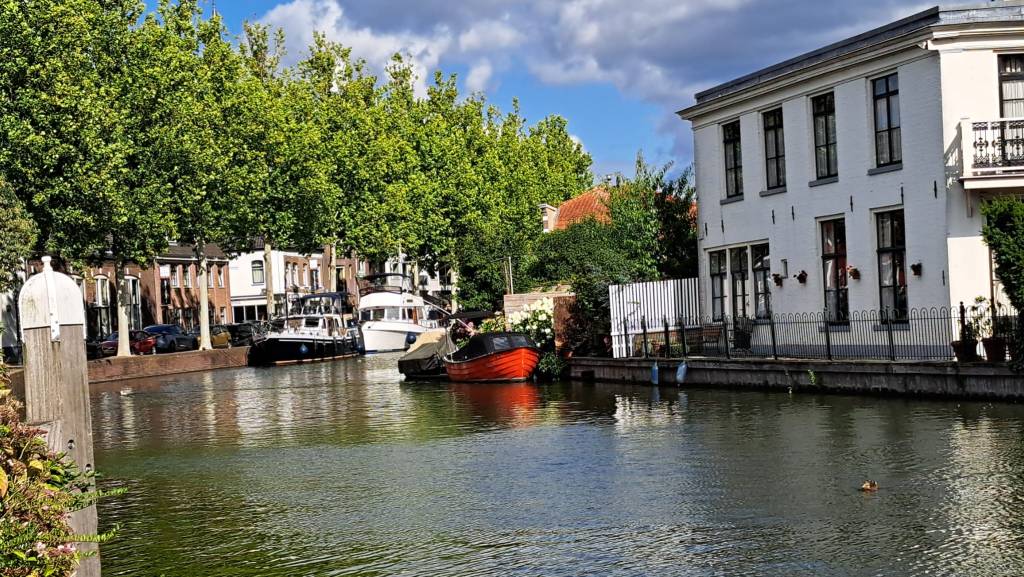
Tag: boating Netherlands

  • By small boat to Appingedam and Delfzij

    Appingedam and Delfzijl are located in the less visited far northeast of the Netherlands. Delfzijl sits on the shore of the bay into which the Eems River empties, connecting it to the North Sea. Appingedam is a few kilometers inland. Both are served by the Eemscanal, a large barge capable canal.

    Appingedam picturesque municipal harbor is in the center, reached through a small lock and then by a tiny canal. The harbormaster came to open the bridge and with very basic English guided us to a back in box. Our bow thruster having just failed in high winds just as we arrived at the lock, getting into a narrow box just a half meter wider that our boat can be a bit of a challenge. We managed to get him to allow us to stay where it is easier to dock.

    Appingedam has been inhabited since prehistoric times, coming into history in the 13th century. It was located on the Delf River, now called the Damsterdiep. The name ‘Appingedam’ refers to the dam built on the Appe (aka Apt) In 1327. It was then a seaport with good access via the river, becoming a trade hub for destinations in Germany and the Baltic. It was then part of Frisia (Friesland), a region of Frisia called Fivelingo. Nowadays it sits between two canals, completely surrounded by water.

    It’s famous hnging kitchens

    In 1536 Appingendam and Gronigen went to war over trade. Appingendam was destroyed, losing it’s position as a trade hub. It was not dead altogether, however. It regained enough economic health that there were funds to build the City Hall in the 1630’s. By the late 1800’s cattle, flour, oil and five breweries provided employment and growth.

    Delfzijl is now the more important of the two towns, being the fifth largest port in the Netherlands. “Delftzijl” refers to a fortified lock on the old Delf canal that connected the rivers Fifel and the Eems. It has been a major port since the Middle Ages. There were six bastions, built in 1591. The town has been the focus of several battles involving the Spanish and French, and in WW2, the Nazis. Today, despite being a fairly important port, the town shows signs of economic stress, with a noticeable number of empty commercial spaces awaiting tenants.

    The bastions of 1591

    We had lunch at Cafeteria Rex. It was doing good business as we waited. It’s set up as a lunchroom with the grill behind the bar so you can watch them work. The lekkerbeck (deep fried cod) was much less expensive than in Gronigen, at €7 versus €10, and bitterballen likewise, and just as good. Bitterballen are a breaded and then deep fried snack made with a stew thickened with roux. In this beef stew they add onions, salt, pepper, parsley and nutmeg.

    The town is protected by a 9 meter/ 30′ dike, sluices and a pumping station. At low tide the sluices open to drain the land. The pumps are used if the low tide is too high to allow for gravity drainage.

    The Uitwierde Church has a free standing tower circa 1200. The church sits on an artificial mound dating from well before the construction of dikes. There’s an old windmill, Mill Adam. The Adam is a corn mill. Originally, the Adam was was paired with the Mill Eva. Adam Mill is now an art exposition space. No one knows if Adam Mill misses Eva Mill. https://www.visitgroningen.nl/en/locations/eemsdelta/blissfully-happy-in-delfzijl/culture-in-delfzijl

    Uitwierde Church

    There’s a monolith tomb dating to 3400 BCE.

  • Tippy canoe

    We entered the Oster (east) Schelde after a night in Willemstadt. The Oster Schelde leads to the North Sea. This means we are in a tidal zone, with significant tidal current at times. If the wind is against the current, or simply if it’s very windy, the water can get pretty rough. This can make us passengers pretty uncomfortable. Fortunately we did not have this issue despite the wind. However upon entering the harbor for the night we had to turn to face the wind to control the boat, otherwise the wind can push the back end of the boat away from the dock when you want the opposite to occur, of course.

    Some friendly boaters helped with the lines, showed us where we were supposed to go, as we had first moored in order to find our assigned spot rather than taking the boat into more narrow spaces. Then they helped us moor at our assigned space, the one given to us by phone earlier in the day.

    The next day at 6:45 a.m. we left for Terneuzen. We did not get far. Just outside the harbor the water was too rough for comfort so we returned to our mooring, having to pay the big bucks for the night. This zone is more expensive than most areas of the Netherlands. The next day promised to be sunny and calm and indeed it was. It is a route said to be traversed by many big ships. It was that as well. The small craft lock was closed for maintenance or repair, so after some confusion we found ourselves going into the huge lock with the big boys.

    On the canal going south we were in some dense fog from time to time. It lifted by the time we arrived at the next lock, at Haanswert. After that huge lock you enter the Wester Schelde. Following it in the southeasterly direction takes you into Antwerp. As we head in the opposite direction, to Terneuzen, we were running with the low tide. We cruised at 7km per hour over our normal cruising speed of 10 kph. Going against the current would mean 7km under our cruising speed, about 3km per hour, so there’s a huge difference. had we gone to Antwerp at this time it would have been very slow going. Here you must pay attention to the tide tables, which we had not required to do since we took the U.S. Power Squadron course in the early 1990’s.

    The last time we entered Belgium we went through Antwerp, going south from the Haaswert lock rather than angling to Terneuzen as we did today. By this route you enter the port of Antwerp, the largest or second in Europe. However AIS (Automatic Identification System) is now required. Something approaching $1000 is what you need to lay out for the purchase and installation of the equipment. This is the first time we have found it to be a requirement, so the expense is not justified.

    So we were off to Terneuzen. We weren’t alone. We were with huge inland barges and gigantic seagoing vessels, but this is a large body of water so we were not at all concerned. For safety and to avoid the sometimes significant wakes, the harbor master told us to stay between the green and yellow markers, the small craft lane. The route is well marked so you avoid the shallow areas exposed by the tide. In fact we passed by several visible sand banks along the way. Most large vessels stayed out of the zone marked by the green and yellow buoys. Using it reduces the distance you need to travel. We were bounced around by wakes from time to time, but nothing above about .5 meters.

    There is not one but two huge locks at Terneuzen. The lock “meester” directed us to the one to starboard, and to go in behind a particular huge ship, one with lots of pipes and things on it making it look like a floating oil refinery. We were tied to the huge ship splinter-laden moorings for over an hour as more lumbering giants entered. Finally about a half dozen monster commercial ships emerged from the open door. Then in went the big boys waiting with us, followed by us and one other small boat, once the lock meester told us it was our turn. It took over an hour to this point and we still had the lock to go. Huge ships struggle to get going, so once the door was open it was at least another 20 minutes before we were out and into the canal, the concerns about the crossing behind us.

    20240509_082202
    Giant lock at Haanswert, two huge barges at the front.
    20240509_091851
    One of the huge ships staying in their lane
    20240509_112211
    In the lock at Terneuzen
    The gigantic gates at the Terneuzen lock- I am holding the boat in place while shooting this thus the shakiness.

  • One Lane Canal III

    Wergea III
    One Lane Canal III, 18 x 24 cm 7″ x 9.5″ on Fabriano 300 gr watercolor paper

    This is based on the view from our boat as we traversed the picturesque, tiny canal that bifurcates Wegea, Netherlands.

  • One Lane Canal II

    One Lane Canal II
    One Lane Canal II, 18 x 24 cm 7″ x 9.5″ on Fabriano 300 gr watercolor paper

    Rich with charm, Wergea is a tiny village in Friesland, We passed through on our boat Viking via their one lane canal, the only canal in the village. Tranquility, harmony of architecture, bikes on the lanes. In good weather the Netherlands is one of the best places on earth.

  • Viking in Nederlands 2021 (video)

    First song by Colm McGuinness. See more of his singing on youtube.
    de hoef sm
    De Hoef, watercolors
    Windmill Nederhorst den berg
    Windmill Nederhorst den berg

    Preview in new tab

    Delft Port Towers
    Delft
    Voorschoten
    Voorschoten
    scene in zwammerdam wc sm
    Zwammerdam, watercolor

    All of these are available for purchase. Easiest way to make arrangements is to contact me at info@garyjkirkpatrick.com Prices range from $150-350 for these. Size A4, approximately 8.5″ x 11″

  • Windmill of Sloten

    sloten windmill sm
    Windmill in Sloten, 32 cm x 41 cm, 12.6 x 16.1″

    Sloten is a small charming town in the Netherlands. The windmill is still in use for grinding flour.

    [sg_popup id=11081]