Rural Singapore, watercolor 21 x 30 cm/ 8.3 x 11.7″
Adding to the long series of watercolor paintings from my travels, Rural Singapore is the first from that trip. The large leaves, variety of colors vegetation, some which is not quite like what I have seen before, yield a strong impression of lushness befitting a warm and humid climate. The abstract elements provide diversity. We are doing more than just giving you what a photo could, another level of variety in form and color with which to feast the eye.
Continuing with my efforts in charcoal, this is a winter scene in the Netherlands.
We’ve traveled extensively on the canals of the Netherlands. Not long ago these canals froze every winter and to this day the Dutch people are over-represented in the Winter Olympic speed skating events.
This canal is located near ‘s-Hertogenbosch. People call it Den Bosch. There are some 160,000 residents. It is the capital of the province of North Brabant and its fourth largest city by population in the Netherlands. It is famous for the Bossche bol – called chocoladebol locally. It is a puff pastry filled with delicious thick whipped cream and covered with chocolate.
Another in my series of Hopper inspired paintings, a woman looks out over a golden field with a thick green forest at its edge. Figures walk in a line towards the dark woods, phantoms in the foreground. Completed in 2021, modified 2025.
From Saatachi’s description: https://www.saatchiart.com/art/Painting-Looking-Out/664581/13637737/view
“Looking Out” is an original acrylic painting on canvas, inspired by the iconic style of Edward Hopper. The expressionistic landscape depicts a woman gazing out over a golden field that meets a thick, verdant forest. The scene takes on a symbolic and mysterious quality with the addition of fantasy figures walking towards the dark woods.
The artist’s use of colorful greens, blues, and yellows creates a vibrant and captivating image. The painting’s technique and materials enhance the overall expressionistic effect, inviting viewers to explore the narrative and emotions within the piece.
Occupying a unique position on ocean trading routes enhanced by its importance to the British Empire, with Malaysia and Thailand to the north, Indonesia to the east and China to northeast, India to the northwest, Singapore developed a rich, diverse Asian cuisine. The result is a potpourri of spices and ingredients, bewildering to most Western visitors.
Hawkers
You can try an astounding variety of dishes at Singapore’s hawkers, vendors of its famous street food housed under open air roofs. Most stalls have a number of offerings, ranging from fried shrimp breads to complex rice dishes. It’s hard to know what you are ordering even though the signs are in English. If you have a knowledgeable friend to join you it’s all the better, which was the case for me.
You sit comfortably while dining on most days as fans keep the air moving. Thus well ventilated, the shaded space immerses you in aromas galore.
Malaysian curry. I had a lot of curries while there. Caution advised.
There is no table service. If that’s what you want choose a restaurant, though you will loose the extensive range of options you will find among the hawkers and you will usually pay much more. Both restaurants and hawkers follow modern hygiene practices so there is no advantage to restaurants in that regard. Hawkers are by far more popular choice of locals, especially for those who especially enjoy or need the budget prices and are willing to bus their own table- you must or you could be fined!
In the course of 11 days I sampled a couple of dozen dishes. Here’s a short slideshow video of what came my way:
Photos of the meals I had while in Singapore.
Culinary influences include Chinese from multiple provinces including Peranakan (southern China), Malaysian, Indonesian, Indian both north and south, and Western traditions including the ubiquitous hamburger, English and the Portuguese-influenced Eurasian, known as Kristang).
The dishes often have a bit of hot spice, with extra on the side. The cuisine in general carries a bit of sweetness, often barely subtle enough for my taste. The Indian dishes include both northern and southern versions, a bit lighter on the hot pepper than you might expect. The Korean restaurant we visited offered meats cooked on the table mounted grills. The sides were for me disappointingly mild, adjusted to the local taste I suppose.
Singapore’s offerings include Chinese hotpots. You can order wheat noodles served in a soy or miso sauce. You can add sliced pork (chāshū), nori (dried seaweed), bamboo shoots (menma), narutomaki, and scallions.
Nearly every region in Japan has its own variation of ramen. One Japanese ramen we went to had bland offerings. Another ramen joint, Enishi is a tiny place with just 12 stools at the bar, cooks and workers flying about. They have ramen dishes more to my liking. This is not a sit and relax kind of place. A sign says that in busy times you may only be allowed 30 minutes. There was a line when we were dining, so I do not think we had even that long. Fortunately the ramen soup is served immediately.
Nearing the end of my visit my kind hosts asked me what I would like to have for dinner. I said I thought I was missing only the Chinese. None of the places we frequented I’d identified as such. He explained that labeling a eatery ‘Chinese’ here would be like labeling a restaurant as Spanish when in Spain. So I had been served Chinese meals that I did not recognize as such. That’s how little I knew about the scene in Singapore. At least I learned more about how vastly Chinese cuisine varies by province. In the west we get mostly Cantonese and Sichuan offerings.
Eggs galore
I’ve never seen so many dishes that come with an egg. Many are fried and laid on top, others hard boiled. The trendy breakfast is toast with a slice of butter with a soft boiled egg on the side.
Toast breakfast with local coffee
The breakfast includes the local coffee called Kopi. It has its roots in Malaysia . It is made from Robusta beans, the least desirable coffee bean, versus shade grown Arabica, then roasted in (eh gad!) margarine and sugar and then strained. They add evaporated and condensed milk. Somehow I managed to avoid it, but if you like it please let me know and tell how that’s even possible. I did not care to give it a go myself.
Desserts
Aside from fruit you can order desserts that from my point of view are quite strange. I can only report on two. You can see my reaction to cendol. It’s a dessert made with green rice flour jelly, coconut milk, and palm sugar syrup. Here there are also red beans. It’s called “dawet” in Java and “lot chong” in Thailand. Despite my initial reactions to red beans in a dessert, they offered an interesting contrast to the crunchy sweetness of the rest. Mango sticky rice was pretty good too, although I am not fond of sticky rice, just because it’s so gummy.
Woman in Black and White, charcoal, 64 x 40 cm/25 x 16″
This drawing began its life as an Italian actress, first as a painting and then appearance modified here as charcoal drawing. This yields a high contrast that leaps from your wall. The foreshortening is extreme. Highlights in the hair pop off the paper.
No visit to Singapore would be complete without a visit to the Buddhist and Hindu temples. The temples are awash in highly colorful imagery.
Buddhist art is dominated by images of the Buddha. The figures are generally in accurate proportions, displaying a good understanding of anatomy. Not all portrayals are realistic overall. Much of the art is repetitive, that is, most images are standard copies of traditional presentations.
I visited the Tooth Relic Temple in Chinatown, which practices a Chinese version of Buddhism. Before you enter you must remove your shoes. You can not display your knees. They provide robes if needed. Photos are allowed at least during visiting hours. In the basement there is a theater and a vegetarian dining hall. The meals are free, donations accepted.
There are no gods in Buddhism. However there are rituals and relics. At the Tooth Relic Temple Buddhist temple people lit incense sticks. facing one way and then the opposite, waving them. There is a relic of a tooth of Buddha, however it is much too large for a human tooth.
From the Tooth Relic Temple, Singapore
The main floor has a 15-feet statue of the Buddha Maitreya, flanked by bodhisattvas.
Cintāmaṇicakra Avalokiteśvara Bodhisattva
Tooth Relic Temple, photo by Chainwit
Acala, one of the eight Zodiac protectors
From Hindu temples in Singapore
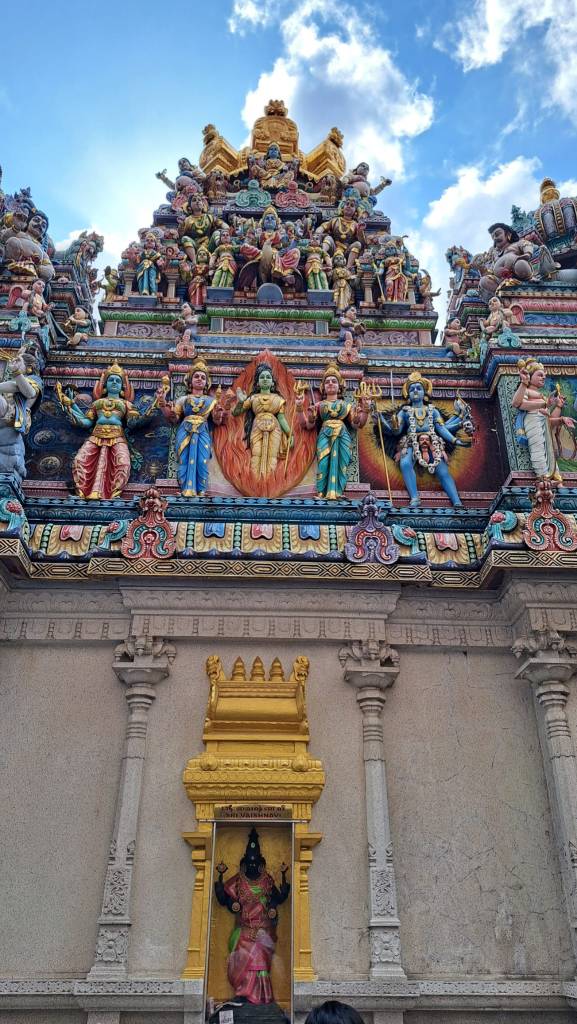
Hindu art is also wildly colorful. Multiple arms and other imaginary appendages are common.
Hindu goddess Kali Nataraja represents Shiva as the “lord of dance”. Sri Veeramakaliamman Temple
Saraswat, Sri Veeramakaliamman Temple
Sri Periyachi Amman
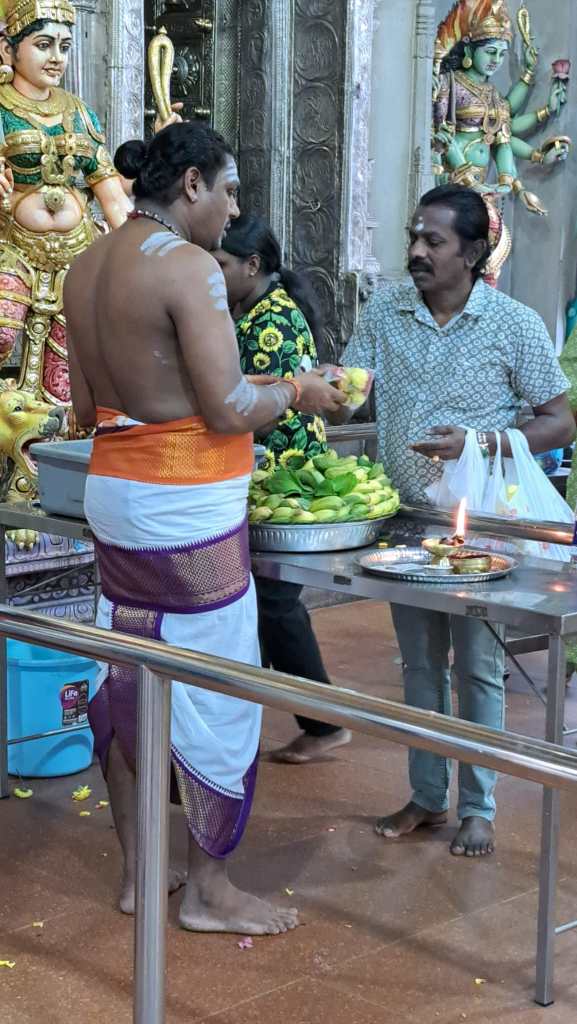
At the Hindu temples during my visits priests dropped flowers onto statues while chanting or praying.
Colourful entrance tower (gopuram), Sri Veeramakaliamman Temple
Buddhism, Hindu, Islam and Christianity are the most prominent religions in Singapore. The Inter-Religious Organisation (IRO) recognizes 10 major religions. Thirty one percent of the population is Buddhist, of which 40% are ethnic Chinese. Interestingly the non-religious form the second largest group at 20%. About 19% are Christians , mainly Catholics and Methodists, Some 15% practice Islam, mostly ethnic Malaysians. Pew’s study found that Singapore is the most religiously diverse country in the world. https://en.wikipedia.org/wiki/Religion_in_Singapore
The government is secular. This came as a result of religious riots in the 1960’s. A few groups are prohibited as cults, most notably Jehovah’s Witnesses and the Moonies, officially named the Unification Church.
Wispy humidity-laced clouds welcome the visitor on the descent to Singapore’s waterfront airport. Lush greenness contrasts with glass and metal skyscrapers, all sitting together in the warm bath that is its climate. It was a quick pass through the passport scanners. My nephew was waiting for me. He didn’t need the sign others waiting for visitors held up. Once I’d jokingly held one up. It said, “Wife.”
He was ready right then and there to zoom me through the city’s tree and flower lined streets in his new and ample Chinese built e-car. We cruised on the “wrong side,” as Singapore was a British colony, to take short walks in the humid sunlight. Jet lag be damned, we were going to the National Museum for the history review it offers, abbreviated since the main exhibit is closed pending renovations.
I should have not have been surprised by the modernity of the museum’s building, given the skyscrapers dominating the central business district. I was, nonetheless, because in my mind I had images of colonial Britain, with its bamboo wicker structures, ceiling fans, khaki uniforms and condescending attitudes.
What I noticed immediately after left side driving was the signage- English predominates. Yet there are four official languages: English, Mandarin, Malay, and Tamil. English serves as the main language for government, education, and business, while the other three correspond to the major ethnic groups in the country but rarely appear other than on restaurants and temples. Most people speak at least some English.
The Republic of Singapore is pegged to the southern end of the Malaysian peninsula just 1 degree north of the equator, separated by a narrow strait crossed by a bridge. Aside from the main island there are some 65 others that seven million call home. There are straits also to either side, with the Singapore Strait to the south. Before the British, Singapore was part of various thalocratic empires, governing bodies primarily sea based with little control over inland areas. When the British arrived Singapore was a fishing village, if the Museum’s narrative is to be believed.
Its modern history starts with Stamford Raffles. He represented the British East India Trading Company. On January 28, 1829 he landed with a squadron of Company ships to meet with the local chief, Temmenggong Abdul Rahman. Agreement to allow Company access in hand, Raffles persuaded the Sultan Hussein Shah of Johor on the Mlaysian peninsula to sign the Treat of Friendship and Alliance on February 6, 1819. The Singapore River then rapidly developed into a port area welcoming traders and travelers from all over.
Raffles involved the Company in the succession struggle of the throne of Johor, and after trading rights with the Dutch East India Company, the British came to control the entire island in 1824. Singapore became the seat of government. In 1867 the British consolidated control as a result of the Straits Settlement.
Singapore was built on the backs of migrant laborers, who worked in construction and loaded the ships. They suffered in the heat and humidity, working long hours for low wages. Indian convicts did most of the hard work building bridges and roads between 1825 and 1873. The 1920’s and 30’s brought Samsui women from China. Best known for their red scarfs, they came in search of construction and industrial jobs. They were mostly from the Sanshui District of modern-day Guangdong, a province in southern China.
Migrants lived in cramped shared quarters in unsanitary conditions. Together they made for a diverse mixture of Oriental cultures, with costumes from the Levant to China. The wealthy walked around in silk robes and satin, while Jews and Arabs stuck to dark rich silks, Turkey red and pure white Madras muslim. Much is documented in photography starting in the mid 19th century. Migration continues, with over 40% of its current population is foreign born.
Singapore became a target of the Japanese expansionism of the 1940’s. The locals describe it as a period of deprivation. You ate little more than your own garden could produce.
The slick exhibits in the museum provide an excellent narrative along with displays of ancient maps, travel chests and timelines. It all came at a stiff price, about $18 USD, though it’s free for residents.
It wasn’t too soon to have a snack. Singapore’s street food markets, called hawker centers, are vibrant hubs where you can find a variety of affordable and delicious dishes influenced by the country’s multicultural heritage. These open-air food courts offer a communal dining experience essential to Singapore’s food culture. There is a bewildering variety of offerings with names I did not recognize even in their English version. No matter, I have a host who’s been here and had that. What a huge difference that makes!
One of Singapore’s many hawkers (street food courts)
Popiah
Hawkers are outdoors but covered. It’s warm of course, but with the roof keeping the sun and rain off and the huge running fans you’ll be comfortable enough most days. The offerings are amazingly inexpensive. A popiah, of Malaysian origin, is a sizable snack for me but a meal for many here. It cost around $5 SD, about $4 USD. For drinks there are fruit juices, soft drinks, and the occasional beer. There is no wine, which is extremely expensive. More of this complex cuisine scene anon.
Más Que Otra Not Cara Bonita – Not Just Another Pretty Face, acrylics 1.8 x 1.3 meters/5.9 x 4.3′, prints only
I find endless inspiration in musical performance, and this original acrylic painting on canvas, “Not Just Another Pretty Face/ No Es Solo Otra Cara Bonita”, is the latest exploration of that theme. Here, a piano player takes center stage, rendered with both abstract and expressionist elements. The oversized canvas is a study in contrasts: light and dark, color and tone, and a blend of artistic styles.
The fluid strokes of acrylic paint create a dynamic interplay between realism and expressionism. The figurative elements of the piano player are grounded in reality, while the surrounding abstract textures evoke the passionate atmosphere of a live musical performance.
This piece makes a dramatic statement, vibrant energy and thought-provoking composition.
Standing in front of the painting in my studio
Some of the other paintings from Arte del Career (Are on the Street) in Picanya, Spain
“Pianist and Dancers” is an expressionistic painting that captures a unique perspective of a performance. The scene unfolds from behind the performers, offering a view of the audience and the distant exit as the curtains rise.
Painted with acrylic on paper, the artist’s style is reminiscent of Degas and Sargent, with dancers gracefully entering from the wings, converging towards the pianist at center stage. The composition and vibrant colors evoke the energy and anticipation of a live musical event.
This large, figurative artwork is ideal for anyone who appreciates music and performing arts. Its unique viewpoint and dynamic composition make it a captivating piece that will add a touch of artistic flair to any space. Invite the beauty of “Pianist and Dancers” into your collection today.
Pianist and Dancers, acrylics, 100 x 70 cm/ 40 x 27.5″ on paper
Contains information related to marketing campaigns of the user. These are shared with Google AdWords / Google Ads when the Google Ads and Google Analytics accounts are linked together.
90 days
__utma
ID used to identify users and sessions
2 years after last activity
__utmt
Used to monitor number of Google Analytics server requests
10 minutes
__utmb
Used to distinguish new sessions and visits. This cookie is set when the GA.js javascript library is loaded and there is no existing __utmb cookie. The cookie is updated every time data is sent to the Google Analytics server.
30 minutes after last activity
__utmc
Used only with old Urchin versions of Google Analytics and not with GA.js. Was used to distinguish between new sessions and visits at the end of a session.
End of session (browser)
__utmz
Contains information about the traffic source or campaign that directed user to the website. The cookie is set when the GA.js javascript is loaded and updated when data is sent to the Google Anaytics server
6 months after last activity
__utmv
Contains custom information set by the web developer via the _setCustomVar method in Google Analytics. This cookie is updated every time new data is sent to the Google Analytics server.
2 years after last activity
__utmx
Used to determine whether a user is included in an A / B or Multivariate test.
18 months
_ga
ID used to identify users
2 years
_gali
Used by Google Analytics to determine which links on a page are being clicked
30 seconds
_ga_
ID used to identify users
2 years
_gid
ID used to identify users for 24 hours after last activity
24 hours
_gat
Used to monitor number of Google Analytics server requests when using Google Tag Manager
1 minute
Marketing cookies are used to follow visitors to websites. The intention is to show ads that are relevant and engaging to the individual user.
A video-sharing platform for users to upload, view, and share videos across various genres and topics.
Registers a unique ID on mobile devices to enable tracking based on geographical GPS location.
1 day
VISITOR_INFO1_LIVE
Tries to estimate the users' bandwidth on pages with integrated YouTube videos. Also used for marketing
179 days
PREF
This cookie stores your preferences and other information, in particular preferred language, how many search results you wish to be shown on your page, and whether or not you wish to have Google’s SafeSearch filter turned on.
10 years from set/ update
YSC
Registers a unique ID to keep statistics of what videos from YouTube the user has seen.
Session
DEVICE_INFO
Used to detect if the visitor has accepted the marketing category in the cookie banner. This cookie is necessary for GDPR-compliance of the website.
179 days
LOGIN_INFO
This cookie is used to play YouTube videos embedded on the website.