Category: Blog 2026

  • Scooting across northern Germany

    Scooting across northern Germany

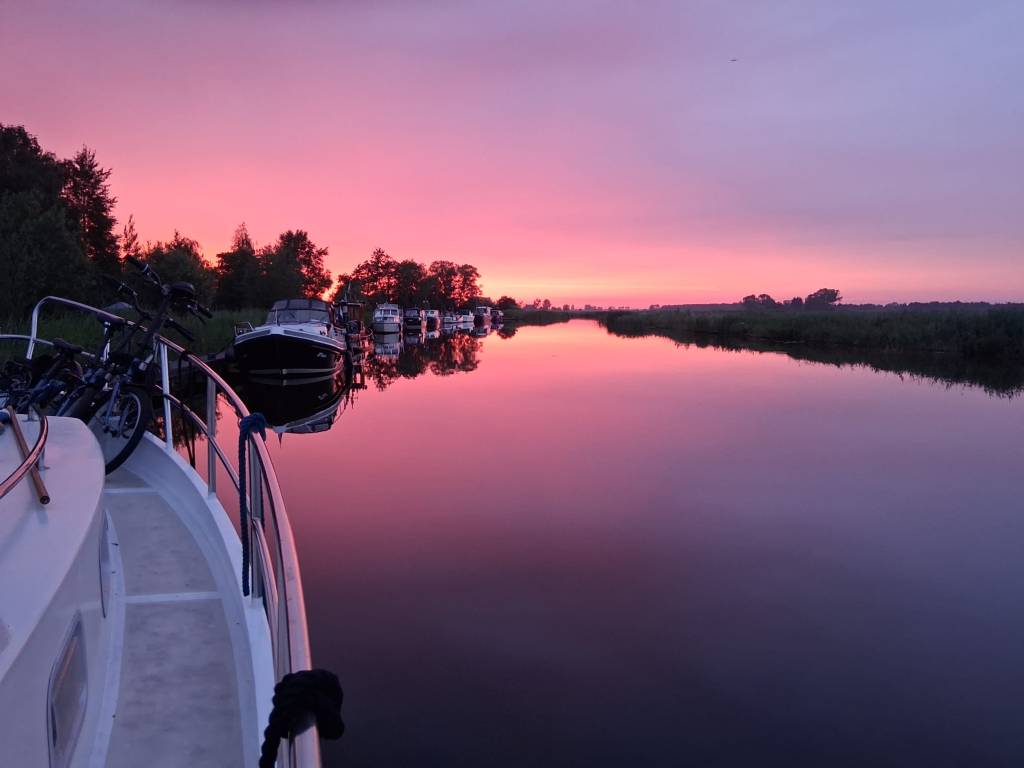
    From Berlin to the Dutch border via the waterways is about 500 kilometers/300 miles. When we traveled 8 hours per day we went a whopping 100 kilometers, bicycle riders everywhere passing us with ease. It’s a relaxing journey, passing through picturesque forests, farmland, villages and small towns. There are industrial zones too, quite a few, which may not be pretty but interesting as you observe the dock workers loading and unloading the barges you share the canal with.

    There are many fuel tankers, recycling loads and some container barges on this route. They usually take the center of the canal when they are loaded in order to have enough depth. We have to thread the needle between the shore and a safe distance from the barge. Canals are cut steep at the sides so you can get quite close without grounding but still you have to monitor the depth gauge. The barge captains are pros and know these canals, so you have confidence that they are not going to take too much room or run you over.

    Along the way we passed through four four or five huge locks on the Mittleland Kaanal and another 11 or so on the Dortmund-Eems Kaanal. Except for the last two on the Dortmund-Eems Kaanal we checked in at the designated “sportboots” docks, those two lacking that facility. In a few cases they replied to a phone call or to VHF radio so we did not have to moor. About half of the lock keepers spoke English, with the others we got a reply but did not understand so we just waited for the light to turn green. Our waits for the lock gates to open were generally short, about 15 minutes or so.

    There are many recycling operations along the Mittleland Kaanal

    Having already visited the cities and towns along the way, with a side trip to Oldenburg prevented by a lock closure, we spent two nights at only one location, https://garyjkirkpatrick.com/magdeburg-germany-home-of-the-reformation-and-a-schnitzel/, until we came Heren neat the Dutch border.

    Hanover is a city worth visiting. We stopped here on our first trip on Viking to Berlin. For more about Hanover see https://garyjkirkpatrick.com/hannover/

    Moonlight Over Hanover, watercolors

    Minden is smaller than Hanover. There an aqueduct takes you over the Weser River. There’s a neat schnitzel restaurant on the river, Schiffmühlen (meaning mill) Gastronomie. The downtown’s medieval architecture is well preserved as Minden was not bombed in WW2. https://garyjkirkpatrick.com/minden/ Bad Essen is smaller still and also has well preserved half-timber buildings and some good eats. https://garyjkirkpatrick.com/day-1-on-the-mittelland-kanal/

    Crossing the Bridge in Bad Essen

    Passing through the last lock on the Dortmund-Eems canal we came to the small lock in Heren only to find it had been closed in April for works. It would open on May 3, May 1 being a holiday. We were stuck for three days. Fortunately it is a lovely spot. Heren has grocery stores and other shopping, an attractive modern Dutch look with newish brick buildings and a main street pedestrian zone. There’s a ship museum with several restored Dutch barges. The Dutch border is just a few kilometers away along a small tree lined canal.

    In Wolfsburg you can visit the Volkswagon factory. Advance ticket purchase is recommended.

    The lock in Heren
    Passing through Meppen, Germany
    There’s a ship museum in Heren.
  • There be monsters

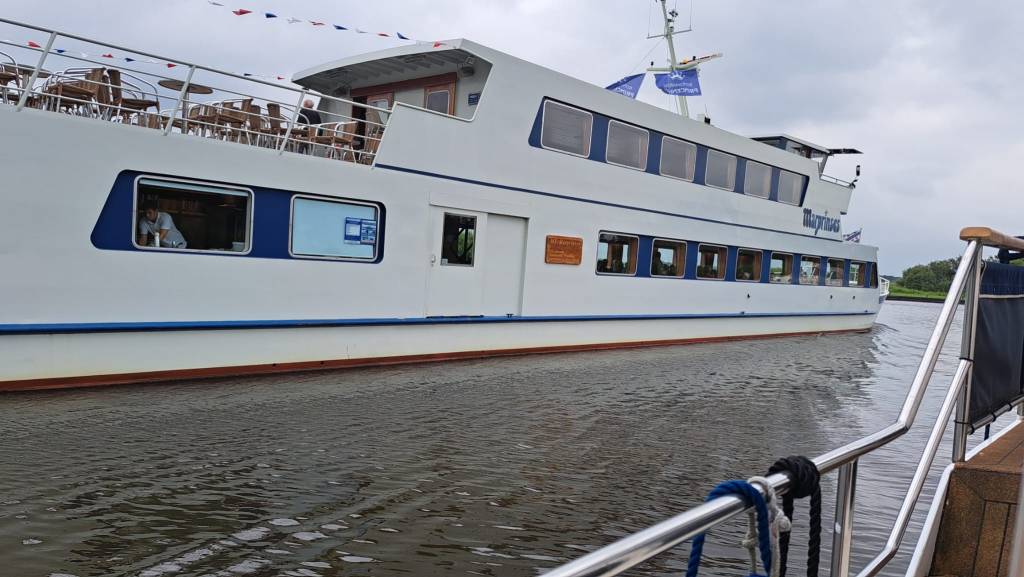
    Cruising the Mittlelandkaanal from Berlin to the Netherlands means you share the waterways with many barges, some of them with monstrous dimensions. We locked through with one double (two barges tied together and propelled by one pusher) measuring over 200 meters.

    When you arrive at a German lock you moor at a location specified for ‘sportboots.’ There’s an intercom to check in with the lock keeper, some of whom speak English. You are letting them know you are there, and waiting for them to tell you to enter. Small boats almost always enter behind larger vessels. If so some reason the larger ship can not stop in time they damage the lock, not you.

    The locks on the canals connecting Berlin with the Rhine, and from that river to the Netherlands if you so choose, are huge, are over two hundred meters long and 7+ meters in depth. Most have floating bollards that you can easily loop your line and then sit back, although we keep a eye on things as the water rises or falls.

    In locks of this size there is little turbulence, but if a large ship hits the throttle too hard small boats are knocked about. To avoid problems we not only stay tied to the bollards but wait for the large ships to exit the lock before we proceed carefully, attentive to strong currents from the huge props.

    I was on the Mississippi River in New Orleans when we came upon an oil tanker. Large waves were coming from it. I assumed it was from the huge ship’s props, but then the smaller boat carrying the port captain, who takes over when the ship is close to docking, sped away. The waves stopped as he disappeared.

    On German canals and rivers there are designated moorings for overnight stays. Large ships usually have their own spaces and ‘sportboots’ their own as well. Outside Hanover we stayed in a mooring near grocery stores which allowed both large ships and small boats, so there are exceptions but they are marked.

    We have been fortunate weather wise thus far. The early mornings are below 5c/40f but it’s been warming to 15-18c/60-65f in the sunny afternoons.

  • Magdeburg, Germany, home of the Reformation. And a schnitzel.

    From Potsdam to Genthin

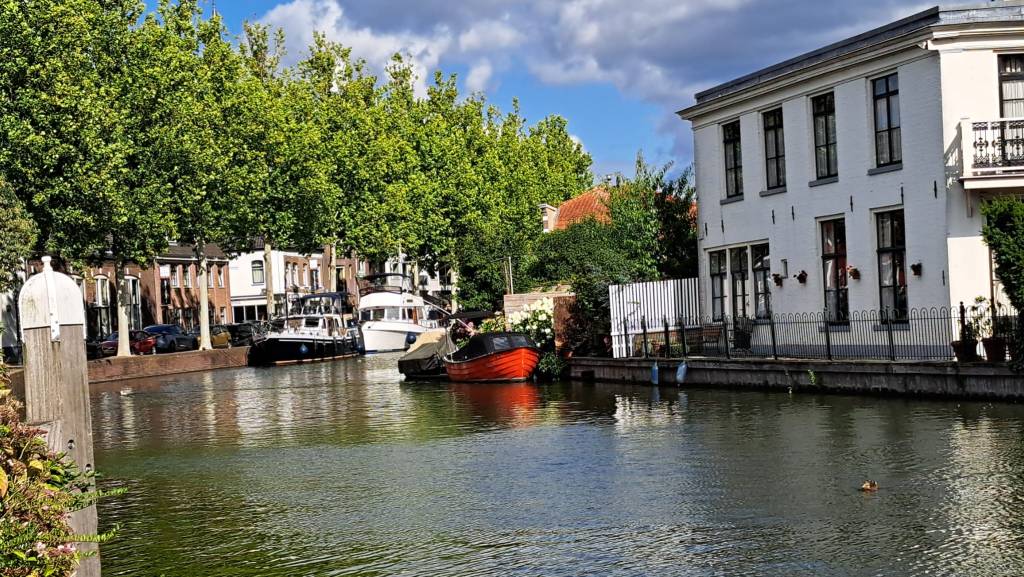
    With cold mornings and sunny afternoons in the forecast, we set off from our winter berth in Potsdam after making a few plumbing repairs due to the winter freeze- they skated on the lake for the first time in years. Heading towards the Netherlands, we chose the southern route that leads to the Mittlelandkaanal. After a night in Genthin we stopped at a free mooring in Burg. It’s less than 30 minutes by train to the ancient city of Magdeburg, with a current population of 242,000.

    Founded by Charlemagne in 805, Magdenburg Otto I made it his seat, ruling Saxony from 836-873. He was the Holy Roman Emperor from 962 until his death in 873. Otto I defeated the Magyars at the Battle of Lechfeld in 955, stopping the Hungarian invasion of Western Europe. He was buried in the Cathedral.

    Magdeburg’s Town Law, granting the right to hold trade exhibitions and conventions, spread through much of Europe in the early Middle Ages. As one of Germany’s largest and most prosperous cities, in good measure because it sits on the Elbe River, Magdeburg joined the Hanseatic League in the 13th century. By then it had 20,000 residents, considered large at the time.

    Martin Luther attended school here as a 12 year old. In 1524 Luther began the movement that led to the Protestant Reformation. Magdeburg was a major force in the effort to break from the corruption of the Church.

    Things did not always go smoothly for the city. In 1188 it was devastated by fire, it suffered 25,000 deaths during the 30 years war, and its old center was largely destroyed by Allied bombing in WW2. There was a POW camp and three subcamps of Buchenwald holding Jews. Dozens were murdered in an effort to cover up the crimes against humanity as the Allies advanced. More were led on death marches as the war ended. It was in East Germany during the Cold War, its development stunted by failed economic policies and a police state government.

    Magdeburg’s center after WW2
    Hundertwasser House in Magdeburg

    We visited the Kulturhistorische Museum Magdeburg (KHM). Most notable is the Magdeburger Reiter (Magdeburg Rider). It might represent Emperor Otto, Otto II or III.  The rider is accompanied by two female figures, usually interpreted as allegories of the Roman Empire and the Slavic peoples, but sometimes Empress Adelaide and Empress Theophanu.  The statue was brightly painted.

    Magdeburger Reiter (Magdeburg Rider
    The Elba in Magdeburg

    Schnitzel and beer, oh so German, in a super local joint!

    Two days before Magdeburg we moored for the night at a marina called Havel Marin just outside Brandenburg. We found just one restaurant within walking or biking distance. It sits on a private road, a bit off putting as you wonder if you are trespassing. We followed the one turn off leading to a small house. Was this it? There is no sign outside. We might have left if there had not been a group of people sitting under an awning drinking beer.

    We ventured inside and only then were we sure we had found the place. There is a sizeable, well stocked bar and tables. The only employee and likely the owner reminds of Ichabod Crane, very tall and slender. We could not tell at first who he was, an employee or just another guest as he was not in any sort of uniform. He speaks no English, but somehow we figured out he works there. So what about a menu so we can see what’s on offer and point to things? Nope, there is no menu. Our online source had mentioned schnitzels so we used that word and he nodded. Then he said something that sounded like the Dutch for egg. It turns out the plate includes a small schnitzel, a few cherry tomatoes, slices of sweet pickles and a fried egg on top of the breaded pork. Fortunately I got him to hold the egg. It was a so so dinner but at €17 for two including two .5 liter beers it was a very reasonable bargain.

    Schniitzel and beer, oh so German!

    More to come on our journey west.

    For my article on Brandenburg see https://garyjkirkpatrick.com/brandenburg/

    Brandenburg Steeple
    Brandernburg, Germany
  • Singapore During WWII: the Former Ford Factory

    Singapore During WWII: the Former Ford Factory

    The Former Ford Factory is now a museum about Singapore during WWII. Built in 1941 as a state of the art facility, it was the first Ford production plant in SE Asia after 15 years building cars in garages. In this very building the British surrendered to the Japanese on February 13, 1942, the office they used left as it was.

    The Brits should have invested more in the defense of Singapore during the 1920’s and 30’s, but given the distances and territory involved it simply did not have enough soldiers and equipment. It’s not that they did not try. In the early 1920’s the British began constructing a naval base, finishing in 1939. However it was too small, only able to support about 20% of the British fleet. The plan was for Singapore to hold out until the rest of the fleet arrived. The Japanese capture of Singapore took about 60 days. The British fleet still had not arrived.

    Japan began bombing Singapore on December 8, 1941, hitting Chinatown and Raffles Place. They landed in Malaysia at the same time. After the 1937 Japanese attack on China many Singaporeans joined the Singapore Volunteers Corps and the Royal Navy Volunteer Reserve, others the Civilian Defense Corps and the Medical Auxiliary Services. Some helped build air raid shelters. These efforts, like the British naval base, were of little use.

    The experienced soldiers of the 5th and 18th divisions of the Japanese armies led the ground assault. Within a day they destroyed or damaged more than half of British largely obsolete aircraft and captured airfields in Malaysia. They belatedly formed eight civilian battalions of 150 people each to build defensive fortifications and others, with just ten days of training, were assigned to defend Jurong Road. Fighting in Singapore itself, which began in early February, 1942, lasted less than a week.

    British Surrender

    On 13 February 1942, Japan captured the Ford factory. On 15 February 1942, Lieutenant-General A. E. Percival unconditionally surrendered in the boardroom, determining the fate of Singapore for the next three and a half years. https://corporate.nas.gov.sg/former-ford-factory/overview/.

    The British surrendered to the Japanese in this very office in the Old Ford Factory Museum. Photos from the meeting scroll on the screen
    Japanese ship entering Singapore’s harbor (museum display)

    Japanese Rule

    There were some 100,000 POW’s and several thousand European citizens at the time of the Japanese takeover. About 3000 were marched to Changi Prison and the nearby barracks, designed to hold 800. Civilians passed them food and money along the way, despite the risks. Once imprisoned they were always hungry, yet made to clear war damage, bury corpses and build memorials to Japanese dead.

    The Japanese massacred thousands of Chinese in February and March of 1942. There were other random acts of violence and intimidation. By 1943 the violence had abated, but there were still arbitrary arrests and torture. Food, fuel and medicine were in short supply in a city of one million with few natural resources. Many survived on what they were able to grow. Starting in September, 1942 many were sent to work on the Siam-Burma Railway. Huge numbers died under the horrific working conditions. Approximately 17,000 were housed in barracks designed for 800.

    Japan’s government renamed Singapore to Syonan-to (Light of the the South), changed the clocks to Japanese time and the calendar to their own. They took over the businesses of all Western companies and some Chinese as well. Businesses were made to produce goods for the Japanese war effort. There was strict rationing and movement was restricted. There was high official unemployment but there were illegal jobs, black markets and a large number of off the books street vendors.

    To reduce overcrowding the Japanese opened farmland, hoping to relocate 300,000 Singapore in Endau, Johor, Malaysia. Some 12,000 Chinese were the first to be sent, successfully establishing farms. The second effort was not successful as the land was not suited for farming, while thousands died from malaria. The effort ceased after that.

    In resistance, Malaysia Communist Chinese formed the Malayan People’s Anti-Japanese Army. Those aligned with the Kuomintang joined Force 136. Allied forces engaged in sabotage, sinking seven Japanese vessels in the Singapore harbor. There were 11 US air raids, ending in March, 1945.

    Post War Singapore

    The Japanese forces of Singapore and Jahore surrendered aboard HMS Sussex. The British returned in September, 1945, welcomed by the locals. There was much need for welfare and relief. The Allied Land Forces – South East Asia tried only 131 men for war crimes. Only two were sentenced to death. The Singapore Chinese Appeal Committee unsuccessfully asked for additional death penalties.

    On April 1, 1946 civilian administration resumed as a Crown Colony. As in Brittan, the government became involved in education, housing, health and social welfare. While the British introduced self-government in Malaysia it did not do so in Singapore. Communist insurrections in China, Malay, Burma, Indochina and the Philippines were a major concern, with Singapore serving as a base for defending against Communist expansion. Malaysia became firmly anti-communist in the 1950’s. As a result Singapore became part of Malaysia on 16 September 1963 following a merger with Malaya, North Borneo, and Sarawak.

    Singapore became an independent republic on 9 August 1965 after its expulsion from Malaysia. It has evolved into not only a major port with its modern facilities but also a major finance center after a difficult period following independence.

  • Singapore’s Cuisine- a Cacophony

    Occupying a unique position on ocean trading routes enhanced by its importance to the British Empire, with Malaysia and Thailand to the north, Indonesia to the east and China to northeast, India to the northwest, Singapore developed a rich, diverse Asian cuisine. The result is a potpourri of spices and ingredients, bewildering to most Western visitors.

    Hawkers

    You can try an astounding variety of dishes at Singapore’s hawkers, vendors of its famous street food housed under open air roofs. Most stalls have a number of offerings, ranging from fried shrimp breads to complex rice dishes. It’s hard to know what you are ordering even though the signs are in English. If you have a knowledgeable friend to join you it’s all the better, which was the case for me.

    You sit comfortably while dining on most days as fans keep the air moving. Thus well ventilated, the shaded space immerses you in aromas galore.

    Malaysian curry. I had a lot of curries while there. Caution advised.

    There is no table service. If that’s what you want choose a restaurant, though you will loose the extensive range of options you will find among the hawkers and you will usually pay much more. Both restaurants and hawkers follow modern hygiene practices so there is no advantage to restaurants in that regard. Hawkers are by far more popular choice of locals, especially for those who especially enjoy or need the budget prices and are willing to bus their own table- you must or you could be fined!

    In the course of 11 days I sampled a couple of dozen dishes. Here’s a short slideshow video of what came my way:

    Photos of the meals I had while in Singapore.

    Culinary influences include Chinese from multiple provinces including Peranakan (southern China), Malaysian, Indonesian, Indian both north and south, and Western traditions including the ubiquitous hamburger, English and the Portuguese-influenced Eurasian, known as Kristang).

    The dishes often have a bit of hot spice, with extra on the side. The cuisine in general carries a bit of sweetness, often barely subtle enough for my taste. The Indian dishes include both northern and southern versions, a bit lighter on the hot pepper than you might expect. The Korean restaurant we visited offered meats cooked on the table mounted grills. The sides were for me disappointingly mild, adjusted to the local taste I suppose.

    Singapore’s offerings include Chinese hotpots. You can order wheat noodles served in a soy or miso sauce. You can add sliced pork (chāshū), nori (dried seaweed), bamboo shoots (menma), narutomaki, and scallions.

    Nearly every region in Japan has its own variation of ramen. One Japanese ramen we went to had bland offerings. Another ramen joint, Enishi is a tiny place with just 12 stools at the bar, cooks and workers flying about. They have ramen dishes more to my liking. This is not a sit and relax kind of place. A sign says that in busy times you may only be allowed 30 minutes. There was a line when we were dining, so I do not think we had even that long. Fortunately the ramen soup is served immediately.

    Nearing the end of my visit my kind hosts asked me what I would like to have for dinner. I said I thought I was missing only the Chinese. None of the places we frequented I’d identified as such. He explained that labeling a eatery ‘Chinese’ here would be like labeling a restaurant as Spanish when in Spain. So I had been served Chinese meals that I did not recognize as such. That’s how little I knew about the scene in Singapore. At least I learned more about how vastly Chinese cuisine varies by province. In the west we get mostly Cantonese and Sichuan offerings.

    Eggs galore

    I’ve never seen so many dishes that come with an egg. Many are fried and laid on top, others hard boiled. The trendy breakfast is toast with a slice of butter with a soft boiled egg on the side.

    Toast breakfast with local coffee

    The breakfast includes the local coffee called Kopi. It has its roots in Malaysia . It is made from Robusta beans, the least desirable coffee bean, versus shade grown Arabica, then roasted in (eh gad!) margarine and sugar and then strained. They add evaporated and condensed milk. Somehow I managed to avoid it, but if you like it please let me know and tell how that’s even possible. I did not care to give it a go myself.

    Desserts

    Aside from fruit you can order desserts that from my point of view are quite strange. I can only report on two. You can see my reaction to cendol. It’s a dessert made with green rice flour jelly, coconut milk, and palm sugar syrup. Here there are also red beans. It’s called “dawet” in Java and “lot chong” in Thailand. Despite my initial reactions to red beans in a dessert, they offered an interesting contrast to the crunchy sweetness of the rest. Mango sticky rice was pretty good too, although I am not fond of sticky rice, just because it’s so gummy.

    Chandol
    Mango sticky rice

    Wikipedia has an extensive article on Singapore’s cuisine. Check it out at https://en.wikipedia.org/wiki/Singaporean_cuisine

  • Amazing art in  Buddhist and Hindu Temples in Singapore

    Amazing art in Buddhist and Hindu Temples in Singapore

    No visit to Singapore would be complete without a visit to the Buddhist and Hindu temples. The temples are awash in highly colorful imagery.

    Buddhist art is dominated by images of the Buddha. The figures are generally in accurate proportions, displaying a good understanding of anatomy. Not all portrayals are realistic overall. Much of the art is repetitive, that is, most images are standard copies of traditional presentations.

    I visited the Tooth Relic Temple in Chinatown, which practices a Chinese version of Buddhism. Before you enter you must remove your shoes. You can not display your knees. They provide robes if needed. Photos are allowed at least during visiting hours. In the basement there is a theater and a vegetarian dining hall. The meals are free, donations accepted.

    There are no gods in Buddhism. However there are rituals and relics. At the Tooth Relic Temple Buddhist temple people lit incense sticks. facing one way and then the opposite, waving them. There is a relic of a tooth of Buddha, however it is much too large for a human tooth.

    From the Tooth Relic Temple, Singapore

    The main floor has a 15-feet statue of the Buddha Maitreya, flanked by bodhisattvas.

    Cintāmaṇicakra Avalokiteśvara Bodhisattva
    Tooth Relic Temple, photo by Chainwit

    Acala, one of the eight Zodiac protectors

    From Hindu temples in Singapore

    Hindu art is also wildly colorful. Multiple arms and other imaginary appendages are common.

    Hindu goddess Kali
    Nataraja represents Shiva as the “lord of dance”.
    Sri Veeramakaliamman Temple
    Saraswat, Sri Veeramakaliamman Temple
    Sri Periyachi Amman

    At the Hindu temples during my visits priests dropped flowers onto statues while chanting or praying.

    Colourful entrance tower (gopuram), Sri Veeramakaliamman Temple

    Buddhism, Hindu, Islam and Christianity are the most prominent religions in Singapore. The Inter-Religious Organisation (IRO) recognizes 10 major religions. Thirty one percent of the population is Buddhist, of which 40% are ethnic Chinese. Interestingly the non-religious form the second largest group at 20%. About 19% are Christians , mainly Catholics and Methodists, Some 15% practice Islam, mostly ethnic Malaysians. Pew’s study found that Singapore is the most religiously diverse country in the world. https://en.wikipedia.org/wiki/Religion_in_Singapore

    The government is secular. This came as a result of religious riots in the 1960’s. A few groups are prohibited as cults, most notably Jehovah’s Witnesses and the Moonies, officially named the Unification Church.

  • Singapore: a mixture of cultures and cuisines

    Wispy humidity-laced clouds welcome the visitor on the descent to Singapore’s waterfront airport. Lush greenness contrasts with glass and metal skyscrapers, all sitting together in the warm bath that is its climate. It was a quick pass through the passport scanners. My nephew was waiting for me. He didn’t need the sign others waiting for visitors held up. Once I’d jokingly held one up. It said, “Wife.”

    He was ready right then and there to zoom me through the city’s tree and flower lined streets in his new and ample Chinese built e-car. We cruised on the “wrong side,” as Singapore was a British colony, to take short walks in the humid sunlight. Jet lag be damned, we were going to the National Museum for the history review it offers, abbreviated since the main exhibit is closed pending renovations.

    I should have not have been surprised by the modernity of the museum’s building, given the skyscrapers dominating the central business district. I was, nonetheless, because in my mind I had images of colonial Britain, with its bamboo wicker structures, ceiling fans, khaki uniforms and condescending attitudes.

    What I noticed immediately after left side driving was the signage- English predominates. Yet there are four official languages: English, Mandarin, Malay, and Tamil. English serves as the main language for government, education, and business, while the other three correspond to the major ethnic groups in the country but rarely appear other than on restaurants and temples. Most people speak at least some English.

    The Republic of Singapore is pegged to the southern end of the Malaysian peninsula just 1 degree north of the equator, separated by a narrow strait crossed by a bridge. Aside from the main island there are some 65 others that seven million call home. There are straits also to either side, with the Singapore Strait to the south. Before the British, Singapore was part of various thalocratic empires, governing bodies primarily sea based with little control over inland areas. When the British arrived Singapore was a fishing village, if the Museum’s narrative is to be believed.

    Its modern history starts with Stamford Raffles. He represented the British East India Trading Company. On January 28, 1829 he landed with a squadron of Company ships to meet with the local chief, Temmenggong Abdul Rahman. Agreement to allow Company access in hand, Raffles persuaded the Sultan Hussein Shah of Johor on the Mlaysian peninsula to sign the Treat of Friendship and Alliance on February 6, 1819. The Singapore River then rapidly developed into a port area welcoming traders and travelers from all over.

    Raffles involved the Company in the succession struggle of the throne of Johor, and after trading rights with the Dutch East India Company, the British came to control the entire island in 1824. Singapore became the seat of government. In 1867 the British consolidated control as a result of the Straits Settlement.

    Singapore was built on the backs of migrant laborers, who worked in construction and loaded the ships. They suffered in the heat and humidity, working long hours for low wages. Indian convicts did most of the hard work building bridges and roads between 1825 and 1873. The 1920’s and 30’s brought Samsui women from China. Best known for their red scarfs, they came in search of construction and industrial jobs. They were mostly from the Sanshui District of modern-day Guangdong, a province in southern China.

    Migrants lived in cramped shared quarters in unsanitary conditions. Together they made for a diverse mixture of Oriental cultures, with costumes from the Levant to China. The wealthy walked around in silk robes and satin, while Jews and Arabs stuck to dark rich silks, Turkey red and pure white Madras muslim. Much is documented in photography starting in the mid 19th century. Migration continues, with over 40% of its current population is foreign born.

    Singapore became a target of the Japanese expansionism of the 1940’s. The locals describe it as a period of deprivation. You ate little more than your own garden could produce.

    The slick exhibits in the museum provide an excellent narrative along with displays of ancient maps, travel chests and timelines. It all came at a stiff price, about $18 USD, though it’s free for residents.

    It wasn’t too soon to have a snack. Singapore’s street food markets, called hawker centers, are vibrant hubs where you can find a variety of affordable and delicious dishes influenced by the country’s multicultural heritage. These open-air food courts offer a communal dining experience essential to Singapore’s food culture. There is a bewildering variety of offerings with names I did not recognize even in their English version. No matter, I have a host who’s been here and had that. What a huge difference that makes!

    One of Singapore’s many hawkers (street food courts)
    Popiah

    Hawkers are outdoors but covered. It’s warm of course, but with the roof keeping the sun and rain off and the huge running fans you’ll be comfortable enough most days. The offerings are amazingly inexpensive. A popiah, of Malaysian origin, is a sizable snack for me but a meal for many here. It cost around $5 SD, about $4 USD. For drinks there are fruit juices, soft drinks, and the occasional beer. There is no wine, which is extremely expensive. More of this complex cuisine scene anon.