

Metz sits at the confluence of the Moselle and Seille rivers. The Cathedral’s height and extensive stained glass dwarf the slack jawed visitor. The town boasts cream colored stone architecture from the Middle Ages. Part of Germany from 1870 to the end of WWI I, it sits near the border of Germany and Luxembourg.
Metz has a rich 3,000-year history, starting with a Celtic oppidum, an iron age fortified town. During the Roman period it had a population of 40,000. It was the Merovingian capital of Austrasia (the northeastern Frankish kingdom), from the 6th to the 8th century. The Carolingian dynasty started by Charles Mantel (Charlemagne was his grandson) began here. It was a republic from the 12th to the 13th century.
Cathédrale Saint-Étienne (Stephen) is a superb example of High Gothic architecture. The nave is 41 meters in height. It has more stained glass than any other building in the world, with works by Gothic and Renaissance glass masters as well as Jacques Villon’s cubism and several by Chagall. It sits where there there has been a church since the 6th century.


We visited the Museum of La Cour d’Or, Metz, the city history museum. You descend several flights to the Roman cistern, discovered when construction began on the current building. There is an unusual and extensive collection of Celtic Roman era sarcophagi and gravestones. The artwork is crude compared to most Roman era carving. There is also a rare and large collection of painted wooden ceilings.


This is a fun city to walk around. The stone construction glows in the sun. There are lots of people about but you don’t feel crowded. There are many side streets and alleys if you get tired of all the upscale shopping on the main street. Plenty of places to stop for refreshment. Quiche Loraine is a big deal. No reason why you couldn’t pair it with one of the many Moselle white wines.
The main grapes are Auxerrois, Müller-Thurgau, Pinot grigio. They also grow Müller-Thurgau, Pinot blanc, Riesling, Gamay and Gewürztraminer. You might also try the rosés, made from Pinot noir and Gamay. See the tourist bureau site for more information https://www.tourisme-metz.com/en/discover-metz-metropole/gastronomy-and-mirabelle-plums
Sicily was ruled by Spain’s Bourbon dynasty. The Spanish lost this kingdom when The Leopard leaped.
Sicily was once ruled by the Bourbons, who held the Spanish throne. The country the Bourbons ruled came to be called The Kingdom of the Two Sicilies. Why two? It was formed when the Bourbons united two kingdoms both called Sicily. The northern half, formally called the Kingdom of Naples but commonly referred to as the Kingdom of Sicily, ranged from Naples all the way south on mainland Italy. This area today is called the Mezzogiorno. In 1816 this Kingdom of Naples merged with the Kingdom of Sicily (the island) under the Bourbons forming the Kingdom of the Two Sicilies.
Leaping Leopards!
In 1957 Giuseppe Tomasi di Lampedusa wrote The Leopard, a novel about the unification of Sicily with the then recently established country we now call Italy. Tomasi was the last in a line of minor princes. The main character of the book is his great-grandfather, Don Giulio Fabrizio Tomasi, the Prince of Lampedusa. Lampedusa is an island. Tomasi died before the book was published. The Leopard became the top selling novel in Italian history, while winning prestigious awards. In 1959 it was made into a movie, and there is now a series on Netflix.
Before the unification (the Risorgimento), Italy was divided into city states. The Pope, for example, ruled Rome and the area around it and south to Naples. The Leopard is about how Sicily became part of the new country with the “invasion” of Garibaldi, leading a mere 1000 soldiers. Clearly there wasn’t much resistance.
The Circle Trip
So here I am now in modern Sicily formed by the Leaping Leopard. And what did I come to see yet again? Ancient Sicily, and there’s a lot of it. You land in Palermo or Catania, join a tour or rent a car and do your own, as I do. Driving is not too difficult if you don’t mind sharing the road with the Italians, who have a rather aggressive driving style.
I started in Catania. There is a neat old Basilica Cattedrale Sant’Agata (1078 though rebuilt after earthquakes), the nearby Roman amphitheater, the Monastero dei Benedettini (16th c), and Ursino Castle from the 13th century, which houses the Civic Museum of Catania. Il Museo Arte Contemporanea Sicilia is small but worth a visit. A walk through the old town displays its ancient character. While Catania is generally unkempt and unattractive, it’s better in the old center.
Mt Etna smokes just an hour’s drive uphill. As usual in Italy there will be some Mario Andretti on your behind, until he finds a bit of a stretch so he can zoom past. Etna is no joke. She erupted again on June 2, just two days after we drove to the southern peak. You’d appreciate the fast drivers if the eruption occurred while you were up there.
From Catania you can go south along the coast to Siracusa (Syracuse in English). It was founded by Greeks circa 733 BCE, becoming the most important city of Magna Grecia, the area comprising southern Italy . There are two main reasons for going to Siracusa. The island of Ortigia is one. The oldest part of the city, it contains the Cattedrale Metropolitana della Natività di Maria Santissima, a UNESCO site. The stately Cathedral dates from the 7th century, with Roman era columns still holding up the roof. Further along through ancient narrow streets and allies there’s the old castle guarding the harbor.
The second main attraction is https://parchiarcheologici.regione.sicilia.it/en/parco-archeologico-di-siracusa-eloro-villa-del-tellaro-e-akrai/ It has a Greek and Roman amphitheater and some mighty big caves. Somewhere I read that the caves were used by the local oracles to deliver their vague premonitions. There are ancient bronze statues (copies) here and there on the expansive grounds There are catacombs nearby.
Sicily has more Greek temples than Greece. From Siracusa you zoom around the coast to the valley of the Temples in Agrigento, a bit inland. Concordia is the most intact. Selinunte, an even larger collection of temples residing on the beautiful coast, is not terribly far. Founded around 628 BCE, Selinunte was one of the most important Greek colonies on the island.


After Selinunte I made a side trip with my daughter and family to Partanna. My grandfather was born there and my grandmother not far away in Santa Ninfa. The drive through the countryside reveals the intensity of its agriculture, and just as you arrive in Partanna there are huge olive oil and wine storage tanks along the main road.
You get a sense of where you come from when you visit your roots. We don’t just pop out of nowhere. There’s a long history behind us, many stories to be told, many we will never uncover. I have one of my own: to this day I do not know who was the father of my uncle Matteo, born to my grandmother. His birth certificate is silent on the matter.
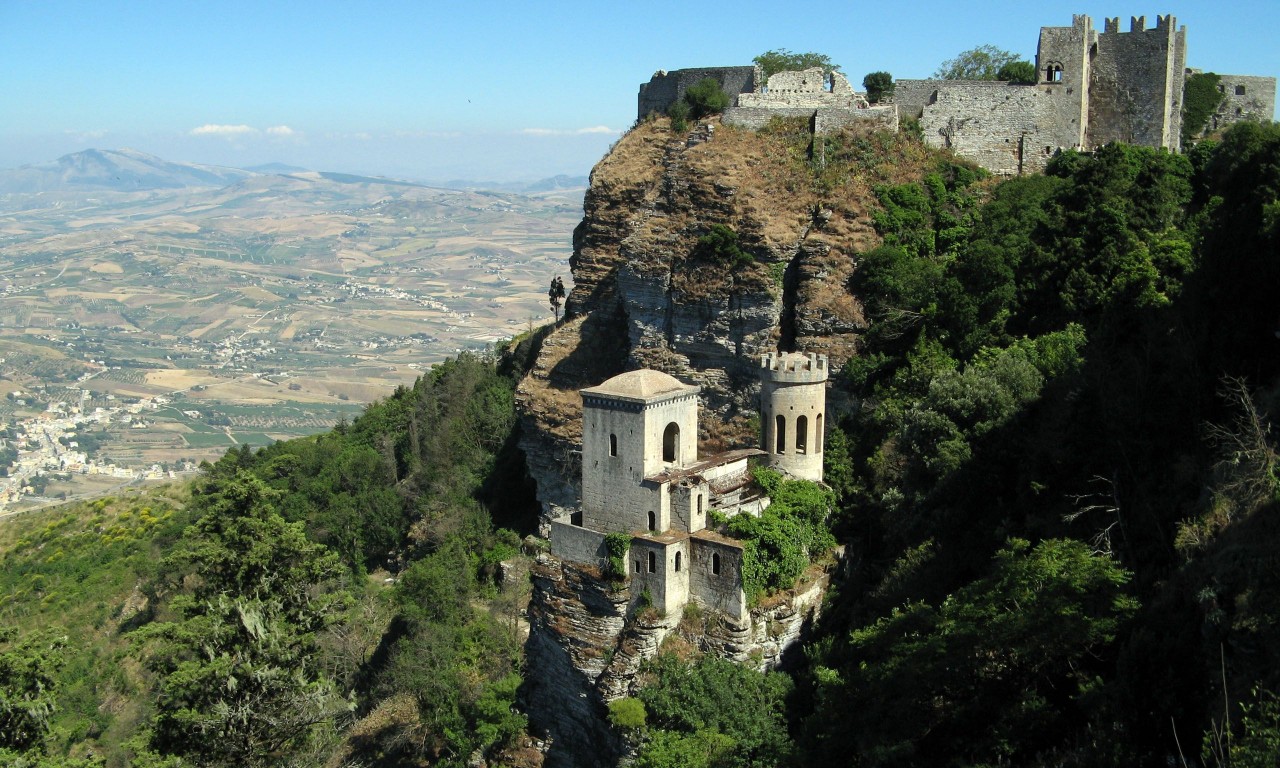
We continued on to Erice, a small town perched on the top of a mountain. You climb to the top via numerous tight and often very steep switchbacks. The stone village has fabulous views of the sea on one side, Trapani on another with its salt drying ponds sparkling under the sun, and extensive agricultural lands elsewhere. We stayed in Villa San Giovanni. The old building is fun to be in. The rooms are a bit dated and basic, but it’s tough to beat the views.


More on Erice from my previous visit is here https://garyjkirkpatrick.com/erice-ancient-mountain-top-village-on-the-coast/
There are great views as you drive along the coast to Palermo, with mountains on one side and the coast on the other. We stopped for one night at a beach apartment, the sandy beach just a five minute walk.
Palermo was settled by the Phoenicians in 734 BCE. The fabulous decorations of the Greek temples in Selinunte Archaeological Park is in the https://www.regione.sicilia.it/beniculturali/salinas/. You’ll be floored by what’s on the walls there. Otherwise Palermo is about the churches and the fabulous art within.

For many the highlight of a visit to Palermo, aside from the cuisine of course, is the church art of Giacomo Serpotta, 1656 –1732. His stucco (plaster) sculpture in the Rococco style will stun even the most casual visitor. His was a self-taught master of this highly detailed realism. According to the free of charge guide he added marble dust to the plaster for sparkle and added strength. His brother and son were also in the church decoration business.

Church architecture in Palermo runs the gamut, from Norman to Baroque. The must see Arab -Norman Palace (11th) dates from Norman times but was built over centuries so you get them all. The Palermo Cathedral is huge, with 17th century paintings and a great painting in the aspe ceiling.
The Duomo of Monreale, which you get to by bus or car, is loaded with Byzantine style mosaics. Just superb! It was built by the Norman kings William II, 1166-89. Who woulda thunk it? Probably not even my blond, blue-eyed Zio Matteo. From the village there are great views of Palermo.

Palermo’s main street downtown is a pedestrian zone. It is lined with upscale shops and restaurants, with perhaps a tavola calda or two. In this part of Italy a tavola calda has arancini, risotto rice shaped into balls coated with corn meal, then deep fried. They have an orange tint so together with the shape and the orange color they came to be called arancini, little oranges. There are other shapes. The round ones are stuffed with ragu. The other shapes have different ingredients, including pistachio sauces.

Follow this street on down and you come to Quattro Canti, an intersection with four effusively decorated facades, one on each corner. Turn right and you find the Cathedral and a but further on the Palazzo dei Normanni.
Posts from previous visits can be found here https://garyjkirkpatrick.com/well-be-back-in-time-treasures-of-sicily-palermo/, here https://garyjkirkpatrick.com/palermo-a-city-to-visit-a-city-on-the-edge/, here https://garyjkirkpatrick.com/the-norman-palace-palermo/and here https://garyjkirkpatrick.com/a-good-friday-procession-in-palermo/
For good itineraries in Palermo, check out https://www.thethinkingtraveller.com/blog/the-best-things-to-do-in-palermo-itineraries

Toul is a small town on the Moselle in the Grand Est region of France. This bridge is just outside the Port de Toul


Scilla is a small fishing village in Calbria. It’s narrow streets stretch across the harbor. We visited in April 2025. We’d never been to Calabria before. For more https://garyjkirkpatrick.com/reggio-de-calabria-then-and-now/
We came upon this beautiful chateau as we proceeded upstream on the Moselle. It’s across the river from Liverdun. In Liverdun’s harbor, which sits well below the cliff upon which the town sits, we stayed a pitch black night, maneuvering carefully to avoid grounding in the shallow waters.


Art meets string theory
This is another in the Pianist series. The dancers whirling dervishness calls forth a parallel universe. My painting Pianist Singer Dancer https://garyjkirkpatrick.com/pianist-singer-ballerina/ first evoked that universe, The energetic dancing brought forth the more intense intrusion of a parallel universe.
The contrasts: between the representative and the abstract, the muted values and the blaring, the forms and motion, the unusual view from behind the performers.

The Château de Montaigu is located on the outskirts of Nancy, France. It was built starting in1757 by the General Receiver of the Farms of Lorraine. The residence was upgraded and expanded starting in 1850. Edouard Salin, a mining engineer and his wife Suzanne bought the residence in 1918. Afire caused significant damage in 1921. Salin and staff dragged the furniture out of the burning structure. The work they undertook respected the style but used new construction methods and materials such as the steel used in the roof.
The rooms contain furnishings in the style of Louis XV (16th century). There are painted wall coverings as well as painting directly on the plaster. You can visit only the ground floor.
See the Chateau’s website https://www.chateaudemontaigu.eu/accueil
