Rome is not a sea of tranquility but this gets close. Tourists are home sheltering in place or restricting their visits to more nearby locations. Many locals work from home or are out of work altogether, reducing the normally intense traffic.
The plaza in front of St Peter’s Basilica in Rome Oct 27 2020
We chose this time to come to get to enjoy Rome without the crowds of tourists, and when the streets are not quite so full of Romans in their cars and on the buses. Italians are normally friendly. They seem even more so now, not so pressured by crowds and traffic.
Looking towards the Gianolo, sometimes called Rome’s 8th hill
We breezed through security. There were just three people with us.
Berini’s Baldachino from the front entrance
St Peter’s never seemed so big. I had a relaxed 15 minutes in front of the Pieta- “relaxed” and “Pieta” have never before been in the same sentence except. Except now. It’s great for us. The empty shops and restaurants tell the opposite story.
There’s a stunningly decorated side chapel with gilded angels by Bernini which is reserved for prayer. We have never gone in as we are not religious but it was empty and there was no guard although there is usually one. What a treat! I do not know who did the figures at the join of the walls and the ceiling, but they are fantastic!
Gilded Angels by Bernini
Masks are everywhere, people keep their distance, the businesses have hand sanitizer, even the Metro entrances. They are trying.
As we prepared to leave for Rome, their pandemic numbers spiked, the country closed down bars and restaurants after 6 p.m., there were clashes between the police and those protesting the new restrictions. On the plus side the Ryan Air flight from Valencia landed 15 minutes early. And we know our way around.
Ciampino Airport is about 15 kilometers/9 miles from Termini, Rome’s central train station from whence you can get just about any where in Rome. You can get a bus from the airport that takes you directly to Termini. It had already left when we arrived and another was not due for over an hour, as they have reduced their frequency significantly given reduced demand. We knew what to do – get a local bus ticket which we needed to do anyway in order to get around town. Then you can take the public bus to the metro and get to Termini that way. Since public transport passes are available in weekly form, and we knew that, we ordered that at the window, which we got to after explaining to the policeman at the door why we wanted in. Apparently you now need good cause to enter. It helps to speak a least a bit of Italian.
There are two buses that take you to the metro, one takes you to the Metro A at Anagnina and the other to Laurentine on Metro B. The Laurentine was just leaving as we arrived. We waved him down. He let us in as he’d only moved a meter or two. We knew we could go to either of the metro stations. Off we went into the dark narrow streets of the countryside between Rome and Ciampino, not just an airport but a city on Rome’s southwest side.
The driver wasted no time imitating Mario Andretti, the famous Italian American race car driver who dominated the circuits over three decades. We lurched around the curves, then forward and back when he tromped on the brakes. Windows and doors rattled on the rough rode, a cacophony making conversation nearly impossible. He screeched to a stop in the middle of nowhere to pick up a lonely passenger. As we proceeded in the blackness I tried to put in our route to our apartment near the Borghese Gallery. It was quite a challenge just to hold onto the phone. I got far enough along with the task to see where we had to get off in order to ride the metro to Termini.
It was a piece of cake from then on. We even knew to take a bus from Termini to get to the flat, although our host recommended that we take a taxi or walk. We ended up with a 5 minute walk versus 20 from Termini. This gave us time to shop for dinner.
We would have to cook for ourselves without any restaurants to choose from, as we could not be sure if any offered takeout. We shopped at the Coop on the way, just two minutes from our destination. The procercy stores sell great bread, quite inexpensive and about as good as what you can get in a bakery. You get it at the meat/cheese/deli counter that almost all of them have. There are fresh pasta shops but in the grocery stores you get just a few choices. There are lots of choices for sauces in the pesto category, as tomato sauces are not the be all they are in the US. Red pepper sauces has became one of my favorites after stints in Italy.
As we were nearly ready to check out, we realized we’d forgotten garlic. I walked through the checkout line to go more directly to the vegetable section. Surprisingly there was no garlic. Or maybe not a surprise. They use it a lot. So I returned to the register where Peggy was placing items on the belt, and started messing with the bag. The woman at the register gave me such a look, like who am I to steal this bag. I laughed and told her, “Siamo insieme.” She laughed and did the rest of her job speaking English. It was a friendly “goodbye and thank you for coming.”
At our digs it was all in Italian. Anyone could figure their way through it though.
Tomorrow another visit to St Peter’s, from whence the Pope announced his support for same sex civil unions. It’s an improvement, and I could care less about what he thinks the difference is between so called sacred ceremonies and civil arrangements. Legally they are the same. Take the same ingredients and just add woo and you have a church wedding.
And that’s what it was like on our fist day in the land of Bunga Bunga – yes, Berlusconi is still holding an elected position, escaping prosecution still, as under Italian law elected officials are immune.
Sloten has just 750 inhabitants yet it is categorized as one of 11 cities in Friesland. It’s at the end of a very narrow canal. Like the other cities, towns and villages we’ve visited out of choice, it’s charm far outweighs its size and relative importance. It has a working windmill in town, pedestrian bridges over canals, bars and restaurants often charming and cosy inside while breezy and picturesque out. The town retains almost all of its defensive structures, designed and built by Memmo Van Coehoorn. It’s original onion-like shape gave rise to the Sipelsneon (Onion Saturday), a fair held every last Saturday of June except this year of course.
Sloten, drawing from 1664
Flowers on bridges is a thing in Friesland.
Restaurant along the canal in town center
When we were walking past a church a very tall woman walking her huge dog stopped to tell us that the church is for sale. It is rarely used, she said, and when it is just 6 or 7 people show up. Many of the areas we have been in are part of the country’s Bible belt. Apparently we have left that zone.
Once a church, now it is for sale
After the overnight in Sloten came Workum. We could not stay in town as there was no space left. There is a small island nearby, where last year we stayed with our Dutch friends. It was beautiful the next day. Unlike in past years, there is very little socializing due to the risk of infection, although in the rural areas there is practically no risk at all.
Near Heeg and Workum, this small island has room for about 10 boats.
As the weather was still excellent and the winds low, we next passed through Makkum and thence into the Ijsselmeer, a body of water about the size of Lake Pontchartrain in Louisiana. We followed our route with our navigation app, but just for fun, as the channels are very clearly marked. The sea was flat as a board, just the way we like it. Even sailboats were happy as there was enough wind. One boat was full of people partying, dancing and probably drinking. A German boat was populated with the naked.
On the way to Harlingen, at the lock near Maakum. There were about 15 boats in there with us. Room for more!
We stayed in the Noorderhaven harbor. To account for the 2 meter tide you have to attach your lines well behind the boat, as we were not on the floating docks, already occupied. It’d been 20 years since we had to deal with a tide, and in Florida on the Gulf side the drop was much less than here. The other boaters and the harbor master made sure we’d done it correctly.
The streets of Harlingen:
Franeker is next on our journey towards the boat’s winter home in Heerenveen. It dates from Carolingian times, around 800 CE. It is notable for the Eise Eisinga Planetarium. The world’s oldest working planetarium was built from 1774 to 1781 by Eise Eisnga, an amateur astronomer. It is an elaborate mechanism that shows the movement of the solar system, taking up a significant portion of his house. The museum was expanded and upgraded since our visit in 2000. It now has an excellent collection of telescopes and related instruments. It is harder to see the mechanism than it was then, it seems to me. The works are what I went back to see, actually, so I was disappointed.
The movement of the planets is displayed on his living room ceiling.
Franeker- here like everywhere everyone sat outdoors
We had an overnight stop in Leuwarden. I just had to go to the terrific Thai restaurant named Thai by Jai. I ordered a shrimp dish. They served an imported Thai chile laden version. I have never seen so many chiles! It was as spicy as anything I have ever had, forcing me to eat white rice, which I would never do otherwise. Aside from the beer it was the only thing I could do to cut the spice.
The next day we made our way to Joure. On our first night we stayed outside town We stayed just outside town. The people moored in front of us stopped by. “Haven’t we met before?” he asked Peggy. In fact we had, in Haren just across the border in Germany. We talked about our journeys. This has been a lonely year, with just one couple staying aboard and few gatherings beyond our time with Ada and Kees, the canals laden with visitors’ boats out for one last journey in the late September sun. This visit from a neighbor was one of very few.
Joure is home to the coffee company Douwe Egberts, founded in 1753. Douwe’s father, Egbert started an import business, serving other businesses but with an over the counter retail business as well. When Douwe came along he changed the focus to coffee importing and roasting as well as tobacco. Today there is a large modern coffee plant just outside town, the aroma of roasted coffee wafting across the plazas and alleys. This is a major improvement over the aromas of cow chips that we found so often in this rural paradise.
There was a Douey Egbert store here for many years. The factory is just outside town.
Joure was also born out of the peat trade. In the 15th century traders dug canals to transport and store goods in the town as it was only reachable by water and thus less likely to be found by marauders. It developed an active ship building industry. Today it is home to about 13,000.
The wind had been blowing for days as we made our way from our two nights here to our winter berth in Herrenveen (1551). It was established to exploit the peat bogs. The current population is about 33,000.
We’d made arrangements to stay the winter several weeks before. However the havenmesiter (harbor master) who was manning the diesel pump when we arrived did not know anything about the deal. We’d spoken with Siiko, the other harbormeister. However the former found us a spot after a few minutes, a relief since he’d told us the marina had filled up in the two weeks since we were last there. The Dutch had been buying every boat in sight and sometimes some that weren’t, as they could not or would not travel abroad.
“Put your boat next to the white boat,” he said. So we did that, rearranging the lines that someone had left on the dock. The electrical chord the harbor master said he’d leave for us was there so we plugged in.
At around 1900 a knock came on the door. It was the Belgian couple we’d spoken to earlier telling us that the slip we were in belonged to the small barge that had just arrived and was waiting to dock. The rain held off and the wind pushed us to the next space and we settled in for the night.
Before long came another knock, one of our other neighbors it was, saying we were using his electricity. We explained that we did not know it was his and were told to use it by the harbormaster. He was good-natured about it, jokingly asking which harbor master it was so he could go kick his ass. We unplugged from his connection and managed to string our two sets of electrical wires together to connect to another slot. We have plenty of battery power, 4 house batteries totaling 330 amp hours and two starting batteries, but plugging in reduces our usage of the batteries.
The next morning I came across Siiko. He said he we had to move yet again, as he had a slip with metered electricity as opposed to one where you have to put in coins. It was an easy move too, despite the strong winds, although I had to turn around twice to get us facing the right way. It seems I’d temporarily confused right with left not once but twice.
We spent the next two days readying the boat for the winter, which involves getting rid of the water in the pipes and pouring in environmentally friendly antifreeze. The Belgian couple took us to the train station, too far to walk with luggage, saving us a cab fare and a wait for someone to show up.
The next three days we spent in Amsterdam. The highlight was another visit to the Rijks (State) Museum. They have a fabulous phone app that takes you on various tours. I took the Rembrandt tour. It’s 60 minutes long although I took 90 as I spent time sketching some of the paintings. What a privilege to do this in front of originals painted by one of the world’s master painters!
Our hotel was in an area of Amsterdam where apparently many Turks live, as the restaurants were practically all Turkish. We went to one, that specialized in grilling, although I ordered a Turkish pizza. The food was very good. However not even the waiters were wearing masks so we were a bit nervous.
The next night we took the tram to an Italian place for dinner. Peggy forgot to wear a mask so we got off. The next one stopped so I asked the ticket seller if she had any masks. In fact she did and gave one to Peggy, refusing any money even. Three teens also boarded on the tram. One did not have his mask on fully. The driver came to his side, put his arm around him, and told him he had to pull his mask up. The teen refused. The driver did not argue, but returned to his seat, and announced that we could not go anywhere as someone was not properly masked. All three boys disembarked.
Public transport, airports and flights are the only circumstances where a mask is required. Restaurants collect your contact information, and must keep it for two weeks. Some offer you a qr code where you can record your information in the event you might have been exposed. Supermarkets still require shopping carts and have one way arrows in the aisles, and provide disinfectant for the handles. Smaller shops still were requiring baskets and disinfectant. As we were departing cases were on the rise as people headed indoors for the winter and the flu season was starting up. There will be another peak season, how serious remains to be seen. The Dutch are generally compliant with health regulations so I would bet on it being reasonably well contained.
On our last night we had dinner with our friends in Haarlem. The Dutch are quite good cooks and lay out a beautiful table. Our hosts are no exception. It was a lovely afternoon and we talked endlessly about our summer and more.
By noon the next day we were in a corona hot spot – Madrid. It was reporting several neighborhoods with high rates of infection, with a limited movement order in place. We were not passing through those areas, amazingly given we took the train to Valencia which leaves from Atocha station, the main one in the city. You’d think even with reduced traffic it would be a hot spot, but it was not.
We had lunch on the street behind the station while waiting for the 1715 high speed train, which cruises at up to 300 kph/185mph. We enjoyed one of the day’s Menu del Dia for about 10 euros ($11.50) while seated outdoors on the sidewalk. First plate, second plate, wine, dessert. Ah, it’s good to be back in Spain!
Urk was an island in the Zuider Zee but the making of the poulder turned it into a coastal town sitting on the Ijsselmeer. To get there from Vollenhofe you must pass first through a lock. Then come several opening bridges in Emmelord, where we stayed the night on a free in town mooring. The bridges open quickly via remote cameras. Once we left Emmelord the trip became somewhat irksome, or I should say “urksome.” As we neared Urk the remote bridge tender became much harder to communicate with. The first bridge, despite having a camera sign, was not opening, so we called. You can get the phone number using the ANWB Almanac, an excellent resource for boaters here. However you get a menu and it is all in Dutch, whereas by marine radio you speak directly to someone and they all speak English- in this case this was not an option. Irks 1, Urk 0Finally Peg managed to get through to the bridge tender, who is also the lock keeper in Urk. He informed us that the lock was closed for the next two weeks. Irks 2, Urk 0.
The green areas are polders, recovered land. Vollenhove was on the Zuiderzee, Urk an island.
He was helpful, however, suggesting we ask the businesses with moorings at the next bridge if we could stay the day. Urk gets a point. We went on. However at the next bridge we were again forced to call. Same number, same system Irks 3, Urk 1. This time Peg was eventually able to find the bridge on the menu and once you entered the bridge number via the phone, it would open in 5 minutes. It did and on we went. Urk scores. Irks 3, Urk 2.
We found some moorings and docked. Peg walked to two businesses she could reach without climbing a fence. However no one was around. Irks 4, Urk 2. We got the bikes off and were about to leave when someone showed up next door. He did not speak any English. Irks 5, Urk 2. However he somehow understood what we wanted and said we could stay behind his place. That was very nice of him. Irks 5, Urk 3.
We backed out and over to his dock just 25 meters away to find his only spot was not well suited for mooring, lacking bollards, and there was a large plastic pipe sticking straight out. Irls 6, Urk 3. We managed to get in and found that our largest fenders were just big enough to keep the pipe for gouging the paint on the hull.
Then we biked the 1.5 km to Urk, a lovely ride in the day’s gorgeous weather. Urk gets a point. Then in town Urk easily makes up for the the deficit. It is full of loving cared for brick fisherman’s homes, bars and restaurants, and small shops.
We are east of Emmelord in Vollenhove. Vollenhove dates at least to 944 CE. Toutenburg Castle (see photo below) was the summer palace of the bishop of Utrecht, also the secular ruler of the area. The wealthy built residences in the town proper, unusual for the time, and as a result Vollenhove came to be called the City of Palaces.
The town is in a peat zone, thus shipping was central to the local economy. It was on the Zuiderzee. They started to drain the Zuiderzee in the 1930’s, then suspended the process when war started, resuming in 1942. Now this and other villages are no longer on the shore but on hard land. Well, a goodly amount of hard land, given how much waterway remains.
The ruins of Toutenburg Castle
Building near the church
Sculptures
The previous day we walked around Blokzijl, an even smaller fishing village than Vollenhofe. There we said goodbye to our Dutch friends with whom we spent some 12 days together as they took us to their favorite moorings and towns in the northeastern part of the country, their favorite.
Blokzijl is a Johnny come lateley, as it was founded only in the 1580’s. It arose out of the peat trade. A canon remains on the dike, used to warn of approaching flood waters of the Zuiderzee upon which it rested. The large houses around this gorgeous harbor date from the 17th century.
Renovated old barge in the harbor at Blokzijl
House facing the harbor in Blokzijl
Blokzijl’s harbor
Kalenburg vies with Geithoorn as the most charming village in the country. The canal runs right through town, and it’s large enough for boats like ours, whereas in Geithoorn the canals are small so you canonly go through on small outboard craft. The houses there are overall more impressive and the canals are crossed by lovely, curved pedestrian bridges. However there are many lovely houses in Kalenburg and two restaurants on the canal. Here is our video of our passage through this one house wide village.
Video by Peg
Neaarby Ossenzijl is located on the canal that connects the Weerribben and Kalenburg. Just 540 people live there but enough beauty for a large city.
Friends pass through the bridge ahead of us
I will have more on the lovely sights of this area.
It’s been more than a six weeks since we returned to the Netherlands. Since then we have been to one charming, prosperous looking village and lovely quiet countryside mooring after another. I have come to see why so many Dutch boaters have little need to take their boats to other countries. You walk or bike past rows of Golden Age (17thc) houses, their tall peaks and false fronts sometimes leaning forward. Each town has a church with a tall tower and a town hall with brightly colored wooden shutters contrasting with the brick construction. Water scenes from the thousands of kilometers of canals,lakes and seas. Boats, barges and ships push through the waters and moor in towns, canals and lakes. And much much more. Then there is the friendly bi-lingual often tall and blond people, who switch to answer you in English, often seamlessly. And it’s a hearty cuisine with lots of fried fish and fried potatoes, sate (peanut sauses), white asparagus, mustard soup, meat balls, hearty seedy breads and crackers, appelgebak mit slagroom (apple pie with thick whipped cream) and other excellent sweets. (Photos mostly by Peg)
We came first to Doesburg, which I mentioned in a previous post. Doesburg has been an important fortified city for a long time due to its position near the intersection of the Ijyssel and the Oude (Old) Ijssel. Martin Kerk (church) has a tower that measures 94 meters tall. Doesburg was a fortified city until 1923.
Martin Kerk
The old City Hall
Near the Old City Hall we ordered mustard soup, a regional favorite. There are many versions of mustard soup. Mustard, cream, stock, maybe bits of ham. Our favorite had bits of serrano ham. You gotta like mustard though! The town is home to the Vinegar and Mustard Factory, which has a small exhibit. It was founded in the early part of the 19th century and looks it in a well preserved way of course.
Many of these small towns have sculptures similar in style to this one.
Mustard soup with a bit of flavorful although not super crusty bread. The bread in the country is generally quite hearty, tasty and often seedy.
Deventer came next, also on the Ijssel River, a town dating from around 750 CE. It was looted and set afire by the Vikings in 882, after which they added a defensive earthen wall where now you find Stenen Wal street. You can seem the remains of the wall. Deventer was home to the Bretheren of the Common Life, a religious philosophy that had some lasting influence. It was among the first to house a printing presses. A Latin School became internationally renowned, and remained in service in changing forms until 1971. Erasmus attended the school.
We approach Deventer, a great view you can only get from the water
Deventer’s gorgeous City Hall
We stayed a night in Hasselt, after one on Lake Streng, a lovely rural spot just outside of Zwolle, which we stopped in twice last year. Zwolle has much more to offer but we’d not seen Hasselt, and besides Zwolle’s finger piers are risky plus you have to climb a ladder to get to the street. We stayed in the marina in Hasselt, there being no alternative. Like the other towns, Hasselt has been around for 1000 years or so, getting city rights in the 13th c.
From our boat you see this as you enter Hasselt
Lovely downtown Hasselt
Meppel is the newest town in the area, coming into being in the 16th century as a result of the peat trade, the norm here.
Entering Mepple you get a glimpse of the old windmill
Harbor in Mepple
We met up with Kees and Ada in De Alde Feanen National Park , after spending a night in Lauwersmeer at a nice spot near the dike at the northernmost part of the country. Just us and two other boats were way out here.
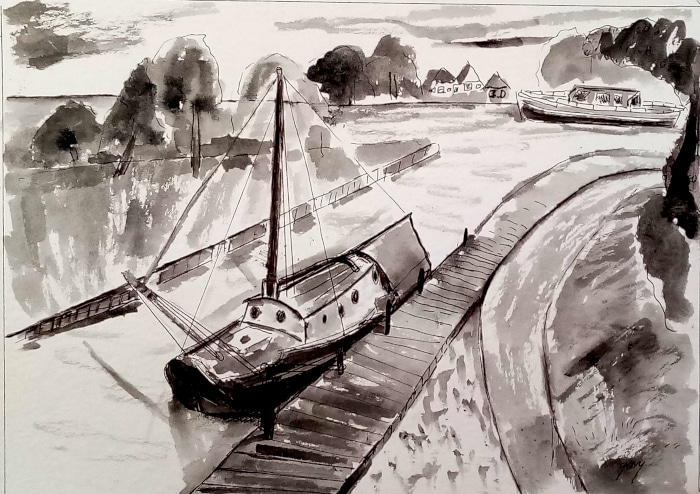
Watercolor sketch of our mooring in Lauwersmeer at sunset
Kees and Ada were waiting for us a bit off the Queen Wilhamena Canal, on a side shoot of a side shoot. We enjoyed great conversations and always get boating tips from them. Ada is excellent at spotting flaws with our lines and fenders. Kees knows these boats well, having owned one for about 60 years. We enjoyed wonderful meals and snacks with them for the next 12 days. Ada is a very good cook. One night we had whitlof (Belgian endive) wrapped in ham, topped with a cream sauce. Another time we had white asperagus.
After two days on this lovely rural spot we took the Queen Wilhamena Canal to Goredijk. I’ll start there with the next post. I wrote about Arnheim here https://garyjkirkpatrick.com/arnhem/. It came just after Doesburg.
Contains information related to marketing campaigns of the user. These are shared with Google AdWords / Google Ads when the Google Ads and Google Analytics accounts are linked together.
90 days
__utma
ID used to identify users and sessions
2 years after last activity
__utmt
Used to monitor number of Google Analytics server requests
10 minutes
__utmb
Used to distinguish new sessions and visits. This cookie is set when the GA.js javascript library is loaded and there is no existing __utmb cookie. The cookie is updated every time data is sent to the Google Analytics server.
30 minutes after last activity
__utmc
Used only with old Urchin versions of Google Analytics and not with GA.js. Was used to distinguish between new sessions and visits at the end of a session.
End of session (browser)
__utmz
Contains information about the traffic source or campaign that directed user to the website. The cookie is set when the GA.js javascript is loaded and updated when data is sent to the Google Anaytics server
6 months after last activity
__utmv
Contains custom information set by the web developer via the _setCustomVar method in Google Analytics. This cookie is updated every time new data is sent to the Google Analytics server.
2 years after last activity
__utmx
Used to determine whether a user is included in an A / B or Multivariate test.
18 months
_ga
ID used to identify users
2 years
_gali
Used by Google Analytics to determine which links on a page are being clicked
30 seconds
_ga_
ID used to identify users
2 years
_gid
ID used to identify users for 24 hours after last activity
24 hours
_gat
Used to monitor number of Google Analytics server requests when using Google Tag Manager
1 minute
Marketing cookies are used to follow visitors to websites. The intention is to show ads that are relevant and engaging to the individual user.
A video-sharing platform for users to upload, view, and share videos across various genres and topics.
Registers a unique ID on mobile devices to enable tracking based on geographical GPS location.
1 day
VISITOR_INFO1_LIVE
Tries to estimate the users' bandwidth on pages with integrated YouTube videos. Also used for marketing
179 days
PREF
This cookie stores your preferences and other information, in particular preferred language, how many search results you wish to be shown on your page, and whether or not you wish to have Google’s SafeSearch filter turned on.
10 years from set/ update
YSC
Registers a unique ID to keep statistics of what videos from YouTube the user has seen.
Session
DEVICE_INFO
Used to detect if the visitor has accepted the marketing category in the cookie banner. This cookie is necessary for GDPR-compliance of the website.
179 days
LOGIN_INFO
This cookie is used to play YouTube videos embedded on the website.