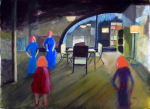
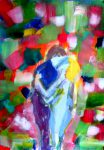
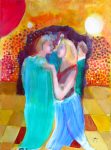
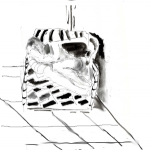
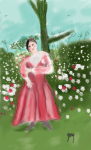
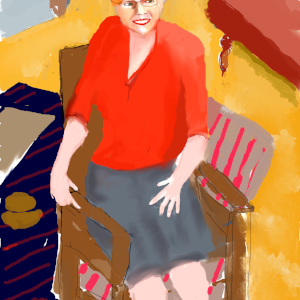
Flamenco Fusion Sala Russafa pen and ink 21 x 15 cm, 8.3 x 5.9″American Folk Fusion Sala Russafa pen and ink 21 x 15 cm, 8.3 x 5.9″
I did these pen and ink drawings at the Berklee School of Music student concerts at Sala Russafa, Nov 11-13, 2017, except for the one at the bottom, which was at the year-end performance of the Valencia campus of the Berklee School of Music in pen and ink.
Among the notable things in Vilnius, the capitol of Lithuania, are the spires and the architecture, featured in the background of this painting. Lithuania is nominally a Roman Catholic country, with 75% of the population purportedly members. However the statistics show that half the population does not believe in the Christian deity. I have portrayed the irony of this apparent contradiction through the unusual placement and distortion of the spires, which serve at once to unite and divide the couple.
Couple in Vilnius, acrylics on paper, 11.7 x 16.5″, A4 30 x 42 cm
Petras Repšys (1940) painted a rather strange set of scenes on the ceiling and walls of a room at the University of Vilnius. It is worth a look. He is a graduate of Vilnius Art Institute (1967) Works in sheet, book, graphic arts, ex libris, easel paintings, frescoes, sculptures, medals. The exilibrisus began to develop in 1969 . Here are some photos of his fresco “Seasons of the Year,” executed from (1974-1984).
Band at El Carmen, acrylics, 8.25 x 16.6, 30 x 40 cm
Band at El Carmen, 12th century monastery in Valencia. They performed during an event I attended. These monasteries were once brightly painted, but not like this! I have the freedom to decorate the Gothic arches as I please, and I like them bouncing off the page.
Artemesia Gentileschi, one of few women painters in the 1600’s, and among the finest of either sex.
Born in Florence in the Baroque era, Artemesia (1593 – c. 1656) was one of the finest painters of her day, and the only one of her sex to achieve recognition. She was the first woman to become a member of the Accademia di Arte del Disegno in Florence was employed by patrons from the Papal states Italy, Naples, and England. Her father Orazio was also very well known and respected as a painter, sharing his knowledge with her from an early age, yet for years they were estranged until possibly near the very end of his life when they worked together in London for the royal family.
Her most famous painting is Judith Slaying Holofernes, a bloody affair that demonstrates her powerful use of light and shadow allo Caravaggio. She made use of her own image in this and many of other paintings.
Judith Slaying Holofernes
Susanna and the Elders (1610). She was 17
Her success was threatened in the earlier years by the crime to which she was subject, and the subsequent trial. In 1611 at age 18 she was raped by Agostino Tassi, a painter Orazio hired to tutor her. At that time if you were raped and the rapist promised to marry you, rape was acceptable provided the promise was kept. She continued having sex with Tassi but he reneged on the marriage commitment – her continued relations with him was not considered exculpatory of his behavior. At the time he was still married and having a sexual relation with his sister in law as well. Part of the trial ordeal was a required gynecological exam. In addition all witnesses had to undergo torture. Their testimony would be deemed credible if they did not change their story. The prosecution was carried out not by her but her father as women did not have standing in these matters. Tassi was found guilty and sentenced to five years or banishment from Rome. He chose the former.
My Ode to Artesimia, acrylics on acrylic paper, 21 x 29.7 cm, 8.3 x 1
St Cecilia Playing a Lute
She handles light beautifully, her underlying drawings are magnificent.
Lucretia
She married a Florentine artist recommended to her by a friend, to which her father grudgingly assented, as was required if she were to marry anyone. Pierantonio Stiattessi was also a painter but not of her stature. He helped her get commissions, fathered their daughter Prudentia but later became a burden. They spent most of her married years apart despite a very good beginning. During these early years in Florence she was accepted into the prestigious Accademia di Arte del Disegno, which also required the approval of her father. During this period Michelangelo Buonarrot, the Michelangelo’s nephew, asked her and other artists to contribute a painting to the house he was building to honor his uncle.
Allegory of the Inclination
Her letters reveal a love affair with a wealthy Florentine named Maringhi . Her husband wrote to her lover in friendly terms using the backside of her love letters. Perhaps Maringhi provided financial or other forms of assistance. By 1621 she and her husband were no longer cohabiting, and she had returned to Rome. She found less success there than in Florence, and by 1630 she moved to Naples, finding lucrative work with the Viceroy. In 1638 she went to London to help her father with a ceiling for which he had been commissioned.
In Alexandra LaPierre’s Artemesia their reunion was awkward at best, coming after 25 years of separation. LaPierre portrays Orazio as fearful of being outranked by his daughter. By 1642 she had finished the work he had been hired to do, leaving England some two years following her father’s sudden death in 1639. She disappears from the records until 1648, when she is back in Naples
While it is true that there were few women painters in this period, there were others. Italians of the era were Sofonisba Anguissola, Lavinia Fontana, and Fede Galizia. Per LaPierre, Artemesia’s success in Naples encouraged a number of female competitors.
Judith and Her Maid Servant. Her treatment of robes is as good as anyone’s.
Most of her paintings feature women as protagonists. While most women were portrayed demurely, her’s were strong and uninhibited, and making a mark in history.
For a broader view of women in art in that era see the video by Art Historian Dr. Vida Hull
There is a good article on wiki if you want more information. wiki on Artemisia Gentileschi I highly recommend LaPierre’s historical novel referenced above. There a very good video on youtube. The producer expresses outrage at the lack of exposure of this fine painter. https://www.youtube.com/watch?v=BoYF2rjCG68
Contains information related to marketing campaigns of the user. These are shared with Google AdWords / Google Ads when the Google Ads and Google Analytics accounts are linked together.
90 days
__utma
ID used to identify users and sessions
2 years after last activity
__utmt
Used to monitor number of Google Analytics server requests
10 minutes
__utmb
Used to distinguish new sessions and visits. This cookie is set when the GA.js javascript library is loaded and there is no existing __utmb cookie. The cookie is updated every time data is sent to the Google Analytics server.
30 minutes after last activity
__utmc
Used only with old Urchin versions of Google Analytics and not with GA.js. Was used to distinguish between new sessions and visits at the end of a session.
End of session (browser)
__utmz
Contains information about the traffic source or campaign that directed user to the website. The cookie is set when the GA.js javascript is loaded and updated when data is sent to the Google Anaytics server
6 months after last activity
__utmv
Contains custom information set by the web developer via the _setCustomVar method in Google Analytics. This cookie is updated every time new data is sent to the Google Analytics server.
2 years after last activity
__utmx
Used to determine whether a user is included in an A / B or Multivariate test.
18 months
_ga
ID used to identify users
2 years
_gali
Used by Google Analytics to determine which links on a page are being clicked
30 seconds
_ga_
ID used to identify users
2 years
_gid
ID used to identify users for 24 hours after last activity
24 hours
_gat
Used to monitor number of Google Analytics server requests when using Google Tag Manager
1 minute
Marketing cookies are used to follow visitors to websites. The intention is to show ads that are relevant and engaging to the individual user.
A video-sharing platform for users to upload, view, and share videos across various genres and topics.
Registers a unique ID on mobile devices to enable tracking based on geographical GPS location.
1 day
VISITOR_INFO1_LIVE
Tries to estimate the users' bandwidth on pages with integrated YouTube videos. Also used for marketing
179 days
PREF
This cookie stores your preferences and other information, in particular preferred language, how many search results you wish to be shown on your page, and whether or not you wish to have Google’s SafeSearch filter turned on.
10 years from set/ update
YSC
Registers a unique ID to keep statistics of what videos from YouTube the user has seen.
Session
DEVICE_INFO
Used to detect if the visitor has accepted the marketing category in the cookie banner. This cookie is necessary for GDPR-compliance of the website.
179 days
LOGIN_INFO
This cookie is used to play YouTube videos embedded on the website.