Author: Gary Kirkpatrick

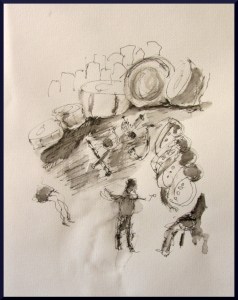
  • ¡Hola de Valencia! First drawing from Palau de la Musica

    ¡Hola de Valencia! First drawing from Palau de la Musica

    We are back in our favorite winter quarters, where the sky is always blue and the winter temperatures moderate, the street life vibrant, the food fresh and varied, and the people warm and friendly.  It’s a place that brings smiles to our face the moment we look out the window or go out the door.

    bar plaza sant jaume
    Bar Sant Jaume (Saint James), pen and ink

    The flight from Rome is normally quite beautiful.  You might get a view of the Coliseo.  You fly over Sardinia and then get a lovely view of Valencia.  Not this flight.  Weather has hit the entire Iberian Peninsula, and even Valencia is effected.  Light rain greets us but still we shed the jackets and sweaters we were wearing to get to the airport in Rome.

    We are staying in a new ‘piso.’  This one is near Plaza de Toros, much larger than our previous place, more expensive too, but better for the painter in the household.  We will miss our view:


    View from Our Place in Plaza Cisneros pen ink
    View from our old place in Plaza Cisneros pen and ink

    We go to the Palau de la Musica here most Sundays to listen to the symphonic bands, of which there are many in the province.  The first Sunday we heard the Banda Municipal.  I often do small pen and ink drawings as I listen.  Here’s the flautist playing a piece by one of local composers:


    Flautist Palau de la Musica
    Flautist Palau de la Musica 2″ x 4″


  • Arrivederci Roma: The Marcus Aurelius

    Arrivederci Roma: The Marcus Aurelius

    October 31, 2015

    It’s our last day in Rome and I spent the morning drawing the statue of Marcus Aurelius in il Museo Capitoline.  This has to be one of the most impressive pieces of art around, for its magnificence, proportions, gilded in bronze and dating from around 180 CE.  It’s astounding and a privilege to sit before it.  It is in its new setting in a special room at the museum.


    Marcus Aurrelius closeup
    Marcus Aurrelius closeup


    Marcus Aurrelius
    Marcus Aurrelius

    Just around the corner there is this Etruscan piece from 700-600 BCE

    Jpeg
    Reclining figure

    This one is terrific but pales in comparison to the Sarcophagus of the Spouses in the Etruscan Museum here- called Villa Giulia.  Circa 520 BCE.  Terracotta.


    Sarcophagus of the Spouses
    Sarcophagus of the Spouses
  • Portrait of Panamanian Woman

    I met her in Panama while we were in the Peace Corps and we kept in touch.  She is photogenic!


    Diva (graphite) A4 8 x 11.5"
    Diva (graphite) A4 8 x 11.5″
  • Museo Nazional de Arte Clasica Romana (Roman Art) has some mighty fine statues

    Museo Nazional de Arte Clasica Romana (Roman Art) has some mighty fine statues


    Amazing Ivory image in black case
    Amazing Ivory image in black case


    The Museo Nazional de Arte Clasica Romana is across the street from Termini.  It houses a fine collection of Roman era sculptures on the first two floors, very professionally exhibited with excellent English translations.  The top floor houses wall paintings from Roman era villas, many of which are in amazing condition.  There are also some excellent examples of mosaic art.  Here are some examples.


    2


    3

  • View of Canal, Giethoorn (acrylics)

    Giethoorn is a tiny village in the Nederlands. In town there are canals and walking paths only. The houses have thatched roofs. It’s a magical place.

    View of Giethoorn (acrylics)  A3 16.5 x 11.5"
    View of Giethoorn (acrylics) A3 16.5 x 11.5″ Sold
  • Museo delle Mura (Museum of the Walls), Rome at St Stephens Gate

    The Museo delle Mura (Museum of the Walls),  is at St Stephens Gate, at the entry to Appia Antica, the Appian Way as it is known in English.  It wasn’t open when we were here last and in 2000 I do not think it even existed.  It is small but the small albeit older style exhibits tell you about the history of the Roman walls and their many alterations and reconstructions.  And the views are great!

    Museum of the Walls), Rome at St Stephens Gate View of both gates
    Museum of the Walls), Rome at St Stephens Gate View of both gates
    View of Appia Antica are from St Stephens Gate
    View of Appia Antica are from St Stephens Gate
    Museum of the Walls), Rome at St Stephens Gate
    Museum of the Walls, Rome at St Stephens Gate
    St Stephens Gate
    St Stephens Gate
    Museum of the Walls), Rome at St Stephens Gate View of both gates
    Museum of the Walls), Rome at St Stephens Gate View of both gates
    St Stephens Gate
    St Stephens Gate


    Museum of the Walls), Rome at St Stephens Gate
    Museum of the Walls, Rome at St Stephens Gate

    You can walk along the top of the walls, as you can see from here.

  • Barberini Palace, Caravaggio, Raphaello, chiaroscuro cieling

    October 21, 2015

    The Barberini Palace, just up the hill from Bernini’s Tritone Fountain, is an immense mansion and the home of the Galeria Nazionale d’Arte Antica, art from about the 15th c -17th century.  Here is Caravaggio’s Narisco- Narcissus. Get a load of the reflection!

    Narciso by Carravagio
    Narciso by Carravagio

    In the galleries I try to find something I can draw. I try to find something that is interesting and doable in 5-10 minutes and where there is a seat, good lighting, things like that. Sketch of Gerrit van Bronckhorst’s Betsaben al Bagno. I’d never heard of this painter. Seems to have been influenced by Caravaggio, given how he treats the light here.

    Gerrit van Bronckhorst Betsaben al Bagno in Galeria Nazionale d'Arte Antica Rome
    Gerrit van Bronckhorst Betsaben al Bagno in Galeria Nazionale d’Arte Antica Rome
    Sketch of van Bronckhorst Betsaben al Bagno
    Sketch of van Bronckhorst Betsaben al Bagno

    Back to Caravaggio, here’s another masterpiece hanging in room 20 (in my best Spanish accent, I asked where this room was in Italian and got a reply in Spanish!).  It’s so gruesome I nearly walked out of the room!


    Caravaggio's Judith and Holofernes
    Caravaggio’s Judith and Holofernes

    Salvator Rosa’s “La Poesia” and “La Musica” (17th century) are superb.

    Salvator Rosa - La Poesia3 Salvator Rosa - La Musica


    And a rarity for the time, a woman painter, and quite a good one!  Portrait of a Young Woman Dressed as a Bacchante

    'Portrait of a Young Woman dressed as a Bacchante, by Angelica Kauffmann, Palazzo Barberini, Rome, Italy.
    ‘Portrait of a Young Woman Dressed as a Bacchante, Angelica Kauffmann,


    Here’s yet another prize- what the Galleria notes as the first female nude:

    Pierre Subleyras
    Pierre Subleyras


    Jacopo Zucchi “Ritratto di Ciela Farnese”

    Jacopo Zucchi 'Ritratto di Ciela Farnese
    Jacopo Zucchi ‘Ritratto di Ciela Farnese


    As for the building, it is a divine palace built by the Barberini family, whose symbol, three bees, appears throughout.  It is in wonderful shape.  The most magnificent room is on the second floor, immense and nearly empty except for several small sofas in the middle.  People lay on them and look at the ceiling, some 20 meters/60 feet above.  Here’s why:

    Pietro da Cortona Triumph of Divine Providence.
    Pietro da Cortona Triumph of Divine Providence.


    You have to go there to appreciate all of these, especially this ceiling though.

    All this for 7 euros.

  • Hagia Sophia (circa 550), one of the world’s greatest buildings

    September 20 2015  Istanbul

    Hagia Sophia miniature (4" x 6") acrylics on postcard stock
    Hagia Sophia miniature (4″ x 6″) acrylics on postcard stock


    The Hagia (Holy) Sophia (Wisdom) is a stunning domed building built as a Greek Orthodox cathedral in 537 when Istanbul, then called Constantinople,  was the capital of the Eastern Roman Empire(also known as the Byzantine Empire).  Between 1204 and 1261 it was a Roman Catholic cathedral.   Following the conquering of the Empire by the Ottomans in 1453, the Hagia Sofia became a mosque.  In 1931 it was closed and then converted into a museum, which it is still.  The minarets and round domes give it an Islamic setting, and some of the interior maintains that influence as well.  Nonetheless it is an impressive structure, notably the dome, and for 1000 years it was the largest cathedral in the world, replaced in 1520 by the Cathedral in Seville.

    Here are some stock photos of the interior.  It is way too dark and large for me to get good photos.   These are mosaics!
    Mosaic from Hagia Sophia
    Mosaic from Hagia Sophia


    220px-Empress_Zoe_mosaic_Hagia_Sophia

    220px-Hagia_Sophia_Imperial_Gate_mosaic_2

    hagia sophia interior 1


    hagia sophia interior 2