With cold mornings and sunny afternoons in the forecast, we set off from our winter berth in Potsdam after making a few plumbing repairs due to the winter freeze- they skated on the lake for the first time in years. Heading towards the Netherlands, we chose the southern route that leads to the Mittlelandkaanal. After a night in Genthin we stopped at a free mooring in Burg. It’s less than 30 minutes by train to the ancient city of Magdeburg, with a current population of 242,000.
Founded by Charlemagne in 805, Magdenburg Otto I made it his seat, ruling Saxony from 836-873. He was the Holy Roman Emperor from 962 until his death in 873. Otto I defeated the Magyars at the Battle of Lechfeld in 955, stopping the Hungarian invasion of Western Europe. He was buried in the Cathedral.
Magdeburg’s Town Law, granting the right to hold trade exhibitions and conventions, spread through much of Europe in the early Middle Ages. As one of Germany’s largest and most prosperous cities, in good measure because it sits on the Elbe River, Magdeburg joined the Hanseatic League in the 13th century. By then it had 20,000 residents, considered large at the time.
Martin Luther attended school here as a 12 year old. In 1524 Luther began the movement that led to the Protestant Reformation. Magdeburg was a major force in the effort to break from the corruption of the Church.
Things did not always go smoothly for the city. In 1188 it was devastated by fire, it suffered 25,000 deaths during the 30 years war, and its old center was largely destroyed by Allied bombing in WW2. There was a POW camp and three subcamps of Buchenwald holding Jews. Dozens were murdered in an effort to cover up the crimes against humanity as the Allies advanced. More were led on death marches as the war ended. It was in East Germany during the Cold War, its development stunted by failed economic policies and a police state government.


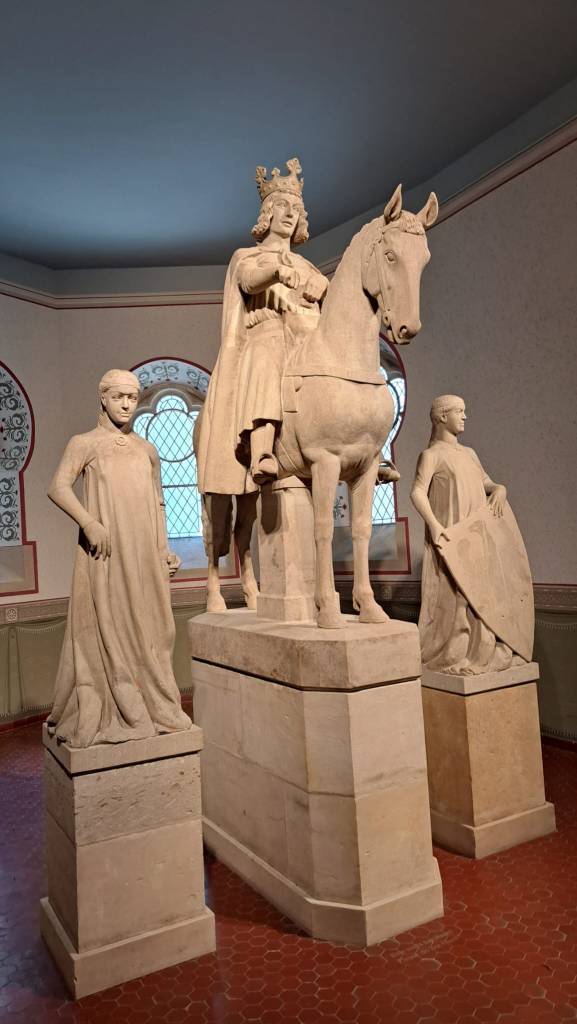
We visited the Kulturhistorische Museum Magdeburg (KHM). Most notable is the Magdeburger Reiter (Magdeburg Rider). It might represent Emperor Otto, Otto II or III. The rider is accompanied by two female figures, usually interpreted as allegories of the Roman Empire and the Slavic peoples, but sometimes Empress Adelaide and Empress Theophanu. The statue was brightly painted.


Schnitzel and beer, oh so German, in a super local joint!
Two days before Magdeburg we moored for the night at a marina called Havel Marin just outside Brandenburg. We found just one restaurant within walking or biking distance. It sits on a private road, a bit off putting as you wonder if you are trespassing. We followed the one turn off leading to a small house. Was this it? There is no sign outside. We might have left if there had not been a group of people sitting under an awning drinking beer.
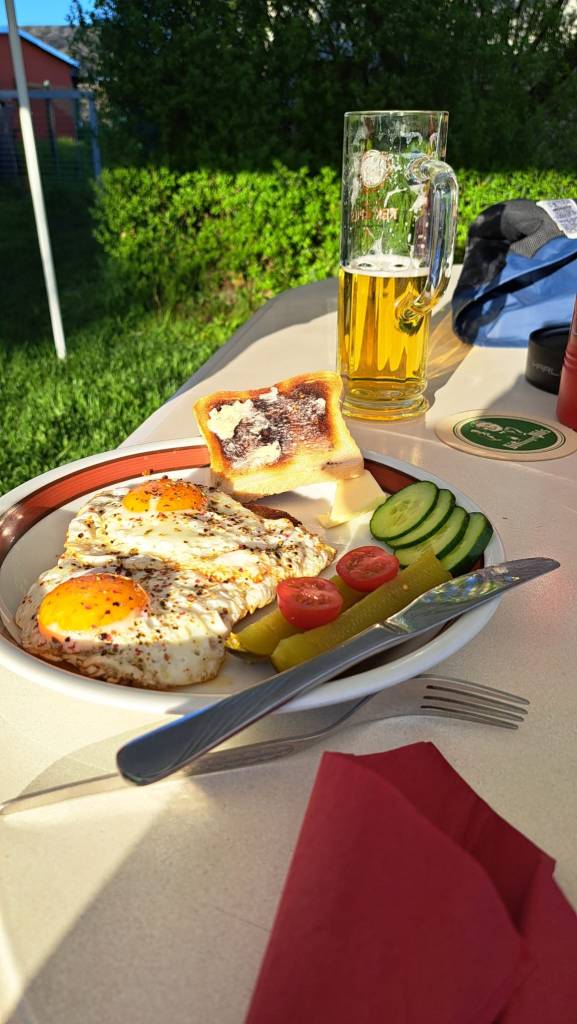
We ventured inside and only then were we sure we had found the place. There is a sizeable, well stocked bar and tables. The only employee and likely the owner reminds of Ichabod Crane, very tall and slender. We could not tell at first who he was, an employee or just another guest as he was not in any sort of uniform. He speaks no English, but somehow we figured out he works there. So what about a menu so we can see what’s on offer and point to things? Nope, there is no menu. Our online source had mentioned schnitzels so we used that word and he nodded. Then he said something that sounded like the Dutch for egg. It turns out the plate includes a small schnitzel, a few cherry tomatoes, slices of sweet pickles and a fried egg on top of the breaded pork. Fortunately I got him to hold the egg. It was a so so dinner but at €17 for two including two .5 liter beers it was a very reasonable bargain.
More to come on our journey west.
For my article on Brandenburg see https://garyjkirkpatrick.com/brandenburg/


Discover more from Gary J Kirkpatrick, Art and Travel
Subscribe to get the latest posts sent to your email.