Tag: WW2

  • Magdeburg, Germany, home of the Reformation. And a schnitzel.

    From Potsdam to Genthin

    With cold mornings and sunny afternoons in the forecast, we set off from our winter berth in Potsdam after making a few plumbing repairs due to the winter freeze- they skated on the lake for the first time in years. Heading towards the Netherlands, we chose the southern route that leads to the Mittlelandkaanal. After a night in Genthin we stopped at a free mooring in Burg. It’s less than 30 minutes by train to the ancient city of Magdeburg, with a current population of 242,000.

    Founded by Charlemagne in 805, Magdenburg Otto I made it his seat, ruling Saxony from 836-873. He was the Holy Roman Emperor from 962 until his death in 873. Otto I defeated the Magyars at the Battle of Lechfeld in 955, stopping the Hungarian invasion of Western Europe. He was buried in the Cathedral.

    Magdeburg’s Town Law, granting the right to hold trade exhibitions and conventions, spread through much of Europe in the early Middle Ages. As one of Germany’s largest and most prosperous cities, in good measure because it sits on the Elbe River, Magdeburg joined the Hanseatic League in the 13th century. By then it had 20,000 residents, considered large at the time.

    Martin Luther attended school here as a 12 year old. In 1524 Luther began the movement that led to the Protestant Reformation. Magdeburg was a major force in the effort to break from the corruption of the Church.

    Things did not always go smoothly for the city. In 1188 it was devastated by fire, it suffered 25,000 deaths during the 30 years war, and its old center was largely destroyed by Allied bombing in WW2. There was a POW camp and three subcamps of Buchenwald holding Jews. Dozens were murdered in an effort to cover up the crimes against humanity as the Allies advanced. More were led on death marches as the war ended. It was in East Germany during the Cold War, its development stunted by failed economic policies and a police state government.

    Magdeburg’s center after WW2
    Hundertwasser House in Magdeburg

    We visited the Kulturhistorische Museum Magdeburg (KHM). Most notable is the Magdeburger Reiter (Magdeburg Rider). It might represent Emperor Otto, Otto II or III.  The rider is accompanied by two female figures, usually interpreted as allegories of the Roman Empire and the Slavic peoples, but sometimes Empress Adelaide and Empress Theophanu.  The statue was brightly painted.
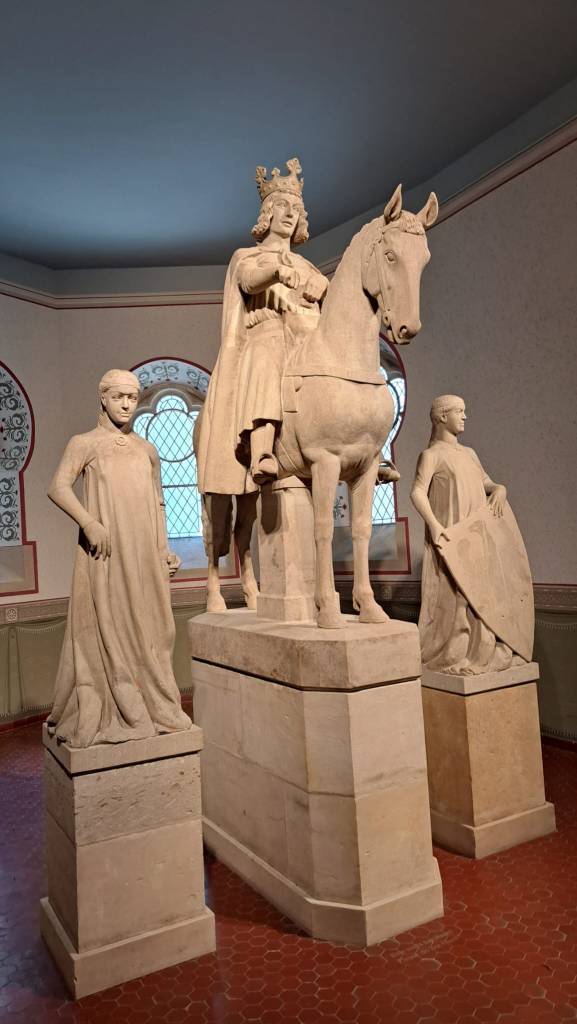
    Magdeburger Reiter (Magdeburg Rider
    The Elba in Magdeburg

    Schnitzel and beer, oh so German, in a super local joint!

    Two days before Magdeburg we moored for the night at a marina called Havel Marin just outside Brandenburg. We found just one restaurant within walking or biking distance. It sits on a private road, a bit off putting as you wonder if you are trespassing. We followed the one turn off leading to a small house. Was this it? There is no sign outside. We might have left if there had not been a group of people sitting under an awning drinking beer.

    We ventured inside and only then were we sure we had found the place. There is a sizeable, well stocked bar and tables. The only employee and likely the owner reminds of Ichabod Crane, very tall and slender. We could not tell at first who he was, an employee or just another guest as he was not in any sort of uniform. He speaks no English, but somehow we figured out he works there. So what about a menu so we can see what’s on offer and point to things? Nope, there is no menu. Our online source had mentioned schnitzels so we used that word and he nodded. Then he said something that sounded like the Dutch for egg. It turns out the plate includes a small schnitzel, a few cherry tomatoes, slices of sweet pickles and a fried egg on top of the breaded pork. Fortunately I got him to hold the egg. It was a so so dinner but at €17 for two including two .5 liter beers it was a very reasonable bargain.
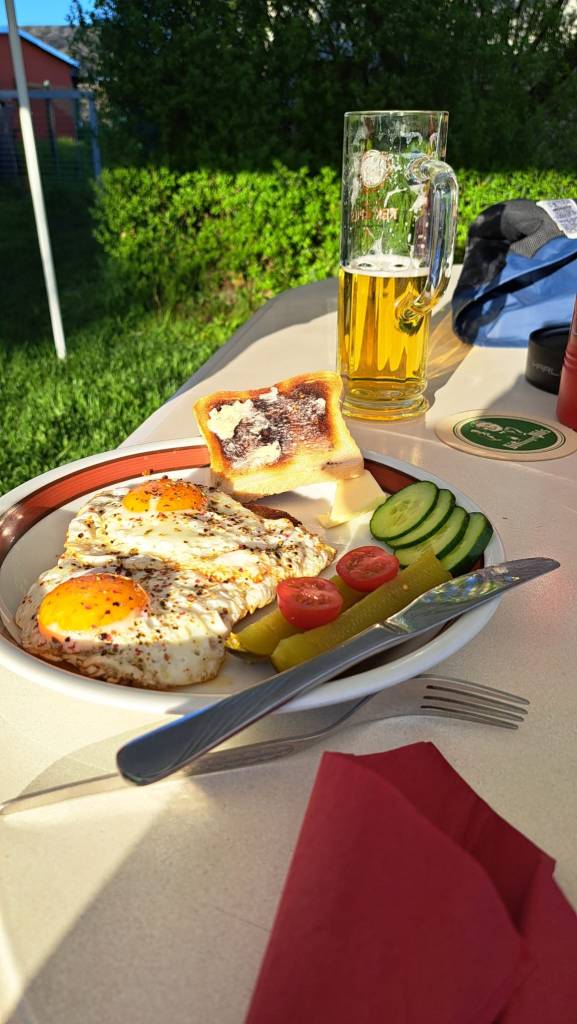
    Schniitzel and beer, oh so German!

    More to come on our journey west.

    For my article on Brandenburg see https://garyjkirkpatrick.com/brandenburg/

    Brandenburg Steeple
    Brandernburg, Germany
  • WW2 in Warsaw

    July 30, 2018

    Today we took our 3rd walking tour of Warsaw. In the first we went to various locations in the Stare Miasto, Old Town. The second was about Communist Warsaw, led by a woman who grew up during that era.  She had to stand in line for everything,  and witnessed the suppression and growth of Solidarity, leading to the downfall of the Iron Curtain.  This afternoon we took the tour of WW2 Warsaw. It takes you to the Jewish ghetto and the location of some of the sites of the uprising in October 1944.

    Memorial to Jewish victims of the Nazis

    The ghetto was set afire by the Nazis to defeat the 1943 uprising. Today its location is marked on the pavement- they speak to you of the nightmare the Nazis created. Rations were a mere 200 calories a day for Jews, and 500 for Poles. Jews were allowed no medicine. If anyone helped a Jew, the penalty was death for that person and the entire family.

    Memorial to resistance fighters

    Memorial to children who helped fight the Nazis.

    Statues of resistance fighter entering the sewer system

    The resistance used the sewers to move from several areas in and near the old town.  The sewers were in use at the time, unlit and required one to walk bent over.  Movements had to be in complete silence.  Eventually these were closed down by the Nazis.

    In preparation for the 1944 uprising, the underground raised money for weapons and supplies by robbing a bank.  Money was transferred from the Polish central bank by armored car.  They raised the about $10 million in today’s dollars.  The uprising took a heavy toll on the city and the population.  The Nazis killed 200,000 people, destroyed about 90% of the old town and 65% of Warsaw as a whole.

    The bank from which the resistance stole $10m. You can still see wartime damage to the brick

    These two uprisings were the largest of occupied Europe.  The 1944 uprising not only hoped to help defeat the Nazis but to keep Poland out of Soviet hands, whose invasion of Poland made no friends in the county.  The result of the Yalta conference as well as their defeat in the uprising, while the Soviet army watched from across the river, led to post war deportations and murders by the Soviets and 50 years of bad governing.

  • Poland’s Enigma in WW2

    Poland’s Enigma in WW2

    We ran across the sculpture and exhibit concerning the breaking of the German Enigma code while walking in the downtown area of Poznan.    I’d heard both that the Polish a Brits broke the enigma code.  There is an excellent movie called “The Imitation Game” about Alan Turing, (see https://en.wikipedia.org/wiki/Alan_Turing ) 

    In late 1932 Marian Rejewski broke the code of the German Enigma machine.  Without knowing how the machine was wired, he was unable to read the messages. Hans-Thilo Schmidt, a French spy obtained information including the daily keys used in the fall of 1932.  They put these materials into Polish hands. With that information and actual coded messages Rejewski was able to turn the coded messages into understandable text.  Later the Germans added two more rotors.  The Poles did not have the resources to break the code again, and thus passed the baton to the UK in July of 1939.  Rejewski, and cryptanalysts Jerzy Różycki and Henryk Zygalski in the interim developed extensive materials which they gave to the UK as well.  Thus Turing was not starting from scratch.