Blog

  • Tallinn, capitol of Estonia and a World Heritage Site

    September 8, 2015

    Self Portrait At Fat Margaret Squate in Talinn
    Self Portrait At Fat Margaret Squate in Talinn
    After a two hour ferry ride across the Gulf of Finland, we made our way to a Bohemian section and met our Bohemian landlord, a woman in her late 20’s perhaps.  She has a small comfortable flat with crazy angle bookshelves and an orderly yet stylishly unkempt look wth open kitchen shelves with jars screwed to the bottom.  Our building is stucco but the area is known for wooden structures, which I will photograph and share with you.
    The  next day (September 8th) we hopped on the tram to the foot of the old town;  public transit does not take you in.  It’s up a few hundred steps and there we are with this lovely view of the town, the port and Baltic Sea in the background.

    IMG_8968

    While walking through town, we run across the fabulous Russian Orthodox Church.  I am sternly warned about wearing my hat inside.  We watch a woman kiss various objects and a priest make blessing signs over a few people allowed beyond the barriers.  No hat , no photography either.  It is much more impressive inside than the Russian Church in Helsinki.

    IMG_8971


    IMG_8980


    This is the old town wall-  up the steps there is a cafe


    IMG_8981

    Another view of the town wall.

    IMG_8976


    This is the fabulous town square.  Pricey restaurants abound and aggressive hosts try to pull you in.

    IMG_8991


    We visited the Estonia History Museum at the Grand Guild Hall.  A few interesting facts: They trace settlement back to around 11,000 years ago when the ice melted enough to allow for human settlement.  The Estonians,  a Finnish people, have inhabited the Baltic Sea area for at least 3000 years.  The country dates to around 1100 but has been independent for only 40 of those years.  Their language is closely related to the Finnish and Sami languages (Norweigan, Swedish and Russian primarily), and distantly related to Hungarian. There are currently a mere 1.5 million inhabitants and an amazing 2200 islands.

    Estonia was annexed by the USSR in 1939 following Stalin’s delightful deal with Hitler, then taken by Germany, before being retaken by the USSR and dominated until 1991.   They welcomed the Germans in WWII, thinking they would be better than the Russians; they changed their minds in short order.  The Finns reacted similarly, having been invaded by the USSR in the same period.

    You might think Estonia is rather backwards.  It isn’t. It has a high per capita income and is one of the most wired countries in the world; Skype was invented here. It has freedom of the press and is in other ways a developed democracy.  English is widely spoken if a bit less fluently than in Finland.  Nonetheless, the musuem’s ehibits were in nearly flawless English, interesting and entertaining as well.

    Per a BBC podcast, the Estonians are very nervous about Russia and have instituted a draft.  About 25% of the population is Russian speaking and they do not feel they are part of Estonia.

    For lunch I had pancakes with meat, as they bluntly put it, which turned out to be ground beef, very basic but certainly not objectionable, and Peg had broth with a hard boiled egg in it and potato salad on the side.  We shared a very good piece of almond cake with icing.  It was inexpensive, just 13 euros for the whole thing.  On the plaza lunches were about 13 per person, by comparison.  No doubt it was a much simpler meal than those at twice the price.

    An interesting walk about town included stops in several artisanal shops-  the place is full of them.   The quality of the work is impressive.  Paintings, drawings, stained glass, leather, jewelry and other handicrafts.

    There is an old Dominican church that is now a theater.  The order was closed down during the Reformation and its property confiscated, just some 300 years after the forcible conversion to Christianity.  Today Estonia is one of the least religious countries on the earth, with 14% saying religion plays an important part in their life.  I saw several of the 14% today, sharing germs via religious objects; hopefully the surfaces are not all that hospitable to the little creatures.

  • Helsinki- some fabulous interior Jugend (Art Nouveau) decorations

    September 8, 2015

     Wow!  Salutorget – a restaurant near the Tourist Info Center and the harbor:
    IMG_8818
    IMG_8811
    IMG_8810
    IMG_8803
    IMG_8800
  • From Helsinki- the surprising beauty of Jugend architecture

    From Helsinki- the surprising beauty of Jugend architecture

    September 7, 2015

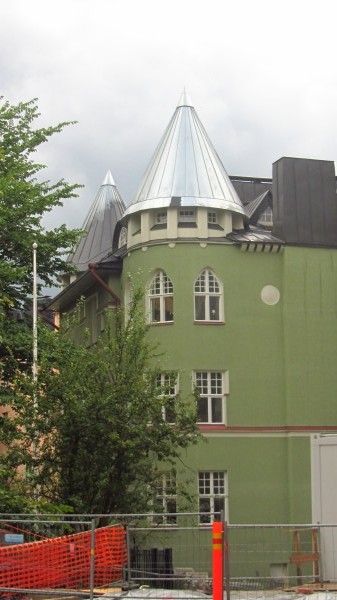
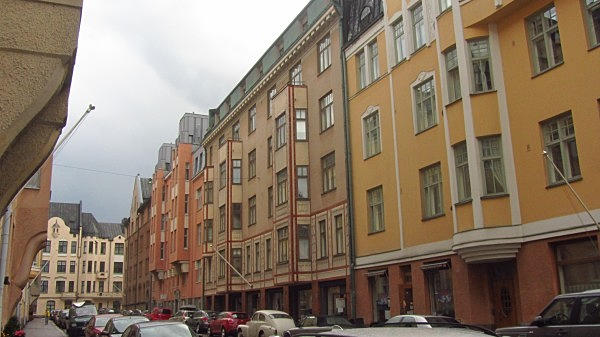
    Jugend architecture is more generally known as Art Nouveau.  In Finland  you see swooping, flowing lines in the decoration.  There are mythological symbols, many from the national epic poem, Kalevala, as well as images of nature, such as owls and bears.  There are elements.   The most important buildings are in stone, but they also used soapstone, a softer rock.  This style was in vogue in the early 20th century.

    I’ll post another entry with interior shots-  quite fabulous!

    Here are some good examples of building exteriors from a two or three block area near the harbor and the Russian Church:

    IMG_8883

    IMG_8859

    IMG_8864

    IMG_8860

  • Sketches of the Dutch

    Here are some drawings and sketches of the Dutch.

    Drawings:

    Young Dutch Man (pencil)
    Young Dutch Man (pencil)


    Rembrandt in Hat (from a self portrait) ink
    Rembrandt in Hat (from a self portrait) ink


    Dutch Man (pen and ink)
    Dutch Man (pen and ink)


    dutch girl on train
    Dutch Girl on Train


    Sketches:

    woman in bar zaandam (mini)
    Woman in Bar, Zaandam (mini)


    Dutch man
    Dutch man


    detoog eet cafe man taking bite (mini)
    Detoog Eet Cafe- man taking bite (mini)


    Cheers
    Cheers (mini)


  • Windmills of Zaandam

    August 31, 2015

    Zaandam windmills
    Zaandam windmills
    Zaandam was quite the industrial center and still there are two chocolate factories – we can smell the chocolate every day- and quite a number of other factories in the area.  The industrial revolution here was powered by windmills.  Most of them are gone- there were some 630 at the peak and there are 14 now.  Here are photos of a portion of what remains:
    windmill2 windmills
    In the above mill they sell flour that I assume they grind there.  They have some speciality flours such as spelt and pancake flour –  I am not sure what they mean by that.  At any rate, the Dutch eat both savory and sweet pancakes.  Here’s a shot of the interior.
    Zaandam windmills  interior
    Zaandam windmills interior
  • Traditional houses of Zaandam

    August 29, 2015

    We walked along the Zaan river today.  Starting in the 17th century this area was heavily indistrialized.  At the peak of windmilll usage there were 635 in the immediate area, draining fields and running factories.  The mills powered lumber, paper, oil, flour and other factories.  Here are some fine examples of the houses of the era:
    Traditional house in Zaandam
    Traditional house in Zaandam

     trad house 3

  • Monet’s “Blue House in Zaandam” and a sketch of a man with beard. Peter the Great’s House.

    I guess I did not do enough walking yesterday, so we walked to downtown Zaandam. I photographed one of the houses Monet painted. It no longer looks the part, as you can see. There are about 35 Zaandam houses by Monet. There is a map you can use to see them all.

     I saw one of Monet’s houses today, and it does not look the part, as you can see.  The port is still there but there is a house in the way.

    Blue House Zaandam by Monet
    Blue House Zaandam by Monet
    Photo of the blue house in Zaandam
    Photo of the blue house in Zaandam

    Peter the Great lived nearby for 8 months, studying ship building.  The house was saved from collapse and is inside a building.  It is so badly sagging that when you enter you lose your balance.  It’s like being in a fun house with many crazy angles.  He was there to learn military ship building but found that the lack of written plans here to be counter-productive to his purposes and so went to England where they used plans.  He later returned to visit the village.  His landlord refused to see him, as Peter had lived there 8 months without paying any rent.

    While Peg was shopping I did a few sketches while having coffee along a canal.  These are miniatures, about  2″ x 4″ in pen and ink:

    Man at Outdoor Cafe
    Man at Outdoor Cafe
    Sketch of Woman At Outdoor Cafe
    Sketch of Woman At Outdoor Cafe

     Of course I have to do these sketches surreptitiously, and the people usually move a lot, so it is quite challenging.


  • Jazz Singer, painting

    Jazz Singer, acrylics, A3, 16.5 x 11.5″

    I was inspired by her natural warmth and the way she connected with her audience, which I hope I captured.

  • Tall Ships 2015:  Miniatures Paintings and Drawings

    [Every 5 years 3-5 masted sailing ships, most of them training vessels, come to Amsterdam.  We sat on the side of the North Sea Canal where I sketched.  And ate pofertjes!  (Small pancakes).   Here are my drawings and paintings from that event.

    (more…)

  • Cats!

    One of my favorite topics!  Here two kittens play in the botanic gardens in Valencia.


    kittens play
    Kittens Play (sold) pastels


    cats long
    Cats Long –pen and ink (sold)


    Black Cat Reading
    Black Cat Reading (sold) water color

     Cat in the Leaves
    Cat in the Leaves


    cat reading red book
    Cat Reading Red Book