Some of my paintings will be on display in Valencia, Spain at El Cau del Roure https://elcaudelroure.com/exposiciones-2/ The paintings will be on display from March 25 until April 2, 2022. The hours are 19-21hours onThursday, Friday and Saturday, Sunday from 11-14 hours. The catalog is attached. Please come by. I plan to be there. The address is Calle Roure 1, 46014 Valencia, behind Consorci Hospital General Universitari de València.
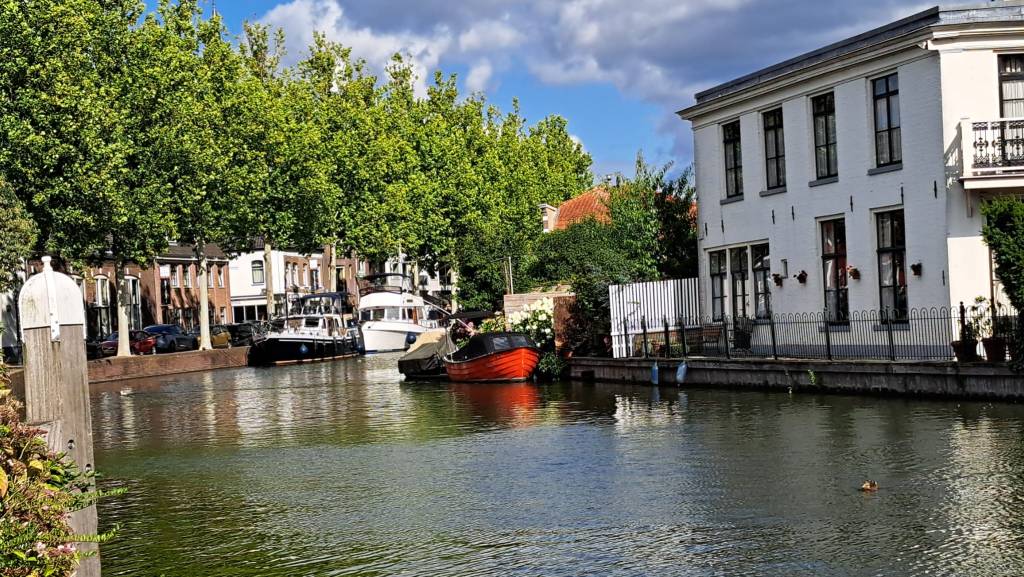
From deep in the heart of Friesland we set off early on a twenty hour journey to the tiny town of Weesp on the River Vecht. There we are joined by nephews for a legacy tour starting in Weesp, to Utrech, Rotterdam, den Haag, Haarlem and Amsterdam.
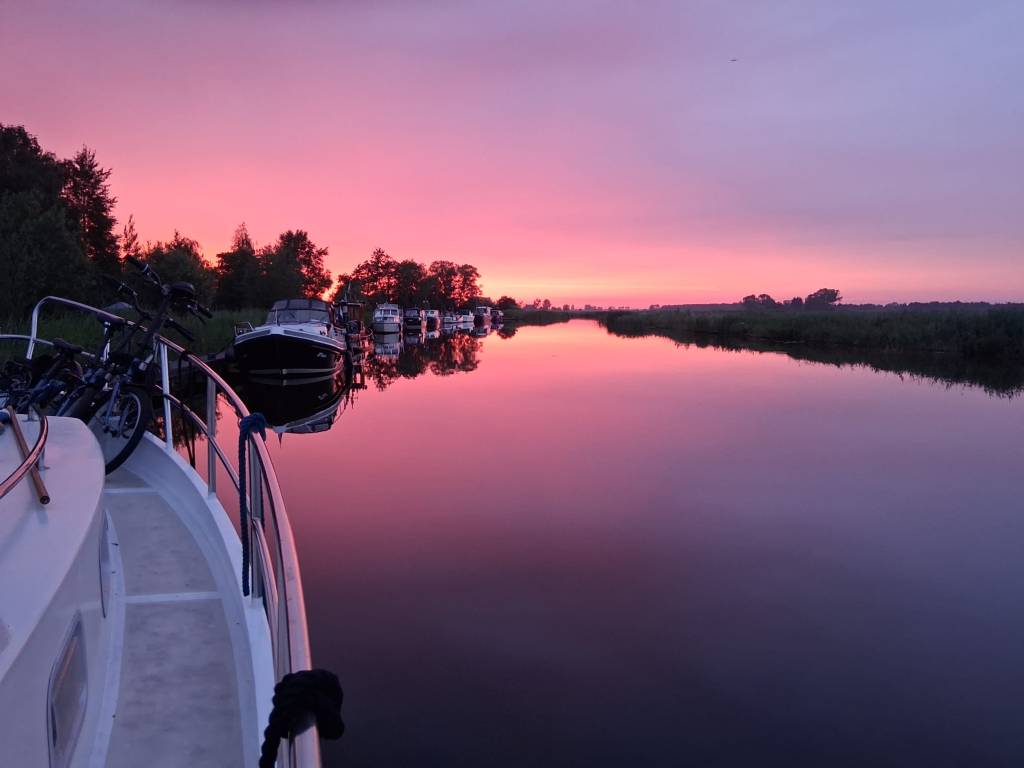
We stayed one night on the Eems River. Arriving around 6 p.m. meant that we would have a hard time finding a mooring at all. The first set of moorings were full, but as usual if the boaters eliminated unnecessary gaps we could have easily fit. We had to go 6 kilometers up the river before we found a mooring in a small park on a curve- that ook more than 30 minutes. Curves are harder to moor to since your bow is farther from the land, making it harder to tie to a bollard. The sailboat’s bowsprit stuck far out, giving us an extra obstacle. Fortunately there were posts to moor to – you never know until you get there. Sometimes there are just rings, meaning you have to get off the boat to attach to the shore. This can be difficult if the wind is pushing you away from the land Here we were able to lasso both the front and aft posts. With posts you have to go around twice, or the lines ride up and off.
There were several locks along the way, filled end to end with boats. It’s summer so the Dutch hit the waterways, even in the less than ideal weather on offer. The lock meister packs them in! You always wonder if some new boater, or a rental boats, will lose control of their vessel. All the experienced boats are on alert.
Looking ahead we could not be certain if the weather would hold. Already we had a problem getting off a mooring with strong winds pinning us to the dock, our bow thruster not there to give us a lateral boost. From the Eems we headed early in the morning into wind and rain, but fortunately everything calmed down once we entered the canal leading to the lock. This made entering the lock much easier, so we were able to gaze upon the beautiful old Muiden Castle.
Muiden, NL Castle, watercolors
Our next uncertainty is the availability moorings in Wessp. Just past the second bridged we found the only one available. Lady Luck overruled Sir Bad Luck us once again. The next morning everyone left so we moved farther from the bridge to avoid the fumes of the boats waiting for the bridge to open as they say just a meter away.
Moored in the center of Weesp
If you’ve not had the pleasure, include Weesp on a tour of small Dutch towns. It’s not far from Amsterdam and can be visited in just a few hours. There are restaurants along the river and a brewery located in a de-consecrated church, with lots of very Dutch architecture. In summer there are flowers galore.
In a country dotted with charming houses, these two tiny, ancient coastal villages offer great examples of small brick fisherman’s houses. Hindelopen opens directly to the Ijsslemeer, an inland sea about the size of Lake Pontchartrain. Workum sits about 2 kilometers off the coast. Both are protected by dikes and locks. The Ijslemeer was formerly part of the North Sea. In the 1950’s dikes and locks were added to control the incursion of the North Sea, after a storm in the early 1950’s killed thousands. If the dikes fail, all the land along the Ijsslemeer are in danger.
You are treated to photo ops nearly everywhere you go.
Downtown WorkumBridge in a park
Workum dates to prior to 1399 when it was awarded city rights. Much of the housing dates from the 16th century. Brick is by far the most widely used building material here as elsewhere in the Netherlands. The roofs are tile, not thatch. Thatch is seldom seen in urban settings due to the fire hazard. There are about 4400 residents of the town.
Hindelopen is smaller than Workum, with a mere 900 inhabitants, and even older. It received city right in 1225. In 1368 it became a member of the Hanseatic League, the major European trading association of the epoch. Its strong sea trade contributed to the development of its own language, a mixture of Frisian, English, Danish and Norwegian, as well as the luxurious costumes and homes we see today. Today aside from Dutch and English many speak the modern version of Frisian.
Hindelopen’s harbor Bar in Hindelopen
Along the harbor are two Vis (fish) shops serving deep fried cod and super fresh herring served raw with optional onions. Dutch sushi, I call it. There’s an old fishing vessel at the adjacent dock providing covered seating, but on this breezy, sunny day we sat outside in the sun enjoying the battered fish and the always excellent fries.
Bridge in a park
Nearby is the Museum Hindelopen. It provides excellent commentary with a point and click device, available in multiple languages. The ground floor focuses on folk costume, the second a fully furnished medieval room. Unfortunately it’s short on the history of this fishing village.
Boats and bikes: the Dutch are known for these modes of transport. Bikes are in daily use, while boats are good weather friends. The infrastructure for both is extensive. For boats its opening bridges, locks, moorings, marinas, parts and repairs, waterside restaurants. In Grou a grocery store has a couple of spots for boats so you can do your shopping easily, around the corner from free water. And now I have seen it all. An ice cream boat!
Ding ding ding! You can hear a long ways on the water so the bells were crystal clear from the far side of the island where we were moored near Woudsen. They showed up a minute or two later. Most everyone ordered. Of course we had to join in!
Face It- Abstract 1, acrylics on Canson paper, 78 x 56 cm, /30 x 22″
As it might appear in your room
This is my first abstract painting, although I have done several paintings with significant abstract areas. Even so there’s more than meets the eye at first glance.
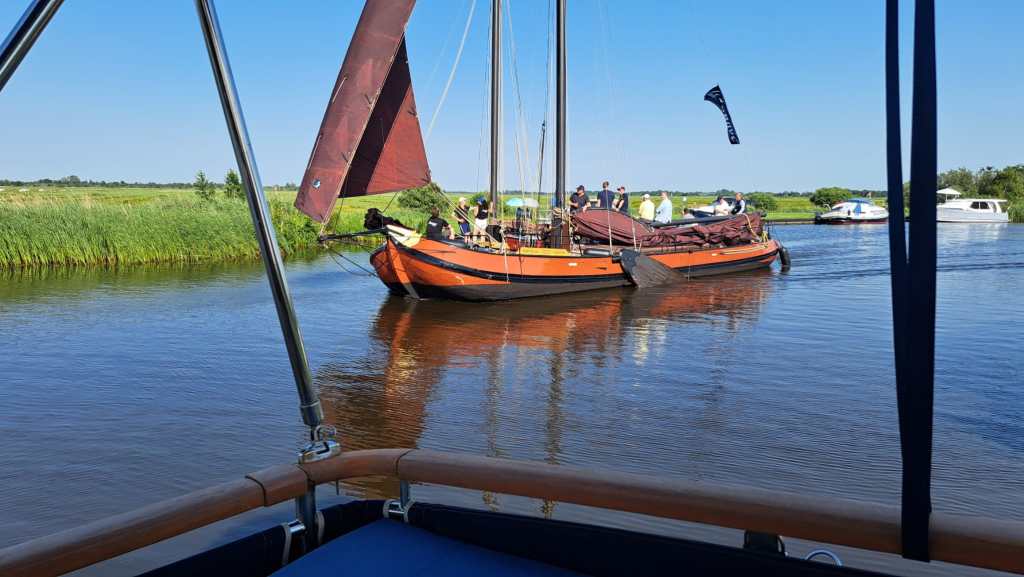
Boating is a major component significant part of Dutch culture, as much as are bicycles. There are hundreds of thousands of pleasure craft who share the main waterways with 100 meter barges and service ships. But the small canals which crisscross the country belong to the small. Mostly.
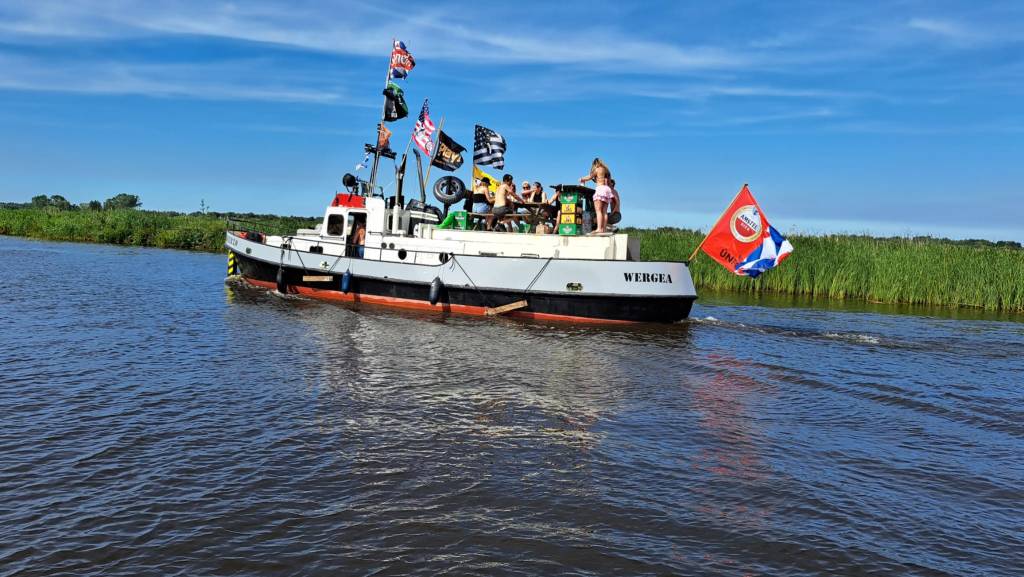
The Province of Friesland is one of the most popular destinations, with thousands of free moorings and many historic small towns. We moored near Grou with some Dutch friends whom we have known for many years. We were endlessly entertained by a wide variety of boats. Some were filled with just young men out with perhaps a dozen friends for a beer or three, cheering as they passed.
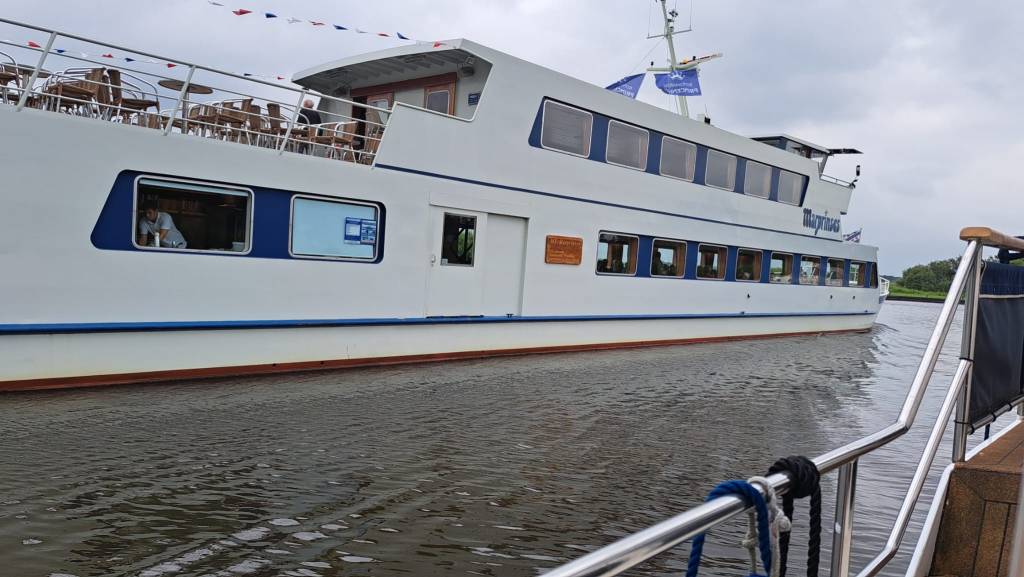
The canal we were on is just 50 meters wide. The large ships loomed over us, its bow wave pressing us into the docks.
A Mississippi style paddle wheel day cruiser
Wedding part waves as they pass
There were stag and wedding parties, day and dinner cruises. The Dutch love their watery land.
Appingedam and Delfzijl are located in the less visited far northeast of the Netherlands. Delfzijl sits on the shore of the bay into which the Eems River empties, connecting it to the North Sea. Appingedam is a few kilometers inland. Both are served by the Eemscanal, a large barge capable canal.
Appingedam picturesque municipal harbor is in the center, reached through a small lock and then by a tiny canal. The harbormaster came to open the bridge and with very basic English guided us to a back in box. Our bow thruster having failed in high winds just as we arrived at the lock, getting into a narrow box just a half meter wider that our boat can be a bit of a challenge. We managed to get him to allow us to stay where it is easier to dock.
Appingedam has been inhabited since prehistoric times, coming into history in the 13th century. It was located on the Delf River, now called the Damsterdiep. The name ‘Appingedam’ refers to the dam built on the Appe (aka Apt) In 1327. It was then a seaport with good access via the river, becoming a trade hub for destinations in Germany and the Baltic. It was then part of Frisia (Friesland), a region of Frisia called Fivelingo. Nowadays it sits between two canals, completely surrounded by water.
Its famous hnging kitchens
In 1536 Appingendam and Gronigen went to war over trade. Appingendam was destroyed, losing it’s position as a trade hub. It was not dead altogether, however. It regained enough economic health that there were funds to build the City Hall in the 1630’s. By the late 1800’s cattle, flour, oil and five breweries provided employment and growth.
Delfzijl is now the more important of the two towns, being the fifth largest port in the Netherlands. “Delftzijl” refers to a fortified lock on the old Delf canal that connected the rivers Fifel and the Eems. It has been a major port since the Middle Ages. There were six bastions, built in 1591. The town has been the focus of several battles involving the Spanish and French, and in WW2, the Nazis. Today, despite being a fairly important port, the town shows signs of economic stress, with a noticeable number of empty commercial spaces awaiting tenants.
The bastions of 1591
We had lunch at Cafeteria Rex. It was doing good business as we waited. It’s set up as a lunchroom with the grill behind the bar so you can watch them work. The lekkerbek (deep fried cod) was much less expensive than in Gronigen, at €7 versus €10, and bitterballen likewise, and just as good. Bitterballen are a breaded and then deep fried snack made with a stew thickened with roux. In this beef stew they add onions, salt, pepper, parsley and nutmeg.
The town is protected by a 9 meter/ 30′ dike, sluices and a pumping station. At low tide the sluices open to drain the land. The pumps are used if the low tide is too high to allow for gravity drainage.
The Uitwierde Church has a free standing tower circa 1200. The church sits on an artificial mound dating from well before the construction of dikes. There’s an old windmill, Mill Adam. The Adam is a corn mill. Originally, the Adam was was paired with the Mill Eva. Adam Mill is now an art exposition space. No one knows if Adam Mill misses Eva Mill. https://www.visitgroningen.nl/en/locations/eemsdelta/blissfully-happy-in-delfzijl/culture-in-delfzijl
Two Houses on a Canal, watercolor, r, 21 x 29 cm/8.3 x 11.8″
How it might look on your wall
We came upon this scene not far from Kalenberg, Netherlands. Kalenberg is in Friesland, which has some of the most picturesque scenes in the country. I have abstracted some of the foliage, sky and water.
Cookie Consent
We use cookies to improve your experience on our site. By using our site, you consent to cookies.
Contains information related to marketing campaigns of the user. These are shared with Google AdWords / Google Ads when the Google Ads and Google Analytics accounts are linked together.
90 days
__utma
ID used to identify users and sessions
2 years after last activity
__utmt
Used to monitor number of Google Analytics server requests
10 minutes
__utmb
Used to distinguish new sessions and visits. This cookie is set when the GA.js javascript library is loaded and there is no existing __utmb cookie. The cookie is updated every time data is sent to the Google Analytics server.
30 minutes after last activity
__utmc
Used only with old Urchin versions of Google Analytics and not with GA.js. Was used to distinguish between new sessions and visits at the end of a session.
End of session (browser)
__utmz
Contains information about the traffic source or campaign that directed user to the website. The cookie is set when the GA.js javascript is loaded and updated when data is sent to the Google Anaytics server
6 months after last activity
__utmv
Contains custom information set by the web developer via the _setCustomVar method in Google Analytics. This cookie is updated every time new data is sent to the Google Analytics server.
2 years after last activity
__utmx
Used to determine whether a user is included in an A / B or Multivariate test.
18 months
_ga
ID used to identify users
2 years
_gali
Used by Google Analytics to determine which links on a page are being clicked
30 seconds
_ga_
ID used to identify users
2 years
_gid
ID used to identify users for 24 hours after last activity
24 hours
_gat
Used to monitor number of Google Analytics server requests when using Google Tag Manager
1 minute
Marketing cookies are used to follow visitors to websites. The intention is to show ads that are relevant and engaging to the individual user.
A video-sharing platform for users to upload, view, and share videos across various genres and topics.
Registers a unique ID on mobile devices to enable tracking based on geographical GPS location.
1 day
VISITOR_INFO1_LIVE
Tries to estimate the users' bandwidth on pages with integrated YouTube videos. Also used for marketing
179 days
PREF
This cookie stores your preferences and other information, in particular preferred language, how many search results you wish to be shown on your page, and whether or not you wish to have Google’s SafeSearch filter turned on.
10 years from set/ update
YSC
Registers a unique ID to keep statistics of what videos from YouTube the user has seen.
Session
DEVICE_INFO
Used to detect if the visitor has accepted the marketing category in the cookie banner. This cookie is necessary for GDPR-compliance of the website.
179 days
LOGIN_INFO
This cookie is used to play YouTube videos embedded on the website.