Blog

  • Barberini Palace, Caravaggio, Raphaello, chiaroscuro cieling

    October 21, 2015

    The Barberini Palace, just up the hill from Bernini’s Tritone Fountain, is an immense mansion and the home of the Galeria Nazionale d’Arte Antica, art from about the 15th c -17th century.  Here is Caravaggio’s Narisco- Narcissus. Get a load of the reflection!

    Narciso by Carravagio
    Narciso by Carravagio

    In the galleries I try to find something I can draw. I try to find something that is interesting and doable in 5-10 minutes and where there is a seat, good lighting, things like that. Sketch of Gerrit van Bronckhorst’s Betsaben al Bagno. I’d never heard of this painter. Seems to have been influenced by Caravaggio, given how he treats the light here.

    Gerrit van Bronckhorst Betsaben al Bagno in Galeria Nazionale d'Arte Antica Rome
    Gerrit van Bronckhorst Betsaben al Bagno in Galeria Nazionale d’Arte Antica Rome
    Sketch of van Bronckhorst Betsaben al Bagno
    Sketch of van Bronckhorst Betsaben al Bagno

    Back to Caravaggio, here’s another masterpiece hanging in room 20 (in my best Spanish accent, I asked where this room was in Italian and got a reply in Spanish!).  It’s so gruesome I nearly walked out of the room!


    Caravaggio's Judith and Holofernes
    Caravaggio’s Judith and Holofernes

    Salvator Rosa’s “La Poesia” and “La Musica” (17th century) are superb.

    Salvator Rosa - La Poesia3 Salvator Rosa - La Musica


    And a rarity for the time, a woman painter, and quite a good one!  Portrait of a Young Woman Dressed as a Bacchante

    'Portrait of a Young Woman dressed as a Bacchante, by Angelica Kauffmann, Palazzo Barberini, Rome, Italy.
    ‘Portrait of a Young Woman Dressed as a Bacchante, Angelica Kauffmann,


    Here’s yet another prize- what the Galleria notes as the first female nude:

    Pierre Subleyras
    Pierre Subleyras


    Jacopo Zucchi “Ritratto di Ciela Farnese”

    Jacopo Zucchi 'Ritratto di Ciela Farnese
    Jacopo Zucchi ‘Ritratto di Ciela Farnese


    As for the building, it is a divine palace built by the Barberini family, whose symbol, three bees, appears throughout.  It is in wonderful shape.  The most magnificent room is on the second floor, immense and nearly empty except for several small sofas in the middle.  People lay on them and look at the ceiling, some 20 meters/60 feet above.  Here’s why:

    Pietro da Cortona Triumph of Divine Providence.
    Pietro da Cortona Triumph of Divine Providence.


    You have to go there to appreciate all of these, especially this ceiling though.

    All this for 7 euros.
  • Hagia Sophia (circa 550), one of the world’s greatest buildings

    September 20 2015  Istanbul

    Hagia Sophia miniature (4" x 6") acrylics on postcard stock
    Hagia Sophia miniature (4″ x 6″) acrylics on postcard stock


    The Hagia (Holy) Sophia (Wisdom) is a stunning domed building built as a Greek Orthodox cathedral in 537 when Istanbul, then called Constantinople,  was the capital of the Eastern Roman Empire(also known as the Byzantine Empire).  Between 1204 and 1261 it was a Roman Catholic cathedral.   Following the conquering of the Empire by the Ottomans in 1453, the Hagia Sofia became a mosque.  In 1931 it was closed and then converted into a museum, which it is still.  The minarets and round domes give it an Islamic setting, and some of the interior maintains that influence as well.  Nonetheless it is an impressive structure, notably the dome, and for 1000 years it was the largest cathedral in the world, replaced in 1520 by the Cathedral in Seville.

    Here are some stock photos of the interior.  It is way too dark and large for me to get good photos.   These are mosaics!
    Mosaic from Hagia Sophia
    Mosaic from Hagia Sophia


    220px-Empress_Zoe_mosaic_Hagia_Sophia

    220px-Hagia_Sophia_Imperial_Gate_mosaic_2

    hagia sophia interior 1


    hagia sophia interior 2


  • Istanbul Modern is another pleasant surprise

    The Istanbul Modern is another pleasant surprise in a city full of them.  The artists on exhibit when I visited yesterday were mostly Turkish, some trained here and others in the US and I think one or two in Germany.  Most of the work is representational but very creative in a modernist sort of way, as you can from the photos I’ve placed below.

    The installations made sense-  how unusual- and were interesting as well- also unusual. One was a young man playing make-shift drums, another various people lip synching Cohen’s ‘Hallelujah.’   Behind thick sets of hanging strands of fabric hangs a geographical globe with stars and planets on the walls, while in another section is a political globe.    In a third room a face of a woman is projected onto a mannequin.  She is singing.
    Not so pleasant is the getting there.  There are large signs and even an arrow pointing tot the enntrance.  The large signs do not point anywhere except for the one with the arrow, which points down a lonely, shabby alley.  I walked past it thinking this could not be.  But it was.
    The location challenge came after I ran across an angry confrontation a few hundred meters from the entrance.  There was angry shouting and a man banging hard on the hood of a van.  There was pushing and shoving.  The police arrived.  I heard four bangs, someone with a notepad came running toward me.  I then turned around and scooted back a hundred meters, and crossed the street.  A security guard told me it was not gun shots, just more banging on the van I suppose, so I went on.  Traffic had piled up between me and the scene so I felt reasonably safe.
    Here are some of the pieces I found interesting.  The first is fabric sewed onto canvas, probably my favorite, which given I am not a fabric art fan in general, is a strong endorsement:
    Istanbul Modern fabric
    Istanbul Modern fabric
    Istanbul Modern
    Istanbul Modern

    IMG_9333IMG_9334

    Istanbul Modern
    Istanbul Modern
    Istanbul Modern
    Istanbul Modern


  • Miniatures and sketches from Istanbul

    Istanbul has had its moments of beauty and grandeur.  You can relive a bit of it’s heyday in the Hagia Sophia, the Archaeology Musem and the Topkapi Palace.


    Topkopi Palace (mini, acrylics)
    Topkopi Palace (mini, acrylics)

    [wpecpp name=”Topkapi Palace” price=”50″ align=right]

    The Topkapi Palace, home of the Sultans, his harem and the eunichs since circa 1450:

    Topkapi Palace Entrance   (mini, acrylics)
    Topkapi Palace Entrance (mini, acrylics)
    Topkapi Palace Courtyard (mini, acrylics)
    Topkapi Palace Courtyard (mini, acrylics)


    While we waited to get into one of the rooms at the Palace (we thought it was the main entrance, but we’d already passed it.  It was just one of the rooms!) I sketched a section of the lovely old wall.


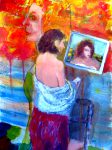
    Turkish woman in bus:


  • Ferry up the Bosphorous

    September 18, 2015

    We took the ferry north on the Bosphorous today.  The busy waterway connecting the Mediteranean with the Black Sea is lined with many palaces and houses.  The constant breeze you get on shore is amplified as we head into it, keeping the boat cool in the warm sun.
    ferry u3 ferryup4 ferry up1 ferry up2

    Women waiting for bus
    Women waiting for bus
    Woman near us at restaurant
    Woman near us at restaurant
  • The Grand Bazaar, Istanbil

    September 22, 2015

    The Grand Bazaar,  also called  ‘Covered Bazaar’ in Turkish is one of the world’s largest and oldest covered markets in the world.  There are 61 covered streets and over 3,000 shops.  About 90 million enter the halls every year, the world’s most visited place  (http://www.travelandleisure.com/slideshows/worlds-most-visited-tourist-attractions/2)

    Peg and Susan at the Grand Baazar
    Peg and Susan at the Grand Baazar

    We came on a slow day, fortunately.  The place is overwhelming just in terms of the sheer number of shops.  Much of it you could buy anywhere, probably most of it.  I have no idea if the deals are good.  Just being there again was enough for me.

    Grand Baazar
    Grand Baazar
    Grand Baazar
    Grand Baazar
  • Galata Bridge, teeming with aromas, sounds and sights

    September 24, 2015

    At the Galata Bridge it’s always lively.  So many sights and aromas, thousands of people, ferries, trams, cars, scooters.  Western dress, some women wearing scarves with western dress, in tradition attire.  No hijabs today.  Small groups of teen boys, few of teen girls.

    Below, a small boat serves as a kitchen.  They make fish sandwhiches and pass them to the land.  The bones go in the water (not a good idea, as the decomposition removed the oxygen from the water)

    Galata Bridge in Istanbul
    Galata Bridge in Istanbul

    This is a great place to people watch.

  • Religion in Turkey

    Walking around Istanbul I began to get the impressions that there was not a high degree of religiosity. There are some women in ha-jib, but a small percentage; otherwise it’s just head scarves if not just plain western dress.  Despite the dominance of the skyline in some areas by minarets and the very loud andcalls to prayer five times a day from more than one mosque at the same time, I did not observe an influx of people heading to the mosques.

    I was surprised, given the success of the AKP, an Islamic party although officially secular as the law prohibits religious parties.  Even the AKP is pro-Western and pro-American.  However they support the Muslim Brotherhood and have been behind efforts to allow women to wear scarves in the public schools- prohibited since the time of Ataturk.

    Gallup’s 2012 survey supports my impression: 23% of Turks are religious, 73% are irreligious and 2% are Atheists (not sure what happened to the other 2%).  By ‘irreligious’ I mean that religion is not important to these people but they are not (at least openly) convinced atheists.   I think Gallup and others mean by ‘atheist’ that you are certain there are no deities.   Atheists do not all assert this, but rather that say that the evidence for deities is absent and that condition is unlikely to ever change.

    The 75%/23% is a far greater spread than one might expect given that some 95% of the population is officially Muslim.  I learned that they are registered as Muslim at birth, and must be so registered, unless their parents can show they have another religion.  This is an intrusion into one’s personal affairs we do not tolerate in the rest of the western world (although there are intrusions, they are of a different sort).

    I do not have a sense of where Turkey is headed.  The continued success of the AKP is worrisome-  they have been in power since the early part of this century.