Author: Gary Kirkpatrick

  • The Green Church

    After several days visiting friends we set off again, despite the weather having turned to gray skies and 30 kph winds. One lock and a bit of cruising brought us to the moorings at the Green Church.

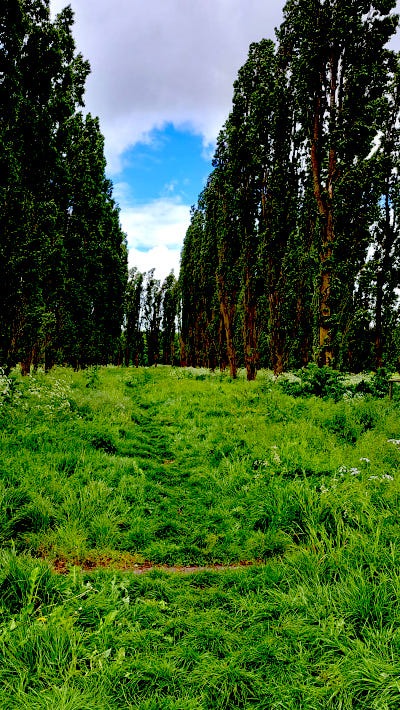
    Set in Flevoland, one of the Netherland’s recovered land provinces, the Green Church is formed by Italian poplar trees forming the outline Notre Dame of Reims. There is no altar or anything else having to do with a church. An artist named Marinus Boezum (1938) came up with the idea in 1978, calling it a “Gothic Growing Project.” With the support of the engineers of the Rijksdienst Ijseelmeerpolders, he planted the 178 poplars you see today. The Green Church is deemed to be Gothic in style, but only as that is style of the church in Reims.

    The Green Cathedral

    There are concrete “ribs” connecting the trees, referencing the ceiling vaults. There are circles of sea shells around the trees, reminding of the sea under which this land stood just 50 years ago.

    There were a number of large scale art projects in Flevoland, of which this is one. They are termed “Land Art,” a concept imported from the United States. The same artist created an identical “cathedral” on the neighboring plot, using oak and beech hedges.

    Flevoland is the largest reclaimed land section in the world. It sits some 6 meters below sea level. Cornelius Levy was the chief engineer of the project which removed the Zuiderzee. The section in which the Cathedral is located was built between 1959 and 1968. Shipwrecks unearthed date to the 16th century. They have been left in place, their locations marked by blue and white striped polls.

    Boezum went to art school in Utrecht. He worked as an artist in the 1950s. In the 1960s his work became more three dimensional, including sculptures and works in public spaces. He was influenced by the 1960 movements Nouveau Réalisme in Europe and Pop Art in America, and is one of the first Dutch conceptual artists.

    He has done many installations and video projects. Other than the Green Cathedral, which I find mildly interesting especially in its current unkempt state, I have no experience with his work, and do not know if it would make me yawn, as so many installation and video projects do.

  • Scooting across the Netherlands

    In Haren we were forced to wait for the weekend to pass before we were allowed to proceed in the small canal linking the Netherlands and Germany. The canal is tree lined, passing through farms and scattered settlements. A small sign marks the border between the two countries.

    Across the border lies Nieuw Amsterdam with free moorings. You just pay for electricity and water if you choose to connect, paying via an app. Gone are the days when you stuck a.50c piece to acquire these services. Automation has taken the jobs of those who collected the coins and responded to complaints. Many of these small towns employed harbor masters who collected the nightly fee, now considered uneconomical. In some harbors the app charges you for mooring if you use electricity.

    Genemuiden
    Waiting for the lock at Ketelhaven
    Genemuiden
    Strange drainage tubes in the Zwarte Water

    The deep lock at Ketelhaven

    We turned south after a rest day, during which we met up with some folks we met during their visit to Valencia. It turned out they were heading to the same marina in Potsdam where we’d moored our boat for last winter’s sub-zero winter. Boaters look out for one another so we were happy to help them with the information we’d collected.

    In mixed skies we proceeded towards Almere where we’d scheduled some minor repairs to our rain hood. The first long day ended just outside Genemuiden in a tiny harbor, with room with just two boats at most with an entry just barely wide enough. We left at 0700 the next day under sunny skies. The winds tend to increase as the day goes on, thus our early departure, and there is some open water ahead. When the wind crosses the water from the east you would get some broadside waves, making for some discomfort.

    We passed just a few pleasure boats and barges before we turned southwest towards the lock at Ketelhaven. At the two locks there you drop about 8 meters into the reclaimed land province called Flevoland. These locks and pumps keep Flevoland from flooding.

    There are no further locks until you come to the Ijseelmeer in Almere. We are not going that far, stopping in Almere Buiten. Here we have friends dating from 2000 when we were aboard Caprice, our first Dutch boat.

    From here on we can slow down, slowing down from the very slow to the super slow. We are free to roam the country, where the boating infrastructure is the best.

  • The lock at Haren (watercolors)

    Lock at Haren, watercolors, 21 x 30 cm/8.3 x 11.7″

  • Scooting across northern Germany

    Scooting across northern Germany

    From Berlin to the Dutch border via the waterways is about 500 kilometers/300 miles. When we traveled 8 hours per day we went a whopping 100 kilometers, bicycle riders everywhere passing us with ease. It’s a relaxing journey, passing through picturesque forests, farmland, villages and small towns. There are industrial zones too, quite a few, which may not be pretty but interesting as you observe the dock workers loading and unloading the barges you share the canal with.

    There are many fuel tankers, recycling loads and some container barges on this route. They usually take the center of the canal when they are loaded in order to have enough depth. We have to thread the needle between the shore and a safe distance from the barge. Canals are cut steep at the sides so you can get quite close without grounding but still you have to monitor the depth gauge. The barge captains are pros and know these canals, so you have confidence that they are not going to take too much room or run you over.

    Along the way we passed through four four or five huge locks on the Mittleland Kaanal and another 11 or so on the Dortmund-Eems Kaanal. Except for the last two on the Dortmund-Eems Kaanal we checked in at the designated “sportboots” docks, those two lacking that facility. In a few cases they replied to a phone call or to VHF radio so we did not have to moor. About half of the lock keepers spoke English, with the others we got a reply but did not understand so we just waited for the light to turn green. Our waits for the lock gates to open were generally short, about 15 minutes or so.

    There are many recycling operations along the Mittleland Kaanal

    Having already visited the cities and towns along the way, with a side trip to Oldenburg prevented by a lock closure, we spent two nights at only one location, https://garyjkirkpatrick.com/magdeburg-germany-home-of-the-reformation-and-a-schnitzel/, until we came Heren neat the Dutch border.

    Hanover is a city worth visiting. We stopped here on our first trip on Viking to Berlin. For more about Hanover see https://garyjkirkpatrick.com/hannover/

    Moonlight Over Hanover, watercolors

    Minden is smaller than Hanover. There an aqueduct takes you over the Weser River. There’s a neat schnitzel restaurant on the river, Schiffmühlen (meaning mill) Gastronomie. The downtown’s medieval architecture is well preserved as Minden was not bombed in WW2. https://garyjkirkpatrick.com/minden/ Bad Essen is smaller still and also has well preserved half-timber buildings and some good eats. https://garyjkirkpatrick.com/day-1-on-the-mittelland-kanal/

    Crossing the Bridge in Bad Essen

    Passing through the last lock on the Dortmund-Eems canal we came to the small lock in Heren only to find it had been closed in April for works. It would open on May 3, May 1 being a holiday. We were stuck for three days. Fortunately it is a lovely spot. Heren has grocery stores and other shopping, an attractive modern Dutch look with newish brick buildings and a main street pedestrian zone. There’s a ship museum with several restored Dutch barges. The Dutch border is just a few kilometers away along a small tree lined canal.

    In Wolfsburg you can visit the Volkswagon factory. Advance ticket purchase is recommended.

    The lock in Heren
    Passing through Meppen, Germany
    There’s a ship museum in Heren.
  • There be monsters

    Cruising the Mittlelandkaanal from Berlin to the Netherlands means you share the waterways with many barges, some of them with monstrous dimensions. We locked through with one double (two barges tied together and propelled by one pusher) measuring over 200 meters.

    When you arrive at a German lock you moor at a location specified for ‘sportboots.’ There’s an intercom to check in with the lock keeper, some of whom speak English. You are letting them know you are there, and waiting for them to tell you to enter. Small boats almost always enter behind larger vessels. If so some reason the larger ship can not stop in time they damage the lock, not you.

    The locks on the canals connecting Berlin with the Rhine, and from that river to the Netherlands if you so choose, are huge, are over two hundred meters long and 7+ meters in depth. Most have floating bollards that you can easily loop your line and then sit back, although we keep a eye on things as the water rises or falls.

    In locks of this size there is little turbulence, but if a large ship hits the throttle too hard small boats are knocked about. To avoid problems we not only stay tied to the bollards but wait for the large ships to exit the lock before we proceed carefully, attentive to strong currents from the huge props.

    I was on the Mississippi River in New Orleans when we came upon an oil tanker. Large waves were coming from it. I assumed it was from the huge ship’s props, but then the smaller boat carrying the port captain, who takes over when the ship is close to docking, sped away. The waves stopped as he disappeared.

    On German canals and rivers there are designated moorings for overnight stays. Large ships usually have their own spaces and ‘sportboots’ their own as well. Outside Hanover we stayed in a mooring near grocery stores which allowed both large ships and small boats, so there are exceptions but they are marked.

    We have been fortunate weather wise thus far. The early mornings are below 5c/40f but it’s been warming to 15-18c/60-65f in the sunny afternoons.

  • Magdeburg, Germany, home of the Reformation. And a schnitzel.

    From Potsdam to Genthin

    With cold mornings and sunny afternoons in the forecast, we set off from our winter berth in Potsdam after making a few plumbing repairs due to the winter freeze- they skated on the lake for the first time in years. Heading towards the Netherlands, we chose the southern route that leads to the Mittlelandkaanal. After a night in Genthin we stopped at a free mooring in Burg. It’s less than 30 minutes by train to the ancient city of Magdeburg, with a current population of 242,000.

    Founded by Charlemagne in 805, Magdenburg Otto I made it his seat, ruling Saxony from 836-873. He was the Holy Roman Emperor from 962 until his death in 873. Otto I defeated the Magyars at the Battle of Lechfeld in 955, stopping the Hungarian invasion of Western Europe. He was buried in the Cathedral.

    Magdeburg’s Town Law, granting the right to hold trade exhibitions and conventions, spread through much of Europe in the early Middle Ages. As one of Germany’s largest and most prosperous cities, in good measure because it sits on the Elbe River, Magdeburg joined the Hanseatic League in the 13th century. By then it had 20,000 residents, considered large at the time.

    Martin Luther attended school here as a 12 year old. In 1524 Luther began the movement that led to the Protestant Reformation. Magdeburg was a major force in the effort to break from the corruption of the Church.

    Things did not always go smoothly for the city. In 1188 it was devastated by fire, it suffered 25,000 deaths during the 30 years war, and its old center was largely destroyed by Allied bombing in WW2. There was a POW camp and three subcamps of Buchenwald holding Jews. Dozens were murdered in an effort to cover up the crimes against humanity as the Allies advanced. More were led on death marches as the war ended. It was in East Germany during the Cold War, its development stunted by failed economic policies and a police state government.

    Magdeburg’s center after WW2
    Hundertwasser House in Magdeburg

    We visited the Kulturhistorische Museum Magdeburg (KHM). Most notable is the Magdeburger Reiter (Magdeburg Rider). It might represent Emperor Otto, Otto II or III.  The rider is accompanied by two female figures, usually interpreted as allegories of the Roman Empire and the Slavic peoples, but sometimes Empress Adelaide and Empress Theophanu.  The statue was brightly painted.

    Magdeburger Reiter (Magdeburg Rider
    The Elba in Magdeburg

    Schnitzel and beer, oh so German, in a super local joint!

    Two days before Magdeburg we moored for the night at a marina called Havel Marin just outside Brandenburg. We found just one restaurant within walking or biking distance. It sits on a private road, a bit off putting as you wonder if you are trespassing. We followed the one turn off leading to a small house. Was this it? There is no sign outside. We might have left if there had not been a group of people sitting under an awning drinking beer.

    We ventured inside and only then were we sure we had found the place. There is a sizeable, well stocked bar and tables. The only employee and likely the owner reminds of Ichabod Crane, very tall and slender. We could not tell at first who he was, an employee or just another guest as he was not in any sort of uniform. He speaks no English, but somehow we figured out he works there. So what about a menu so we can see what’s on offer and point to things? Nope, there is no menu. Our online source had mentioned schnitzels so we used that word and he nodded. Then he said something that sounded like the Dutch for egg. It turns out the plate includes a small schnitzel, a few cherry tomatoes, slices of sweet pickles and a fried egg on top of the breaded pork. Fortunately I got him to hold the egg. It was a so so dinner but at €17 for two including two .5 liter beers it was a very reasonable bargain.

    Schniitzel and beer, oh so German!

    More to come on our journey west.

    For my article on Brandenburg see https://garyjkirkpatrick.com/brandenburg/

    Brandenburg Steeple
    Brandernburg, Germany
  • Viking (ink drawing)

    Viking at Geldese Hout Bridge, NL

    Drawing of our 12 meter boat

  • Paintings and drawings from recent voyages

    We are about to being our last season aboard Viking. Here are paintings and drawings from recent voyages plus some from Italy

    Music by Bobby Darin

  • Not Just Another Pretty Face II/ Más Que Otra Cara Bonita II (painting)

    Not Just Another Pretty Face II/ Más Que Otra Cara Bonita II, acrylics on Canson paper, 100 x 70cm, /39 x 27″

    For sale at https://www.saatchiart.com/art/Painting-Not-Just-Another-Pretty-Face-Mas-Que-Otra-Cara-Bonita-II/664581/13733277/view

    This is a second version of this piece. The first belongs to Dones de Picanya.

    From Saatach’s description

    I have done many paintings and drawings inspired by musical performances. This second original acrylic painting on paper, “Not Just Another Pretty Face/ Mas Que Otra Cara Bonita”, is the latest in a series of music related work. The piano player takes center stage, rendered with both abstract and expressionist elements. The large painting is a study in contrasts: light and dark, color and tone, and a blend of artistic styles.

    There’s a dynamic interplay between the abstract, realistic and expressionist. The figurative elements of the piano player are grounded in reality, while the surrounding abstract textures evoke the passionate atmosphere of a live musical performance.

    This piece makes a dramatic statement, vibrant energy and thought-provoking composition.