Topkopi Palace, miniature (4″ x 6″) acrylics on postcard stock
October 1, 2015
Our two weeks in Turkey was filled with surprises. I wasn’t so surprised by the Hagia Sophia, built around 550 on same site as two previous churches- my rendition below (on postcard stock). But I was by how un-religious the people are. There are five calls to prayer per day- and they are loud and difficult to ignore. But there’s hardly a rush to the Mosque. I did a bit of research on the topic (blog entry ‘Religion in Turkey).
Another surprise was the cuisine. It is very complex, sophisticated and exquisite. The pastries! I was stunned. Now the coffee, you can have it. Stick to the tea.
The other pleasant surprise – Istanbul Modern. I’ve posted here some photos. Their modern art collection is excellent, not so far out it makes no sense, but experimental enough to hold your attention.
The other pleasant surprise – Istanbul Modern. I’ve posted some photos in another entry. Their modern art collection is excellent, not so far out it makes no sense, but experimental enough to hold your attention.
On the less surprising but very pleasant side of things, The Bosphorus, the strait that divides Turkey between the “European” side and the “Asian” side, is always busy with ferries and ships, making a lovely backdrop for countless numbers, for the city is built on hills.
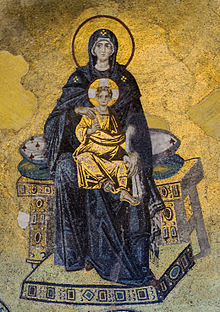
The main sites include the Blue Mosque and the Hagia Sophia. The former is not all that impressive, other than its size and airy feeling, unless you are a fan of their mosaics. They can be beautiful but they seemed overwhelmed by the size of the place. The Hagia is much more interesting not only for the structure but also the lovely (and sufficiently large) mosaics. You’d be surprised by its age and beauty, but I’d been there before. Here’s my rendition:
Hagia Sophia
Being unrestricted by Islamic rules governing art, they can show the human figure. It’s well worn themes, but some are beautifully executed. I was not so surprised as a bit more appreciative than the last time, not that I fell asleep in here then.
Mosaic from Hagia Sophia
I visited the Archaeological Museum, near the Topkapi Palace (it too, but it was so crowded we left before seeing very much of it, although the view alone is almost worth it). I had no idea that there would be some excellent Roman era sculptures, notably Alexander the Great and Sappho. I felt honored to be able to stand and sketch them in my little notebook.
There is an excellent overview of the history of the city, to the dawn of its history, its establishment as the capitol of the Eastern (Byzantine) Empire by Constantine, its sacking by the Crusaders (they thought it was a Muslim city, but it was Christian at that time), and its conquest by the Ottoman Turks. The explanations are in excellent English, here and in fact everywhere we went in Istanbul (a very pleasant surprise). This museum is worth another visit as I did not finish this section and there are two more buildings.
With more time I would try to visit more of the palaces and archaeological sites I learned about at the museum. The palaces you can see along the Bosphorus are both immense and stunningly beautiful (at least from outside).
The old wall is largely gone, but here’s a rendition of it.
Istanbul’s old walls
If you’ve never visited, I suggest you put this city, nay, country (i’ve been elsewhere and it’s fabulous in differing ways) on your list.
We visited the capitol of Estonia, Tallinn, for a week. We’ve become fans of this small city of a small country just 200 kilometers from the Russian border.
At Fat Margaret Square in Tallinn
[wpepsc name=”At Fat Margaret Square in Tallinn pen and ink A3 11.5 x 16.5″” price=”250″ align=”center”]
We flew from Istanbul to Rome. We’ve rented an apartment on Tiburtina. We are a few steps from a Sicilian bakery, several pizza al talgio (sold by weight) places, tavola calda- ‘hot tables’ meaning you order from the glass case and they weigh and bring it to you, a good and expensive way to eat out. There are restaurants, including a highly rated modestly priced one down the street, and there’s Picolo Molisi right next to it. P.M. is a well known fish restaurant we’ve been to several times. I never knew exactly where it was, having gone there by car only via lots of one way streets. It’s hard to find, too, because there is only a very tiny sign on the side street.
We’ve got a bar downstairs. It’s full of coffee clatchers and every other imaginable type of person. There’s a post office, three grocery stores within a five minute walk. Termini, the main train station, is just 10 minutes or so walking. We have two buses and down the street a bit is the tram that takes you to San Giovane and out to Pigneto.
October
Visit to the bar at Doria Pamphili, a drawing of a Cardinal, probably somebody in the Pamphili family.
We ate out for every meal other than some breakfasts while in Istanbul. We went to three high class restaurants, others that were very good even excellent but the cuisine was not so fancy and the surroundings often less so. I also had kebabs from fast food places. I think I got a good sample of what Turkish cuisine or at least the Istanbul version has to offer.
The cuisine of Istanbul is largely influenced by that of the Ottoman Empire, generally subtly spiced, with more rice than bulgar, although I experienced the opposite. You can get lots of veggie stews (türlü). There are many versions with eggplant. Also there are various meat dishes featuring eggplant, which obviously the Turks really love so right there they had me. I had an eggplant stuffed with meat and others with bits of meat in a stew.
Savoy is a fancy place up the hill from us – very up the hill. Like many places, it was as much outdoor seating as indoor, the walls removed to allow unfettered access to the cool night air. They offered sea bass and a variety of other fish, all excellently prepared. One of us had a sea bass. They had a special on blue fish, which I ordered. It came as several smaller fishes, grilled, with a nice smoky flavor.
In a place owned by a Kurdish family and many of them work there, including the parents, most of the nine brothers, but not the two teen girls. It is not far from Hagia Sophia on a restaurant row. I ordered a meat stew. It came out atop a charcoal burning container. It was boiling when they sat it down. They had to remove the charcoal under the dish so I could approach things without getting burned. It was totally fabulous. I can not begin to describe the subtle blend of flavors. It might have been a Kurdish dish. It looked something like this:
turkish meat dish
We had lunch with Debbie and Kelly, whom we met in Panama. We were all in the Peace Corps. I hope they will share their memories of this lunch.
Appetizers, called mezes when accompanying an alcoholic beverage, are the best part of any meal. On one of the three fance places we visited, up the hill towards a nice selection ran as $40 including wine at $7 a glass, by far the most expensive spot we chose on this trip. It is up the hill towards the Savoy and across the street from a small stand selling tacos. Tacos?
Mezes include hummus, baba ganoush, yogurt sauces, dolams and a few other common things you can get in many places in the US and Europe. Not so easy to find in the West: a tomato/cilantro combo that’s a bit spicy, white goat cheeses, various other eggplant dishes with or without tomatoes. The possibilities are extensive.
Wine is generally expensive in Turkey. The bottle at Savoy ran about $25. Beer was generally inexpensive.
Olive oil is most commonly used in cooking. There are a variety of olives available in the grocery stores.
Kepap /kepabs are everywhere. You can get them in pita bread or a baguette of some sort. They have chicken as well as ‘duram’ (wrap) kepaps. I did not have any that were worth writing home about. Unlike what I have had elsewhere, these were plain, lacking sauce, lettuce, or tomato. They were less than $2 (4 lire). Kebaps as in shish kebaps are another matter. Skewered meat, always succulent and super tender, they came with veggies and rice or bulgar. I never went wrong with one of those.
Our favorite place was just up the street steeply from us. It was run by a couple of guys and someone’s mom, who mostly just sat there sternly. We sat outside on a level spot they’d hacked out, inside a small wall separating us from the sidewalk. They have a wood burning oven. After you order they put in some bread. It’s huge, impressive both in appearance and texture.
Wine is generally expensive in Turkey. The bottle at Savoy ran about $25. Beer was generally inexpensive.
Olive oil is most commonly used in cooking. There are a variety of olives available in the grocery stores.
Kepap /kepabs are everywhere. You can get them in pita bread or a baguette of some sort. They have chicken as well as ‘duram’ (wrap) kepaps. I did not have any that were worth writing home about. Unlike what I have had elsewhere, these were plain, lacking sauce, lettuce, or tomato. They were less than $2 (4 lire). Kebaps as in shish kebaps are another matter. Skewered meat, always succulent and super tender, they came with veggies and rice or bulgar. I never went wrong with one of those.
Our favorite place was just up the street steeply from us. It was run by a couple of guys and someone’s mom, who mostly just sat there sternly. We sat outside on a level spot they’d hacked out, inside a small wall separating us from the sidewalk.
They have a wood burning oven. After you order they put in some bread. It’s huge, impressive both in appearance and texture.
Turkish puffed up bread
They serve up a pide that is out of this world! Reminds me of a pizza, but never a tomato sauce on one of these. They come with cheese or meat, usually with veggies on top too.
Pides
Turkish pizza is a rather limited affair but certainly you can’t go wrong. It’s a light and inexpensive meal.
Turkish pizza (lamacun)
We went down the hill for breakfast several times. There’s a small place that sits below ground level, as did the one up the street; I wonder how they keep the water out when it rains. Three steps down and you’re in this modest restaurant run by two women.
A Turkish breakfast consists of white cheese (probably goat), olives, bread, hard boiled egg, tomato, cucumber, and bread. Tea is typical and probably included in the modest price. I always got the coffee, not being a tea fan. It was the only thing I tried that I did not like very much. I am not talking just about Turkish coffee (here’s a photo I took in the restaurant):
My emply cup of Turkish coffee
They certainly do not skimp on the coffee grounds- that’s a toothpick you see standing up! As you see here they brew it in the cup. The ground sink to the bottom so you never get any in your mouth as long as you are reasonably careful. You can add sugar or mils and stir. The grounds are gone in a few seconds.
Turkish breakfast
You can order scrambled eggs and omelettes. Breakfast here did not cost more than $3 or so, and always very good. Here’s another item you can order for breakfast. My pals really liked it at this place:
Menemen, an egg dish
I’d go back to Istanbul just for the food. And I’ve not gotten to the desserts! That’s next.
Istanbul Modern art — the official title excludes ‘art.’ I went there today. It’s a 20 minute walk from our place. On the way I came across some sort of angry crowd scene. The cops had just arrived when I heard what sounded like 4 gunshots. I retreated and crossed the street. A security guard told me it was not gunshots so I went on. The museum is a bit hard to find. There are big signs on the street but only one with an arrow and it pointed down a lonely decrepit alley. I walked past, looking for a more official looking entrance but there weren’t any. I went down the alley and found the Museum.
I am glad I did. It is small but had an excellent exhibit, mostly of Turkish painters, some of them trained in Turkey, others in the US and Germany, Here are some photos of my favorites:
The Hagia (Holy) Sophia (Wisdom) is a stunning domed building built as a Greek Orthodox cathedral in 537 when Istanbul, then called Constantinople, was the capital of the Eastern Roman Empire(also known as the Byzantine Empire). Between 1204 and 1261 it was a Roman Catholic cathedral. Following the conquering of the Empire by the Ottomans in 1453, the Hagia Sofia became a mosque. In 1931 it was closed and then converted into a museum, which it is still. The minarets and round domes give it an Islamic setting, and some of the interior maintains that influence as well. Nonetheless it is an impressive structure, notably the dome, and for 1000 years it was the largest cathedral in the world, replaced in 1520 by the Cathedral in Seville.
Here are some stock photos of the interior. It is way too dark and large for me to get good photos.
This small village is thick with canals, 180 foot bridges and brick houses with thatched roofs, making for picturesque scenes at every turn. It was founded by Franciscians circa 1200. Now 2600 people live there. We took a boat through the canals. Here are my favorite spots. All are miniatures, approximately 4″ x 6″. The watercolors are on post card stock.
Giethoorn Two Houses – watercolor on post card stock A6 approx 2″ x 4″
[wpecpp name=”Giethoorn Two Houses” price=”50″ align=”center”]
]
Giethoorn, 3 bridges post card A6 approx 2″ x 4″
[wpecpp name=”Giethoorn, 3 bridges post card A6″ price=”50″ align=”center”]
Giethoorn, Boat Nears Bridge, watercolor A6 approx 2″ x 4″
[wpecpp name=”Giethoorn, 3 bridges post card A6″ price=”50″ align=”center”]
Our place is just 100 meters from the Bosphorus, the straight that separates Europe and Asia in Istanbul. It’s a steep street, as so many are as the city is built on many hills. Near the top of the street it gets even steeper, reminding of the streets of S.F.
There are cats everywhere; I gather they do not have a neutering program. One kitten came onto the ledge of the open widow at the restaurant where we had a Turkish breakfast – cheese, bread, olives, coffee brewed in the cup (about $8 for the two of us). This one helped me eat the pink baloney looking slice they’d put on my plate. The friendly restaurant owner and then the cook chased it away several times, to no avail, apologizing to us for its presence. They did not seem to know we liked having it there. On the last effort I am sure they saw the pink stuff I’d just given it.
This is a place of delights and annoyances. From the restaurant we went to after breakfast – Peggy did not like the Turkish coffee- you can see the dome of the Hagia Sofia, shining still after 1800 years or so of gracing the plant, and the spires of the Blue Mosque. Somewhere over there too is the museum that houses Mohammed’s beard. Or so they say. The bay bristtles with ferry traffic, making for lively viewing as you sip the cappuccino they serve from the pushbuttom machine, which apparently thinks too much milk is a good thing.
The Bosphorous, Istanbul
On the other hand prices are not always posted in the small shops. For some reason they see ‘toruist who does not know what things cost’ branded on our foreheads. Last night the shop keeper tried to charge us 6 TL ($2) for a small container of yogurt (we went elsewhere and got a bigger one for less than 1/2 that) and the taxi who took us the last 5 minutes of our near midnight journey charged us 20TL ($6.50). He said it was a metered ride. His meter was well hidden. Our landlady told us 10TL was plenty and to argue prices. I’ve not gotten to the argue stage yet.
This was our last day in Tallin. Tomorrow at noonish we return to Helsinki and fly to Istanbul on Monday. It was an excellent day, with a visit to the Estonian Museum of Applied Arts and Design. There we concentrated on the “New Nordic Fashion Illustration 2” exhibit. I think you will agree that the works are fabulous!
Illustration is an orphan art genre. It’s uses are primarily in advertising or as aids of other sorts, such as in books and magazines to support the story line. Its pinnacle is reached in fashion illustration. This use goes back to around 1750, per the exhibit we saw in Amsterdam at Rijks Museum. But since the advent of fashion photography “…the focus has shifted from conveying garments to independent self-expression, creating a new visual and captivating context and fascinating the viewer with idiosyncratic worlds, which in their uniqueness have found broad application in the fashion industry, magazines, the interior design of fashion outlets, and in the marketing strategies of the most diverse brands in the field of fashion and pop culture.” http://www.etdm.ee/en/news?news_id=360
I struggle to see why we can not call this ‘art’ other than it’s end use, reflected in the lack of signatures on most of the pieces. The artist hopes not to so much to make a statement as to sell the piece to a commercial entity. Otherwise, it’s art.
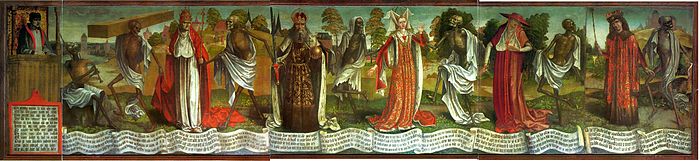
Another interesting day in Tallinn, the capitol of Estonia. I visited the St. Nicholas’ Church, Niguliste kirik. It is famous for the Danse Macabre fragment, as seen below, which is about 1/3 of the original 30 meter (100′) work. It owes its theme to the Black Death that afflicted much of Europe. Unfortunately it is not easy to see, as it is protected by highly reflected glass or plastic.
Bernt Notke: Danse Macabre (end of 15th c)
Here’s the altar screen, also a fine piece:
Niguliste (St Nicolas) Church. Altar screen
Afterwards we visited the Occupations (Nazi and Soviet) Museums. There’s an excellent exhibit about the Nazi and Soviet Occupations, very well translated (as is the norm here) into English. The USSR got there first, pursuant to its pact with the Nazis dividing eastern Europe. Then came the Nazis, driving the Russians well back across the border, from Tallinn, the capital, just 210 kilometers away. Like the Finns the Estonians welcomed the Nazis at first, but many changed their minds. Others enlisted in the German armed services, on the side opposite to those who joined USSR forces. The Nazis murdered tens of thousands (not many were Jews from here), setting up 10 extermination camps. While at first some thought the Nazis would bring freedom, they were soon revealed to be another occupying power, exploiting Estonia for all they could in the interest of its war ambitions. Some Estonians fought the Russians on the latter’s way out, inflicting significant damages. The Nazis disarmed them once the Russians were gone. The Germans instituted the draft in 1942, eliminating most of the remaining support they had from the populace.
Lunch was at the Boheme Cafe near our house. There were some interesting pastas on the menu but we stuck with more local fare. I had buckwheat with salmon and shrimp in a tomato basil sauce. I am not sure how local the sauce was. In any case the sauce over-powered the seafood and the buckwheat, which was in grain form. Peg got mushroom pancakes, not at all objectionable but not very interesting either. What was more interesting was the conversation with the waitresses and the tall slender blond sitting nearby. They tolds us English instruction starts in first grade if not sooner. All movies and tv shows are in English if they originate that way, and there are no subtitles. The system works, and it is the same in Holland, Finland, and I bet the rest of these northern countries. Think Abba. They were Swiss.
I’d picked up a local art scene paper. The young blond noted I was taking photos of some of the fashion shots and told us about the exhibit. We’ll go tomorrow.
This was among the friendlier moments we’ve had here. They do not smile much.
Cookie Consent
We use cookies to improve your experience on our site. By using our site, you consent to cookies.
Contains information related to marketing campaigns of the user. These are shared with Google AdWords / Google Ads when the Google Ads and Google Analytics accounts are linked together.
90 days
__utma
ID used to identify users and sessions
2 years after last activity
__utmt
Used to monitor number of Google Analytics server requests
10 minutes
__utmb
Used to distinguish new sessions and visits. This cookie is set when the GA.js javascript library is loaded and there is no existing __utmb cookie. The cookie is updated every time data is sent to the Google Analytics server.
30 minutes after last activity
__utmc
Used only with old Urchin versions of Google Analytics and not with GA.js. Was used to distinguish between new sessions and visits at the end of a session.
End of session (browser)
__utmz
Contains information about the traffic source or campaign that directed user to the website. The cookie is set when the GA.js javascript is loaded and updated when data is sent to the Google Anaytics server
6 months after last activity
__utmv
Contains custom information set by the web developer via the _setCustomVar method in Google Analytics. This cookie is updated every time new data is sent to the Google Analytics server.
2 years after last activity
__utmx
Used to determine whether a user is included in an A / B or Multivariate test.
18 months
_ga
ID used to identify users
2 years
_gali
Used by Google Analytics to determine which links on a page are being clicked
30 seconds
_ga_
ID used to identify users
2 years
_gid
ID used to identify users for 24 hours after last activity
24 hours
_gat
Used to monitor number of Google Analytics server requests when using Google Tag Manager
1 minute
Marketing cookies are used to follow visitors to websites. The intention is to show ads that are relevant and engaging to the individual user.
A video-sharing platform for users to upload, view, and share videos across various genres and topics.
Registers a unique ID on mobile devices to enable tracking based on geographical GPS location.
1 day
VISITOR_INFO1_LIVE
Tries to estimate the users' bandwidth on pages with integrated YouTube videos. Also used for marketing
179 days
PREF
This cookie stores your preferences and other information, in particular preferred language, how many search results you wish to be shown on your page, and whether or not you wish to have Google’s SafeSearch filter turned on.
10 years from set/ update
YSC
Registers a unique ID to keep statistics of what videos from YouTube the user has seen.
Session
DEVICE_INFO
Used to detect if the visitor has accepted the marketing category in the cookie banner. This cookie is necessary for GDPR-compliance of the website.
179 days
LOGIN_INFO
This cookie is used to play YouTube videos embedded on the website.