Category: Van Gogh’s World

  • In a van Gogh Field

    This adds to my series of paintings echoing Van Gogh.  The lark makes an appearance in the scrumbly, swilley sky as brightly dressed visitors head for the field.

    In Vincent's Field
    In a Van Gogh Field, acrylics on Arches, 57 x 76 cm, 22.5 x 30”
  • In Vincent’s Field

    This is after Van Gogh’s “Wheat Field with a Lark,”   It is the fifth in the series, starring my wife Peg and my friend Vincent. 

    In vincent's field sm
    in Vincent’s Field, acrylics on Archers, 57 x 76 cm, 22.5 x 30”
  • Shopping Local! (vers 2)

    Shopping Local II, acrylics on canvas, 8 x 8″, 20 x 20 cm
    This is a smaller version of my submission for a special exhibit at Art Basel in Miami September, 2019.  The exhibit is about Consumerism.  
    “The browsing, selection and purchase of goods and commodities have become one of the defining activities of modern urban life. In this consumer culture, shopping has become a crucial ritual for shaping and transforming our identities. Artists have always been fascinated and intrigued by the consumer culture and the way it shapes our society.
    At first perceived as the American phenomenon, the consumerist lifestyle has soon spilled over to the rest of the world through globalization and the rise of the free market economy. Unlike Pop Art’s playful and often ambivalent attitude towards the consumer culture, the generation of artists that came after took a more decisive and hostile stand towards it. Since advertising has always played a crucial role in perpetuating mechanisms and values of consumer culture, many of these artists have made it the center of their practice. For example, Ron English has introduced the concept of billboard hijacking where he appropriated the mass media messages and imagery to create subversive and political statements. Today, many contemporary artists explore and criticize the idea of consumerism in a variety of ways. Employing various visual and conceptual strategies to question consumerism, artists such as Gabriel Kuri, Josephine Meckseper, Irina Korina or Martin Basher explore various aspects of commerce and exchange such as models of trading with it as in selling and buying, the labor that generates these goods, global distribution networks, social and economic structures that support it, the notion of value or the role of goods consumption in construction of our identities. Rather than criticizing the consumption on a superficial level, they tend to deconstruct this phenomenon from the inside out.”
  • Shopping Local!

    Shopping Local 1, acrylics on canvas, 10 x 10″, 25 x 25 cm pprox
    The browsing, selection and purchase of goods and commodities have become one of the defining activities of modern urban life. In this consumer culture, shopping has become a crucial ritual for shaping and transforming our identities. Artists have always been fascinated and intrigued by the consumer culture and the way it shapes our society.
    At first perceived as the American phenomenon, the consumerist lifestyle has soon spilled over to the rest of the world through globalization and the rise of the free market economy. Unlike Pop Art’s playful and often ambivalent attitude towards the consumer culture, the generation of artists that came after took a more decisive and hostile stand towards it. Since advertising has always played a crucial role in perpetuating mechanisms and values of consumer culture, many of these artists have made it the center of their practice. For example, Ron English has introduced the concept of billboard hijacking where he appropriated the mass media messages and imagery to create subversive and political statements. Today, many contemporary artists explore and criticize the idea of consumerism in a variety of ways. Employing various visual and conceptual strategies to question consumerism, artists such as Gabriel Kuri, Josephine Meckseper, Irina Korina or Martin Basher explore various aspects of commerce and exchange such as models of trading with it as in selling and buying, the labor that generates these goods, global distribution networks, social and economic structures that support it, the notion of value or the role of goods consumption in construction of our identities. Rather than criticizing the consumption on a superficial level, they tend to deconstruct this phenomenon from the inside out.
  • Peg in Vincent’s Wheat Field (digital)

    This is after Van Gogh’s “Wheat Field with a Lark.”   Starring my wife Peg and my friend Vincent.


    Peg in Vincent’s Wheatfield, digital painting


  • Pegs in the Night Cafe

    My wife Peg is in the Night Cafe in Arles, France, made famous by Van Gogh.  Original digital painting.


    Pegs in the Night Cafe
                                                Pegs in the Night Cafe, digital, prints only

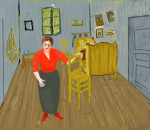
  • Peg Visits Vincent Van Gogh’s Room in Arles

    Peg Visits Vincent Van Gogh’s Room in Arles

    Peg Visits Vincent’s Room in Arles


    Peg Visits Vincent's Room in Arles
    Peg Visits Vincent’s Room in Arles, digital, prints only

  • Manuel in Vincent’s Room (Digital painting)

    I painted a portrait of Manuel, one of the excellent models I have been privileged to work with in Valencia.  I put him into my rendition of Van Gogh’s Room at Arles.  


    Manuel in Vincent's Room
    Manuel in Vincent’s Room, prints

  • Peg Finds Vincent’s Chair (digital painting)


    Peg Finds Vincent’s Van Gogh’s Chair

    Peg Finds Vincent's Chair
    Peg Finds Vincent’s Chair, prints only


    “Oh my, you are a most talented artist!  Peg by Vincent’s Chair is superb, and the lovely young singer is mesmerizing.  Also the dancers “only having eyes for each other” is so well captured.”  From an email