Tag: Flevoland

  • Once upon a zee

    Once upon a zee

    Before the construction of Flevoland, Genemuiden was a port on the Zuiderzee. It was granted city rights all the way back in 1275. Nothing remains from before 1866, unfortunately, when fires destroyed the town after haystacks caught fire. To this day there is no smoking permitted on that street, probably the only such designation in the EU.

    Judging by the 5 churches in the town there’s a lot of interest in religion in the town, but of course actual attendance is another matter. All the churches are Protestant in this northeast edge of the country’s Bible-belt. In some areas of the Bible belt people adhere to old fashioned clothing. I do not see that here.

    We arrived on Ascension day to find closures and reduced hours. The Eet Cafe, for example, was open but only provided beverages. Few people were out on the streets. It’s a national holiday, which no doubt accounts for the lack of activity, rather than Ascension day, as that’s a Catholic celebration. Unfortunately the harbor meister did stop by for our payment.

    We came here to have electricity as the overnight temperature was to drop to 3c, about 38f. We use a small electric heater when plugged into shore power, otherwise we have a diesel heater. We do not run the diesel heater at night to avoid CO accumulation. It takes the chill off in the morning when our indoor temperatures drops to around 15-16c, in the low 60’s.

    Floor mats made from bull rush reed that grew on the shoreline of the Zuiderzee was a principal product of the town. When Flevoland cut off the sea the bull rush was unable to survive the change. Now they import coconut fiber from India to make the mats and have expanded to a wide range of materials and products. Most of the town’s employment come from the large factories.

    We learned this and more at the Tapijtmuseum, https://www.tapijtmuseum.nl/over-het-museum after a good kip (chicken) sate at the friendly Eet Cafe Schippers. In the days of bull rush weaving, men waded into the reeds wearing clogs, a leather shin protector, ordinary clothes and a scythe to harvest the reed. This occurred in July and August but still the water is cold if you are in it all day. They could harvest up 100 bundles a day per person. At 3 p.m. they put the reeds out to dry in the wind and sun, after which the reeds were processed into mats. From the early hand weaving they have progressed to the most modern, computer-run equipment.

    Processing the harvest
    Operating the old electric loom
    Poster at the Eet Cafe

    Two loom operator’s joined our guide, who explained how the historic looms worked. Among their collection is a Jacquard loom, patented by the Frenchman of that name in 1802. It uses punch cards to weave complex designs, now done by computers. Each pass of the loom moves another card into place. It’s introduction revolutionized the industry.

    Queen Maxima wearing her maxed out hat inaugurated the reopening of the museum in September 2026 following its renovation. The Queen walked on an orange carpet laid for the occasion.

    Queen Maxima

    After our friendly retired civil engineer tour guide finished up with the Dutch couple that’d joined us, we were invited to have a coffee. The entire staff, being two women and the tour guide after he wrapped up, joined us. They wanted to know where we were from and where we were going. They made us feel right at home. We always find a way to compliment our host country. Certainly the Netherlands has much to offer.

    And then we were off to fight the wind at the municipal marina’s water point dock before mooring once again at the small haven just outside town.

  • The Green Church

    After several days visiting friends we set off again, despite the weather having turned to gray skies and 30 kph winds. One lock and a bit of cruising brought us to the moorings at the Green Church.

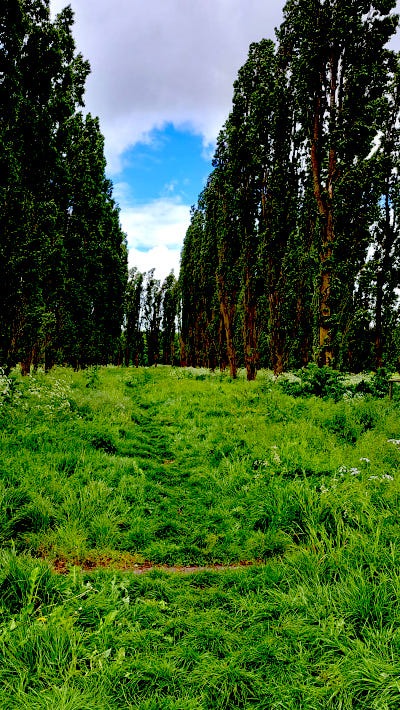
    Set in Flevoland, one of the Netherland’s recovered land provinces, the Green Church is formed by Italian poplar trees forming the outline Notre Dame of Reims. There is no altar or anything else having to do with a church. An artist named Marinus Boezum (1938) came up with the idea in 1978, calling it a “Gothic Growing Project.” With the support of the engineers of the Rijksdienst Ijseelmeerpolders, he planted the 178 poplars you see today. The Green Church is deemed to be Gothic in style, but only as that is style of the church in Reims.

    The Green Cathedral

    There are concrete “ribs” connecting the trees, referencing the ceiling vaults. There are circles of sea shells around the trees, reminding of the sea under which this land stood just 50 years ago.

    There were a number of large scale art projects in Flevoland, of which this is one. They are termed “Land Art,” a concept imported from the United States. The same artist created an identical “cathedral” on the neighboring plot, using oak and beech hedges.

    Flevoland is the largest reclaimed land section in the world. It sits some 6 meters below sea level. Cornelius Levy was the chief engineer of the project which removed the Zuiderzee. The section in which the Cathedral is located was built between 1959 and 1968. Shipwrecks unearthed date to the 16th century. They have been left in place, their locations marked by blue and white striped polls.

    Boezum went to art school in Utrecht. He worked as an artist in the 1950s. In the 1960s his work became more three dimensional, including sculptures and works in public spaces. He was influenced by the 1960 movements Nouveau Réalisme in Europe and Pop Art in America, and is one of the first Dutch conceptual artists.

    He has done many installations and video projects. Other than the Green Cathedral, which I find mildly interesting especially in its current unkempt state, I have no experience with his work, and do not know if it would make me yawn, as so many installation and video projects do.

  • Scooting across the Netherlands

    In Haren we were forced to wait for the weekend to pass before we were allowed to proceed in the small canal linking the Netherlands and Germany. The canal is tree lined, passing through farms and scattered settlements. A small sign marks the border between the two countries.

    Across the border lies Nieuw Amsterdam with free moorings. You just pay for electricity and water if you choose to connect, paying via an app. Gone are the days when you stuck a.50c piece to acquire these services. Automation has taken the jobs of those who collected the coins and responded to complaints. Many of these small towns employed harbor masters who collected the nightly fee, now considered uneconomical. In some harbors the app charges you for mooring if you use electricity.

    Genemuiden
    Waiting for the lock at Ketelhaven
    Genemuiden
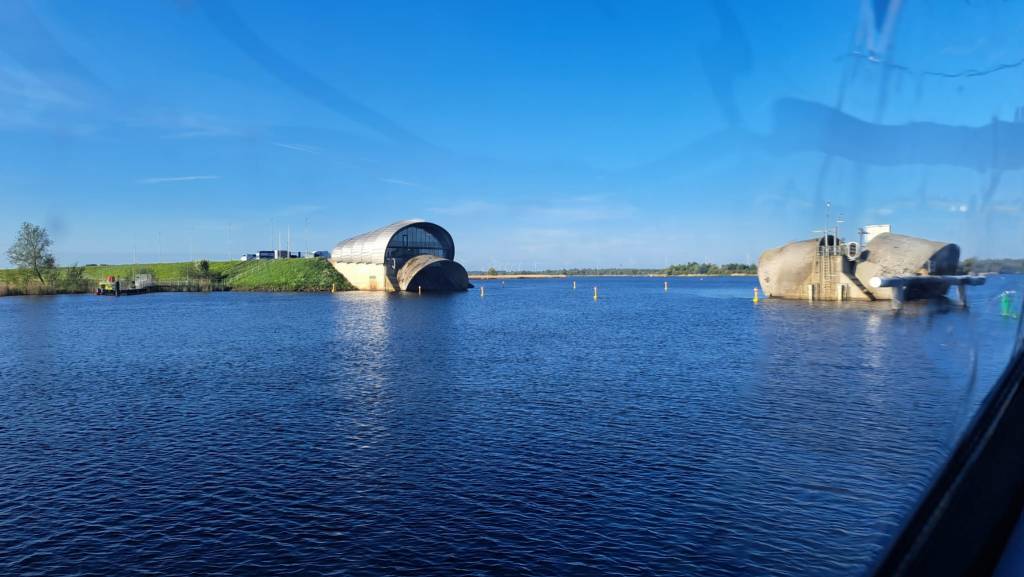
    Strange drainage tubes in the Zwarte Water

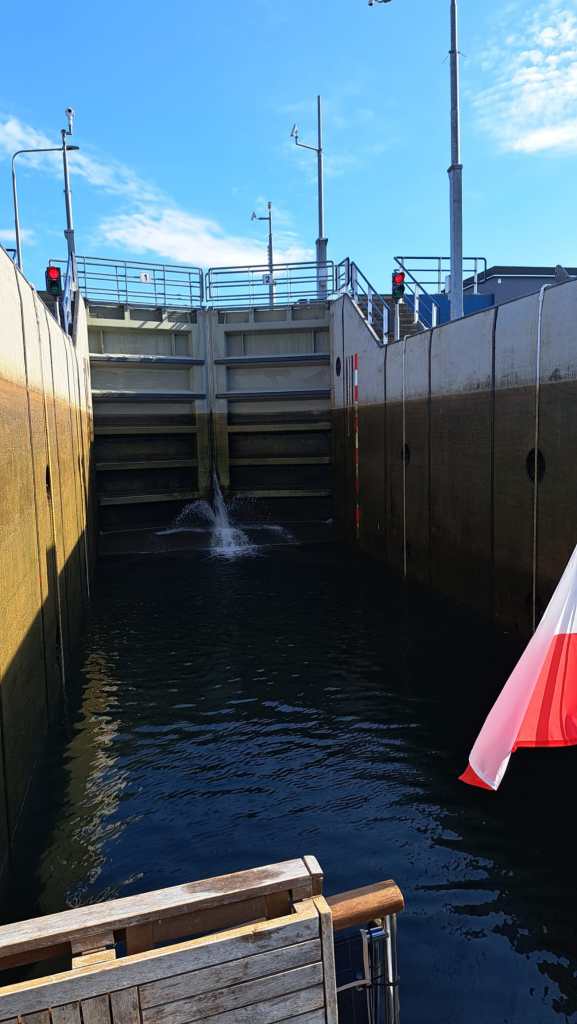
    The deep lock at Ketelhaven

    We turned south after a rest day, during which we met up with some folks we met during their visit to Valencia. It turned out they were heading to the same marina in Potsdam where we’d moored our boat for last winter’s sub-zero winter. Boaters look out for one another so we were happy to help them with the information we’d collected.

    In mixed skies we proceeded towards Almere where we’d scheduled some minor repairs to our rain hood. The first long day ended just outside Genemuiden in a tiny harbor, with room with just two boats at most with an entry just barely wide enough. We left at 0700 the next day under sunny skies. The winds tend to increase as the day goes on, thus our early departure, and there is some open water ahead. When the wind crosses the water from the east you would get some broadside waves, making for some discomfort.

    We passed just a few pleasure boats and barges before we turned southwest towards the lock at Ketelhaven. At the two locks there you drop about 8 meters into the reclaimed land province called Flevoland. These locks and pumps keep Flevoland from flooding.

    There are no further locks until you come to the Ijseelmeer in Almere. We are not going that far, stopping in Almere Buiten. Here we have friends dating from 2000 when we were aboard Caprice, our first Dutch boat.

    From here on we can slow down, slowing down from the very slow to the super slow. We are free to roam the country, where the boating infrastructure is the best.