Category: Spain

  • Aranjuez, the summer palace of the Spanish royalty

    Aranjuez, the summer palace of the Spanish royalty

    Aranjuez is just south of Madrid and home to the summer palace.  It was built in the second half of the 16th century under Phillip II.  The town was originally inhabited only by the court but now is a small but vibrant town dominated by the tourists who visit the palace.

    The main entrance is through a gate that leads onto a large courtyard.


    Palacio de Aranjuez pen and ink
    Palacio de Aranjuez pen and ink, (5 x7″, 12.7 x 17.8 cm- to purchase see bottom)


    Palcio de Sivela, Aranjuez
    Palcio de Sivela, Aranjuez

    Visitors would have entered through the doors to be confronted with a magnificent marble staircase and a ceiling high above.   Nowadays visitors enter through a much smaller entrance in the Renaissance style wing.  This style features a rather flat presentation, with pediments of various sorts adoring the windows.  Here you can also see the Romanesque arches, rounded versus the sharper edges of the Gothic style.

    The interior visitors access is limited to two floors.  Once you climb the main staircase there perhaps a dozen rooms.  Some are more what you might expect in terms of high and painted ceilings, luxurious furnishings, and rich colors.  Others are intensely decorated with ceramics:


    Aranjuez Ceramics
    Aranjuez Ceramics


    OLYMPUS DIGITAL CAMERA
    Aranjuez interior

    The palace sits on the conjunction of two rivers, the Tagus and Jarama.  The rivers feed numerous fountains and maintain the extensive gardens.

    Fountains Aranjuez
    Fountains Aranjuez
    Fountains Aranjuez
    Fountains Aranjuez
    Aranjuez River Tajo
    Aranjuez River Tajo

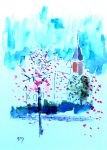
    Nearby is the Palcio de Sivela, built in 1860 and completely restored in 1988.  Here is my impression of it
    Palcio de Sivela, Aranjuez
    Palcio de Sivela, Aranjuez (watercolor, 5 x7″, 12.7 x 17.8 cm) sold
  • On the back road to Aranjuez- Torcas de Palancares

    On the back road to Aranjuez- Torcas de Palancares

    December 6, 2016

    We set off on our journey from Valencia to Aranjuez at 7am on Sunday.  The train route takes you west through massive fields of grapes dotted by the occasional and equally massive wine storage units jutting some 25 meters toward the clouds, stopping in a seemingly endless number of small towns along the way.  Progress is slow and the it gets much slower as then we enter the National Park known as Torcas de Palancares, leaving the farms behind.

    The ravines (barrancos) along the train route from Valencia to Aranjuez dig deeply into the rocky orange soil. Because it has been raining, itself a bit of a refreshing oddity, rivulets flow beneath the train as it slows to 20 kph as we inched across trestles, looking straight over the side at the rocky bottom far below.  You don’t feel confident out there in the middle.  They are going that slowly for good reason.

    There are more people on the train – so vacant we practically got on a first name basis with the conductor- than live in the protected zone portion of the journey, judging by the total lack of dwellings and just the occasional dirt road.  A large bird, a hawk or perhaps even an owl, swoops across the tracks, looking for an unwary rabbit.  The boars are too big to lift so they are safe from his talons.

    (more…)

  • Cáceres: you could shoot a medieval movie here and wouldn’t even have to remove the cars

    Cáceres has an old walled town in its center.  Walk around and you are in the middle ages, given the buildings, the stone streets and total absence of cars.  There is a blend of Roman, Moorish, Gothic and Italian Renaissance architecture, not to mention the stork nests.   There are thirty towers from the Islamic period still standing.

    Humans have inhabited the area since prehistoric times. Evidence of this can be found in the caves of Maltravieso, with cave paintings dating to 25,000 BCE.  The city was founded by the Romans in 25 BC and is a Unesco World Heritage Site, quite justifiably so.

    Cáceres is in the part of Spain called Extremadura.  I always thought that the name Extremadura referred to the extremely hard (dura) quality of the soil and life there but more accurately extremadura is from Latin words meaning literally “outermost hard”, the outermost secure border of an occupied territory.  During La Reconquista it was the westernmost holding of the Christians.

    caceres cathedral

    (more…)

  • Cuenca, Spain: City on a cliff

    Cuenca, Spain: City on a cliff

    Cuenca, Spain: City on a cliff

    Cuenca is situated northwest of Valencia and southeast of Madrid, just an hour from either on the AVE, the fast train.  It is known for the houses perched on the cliffs and for the Júcar and the Huécar, two rivers (well, streams is a better word) which encase it.  The town was first settled by the Moors, who sought to take advantage of its natural fortress qualities.  Nonetheless they lost it in 1177 to the Christians.

    The area offers an interesting cuisine, which I will comment upon below the photos.

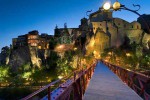
    cuenca bridge
    Looking at the town from across the bridge
    13051596_10154168775298331_2776704917126771407_n
    Some of the famous cliff side residences
    13043738_10154169598503331_9073303365152680531_n
    Whoa!
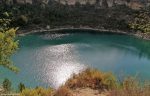
    Near the juncture of the two rivers
    Near the juncture of the two rivers
    12994548_10154169631793331_2775750632472865573_n
    View from Restaurante el Secreto, Cuenca

    cuena from above

    Cathedral in Cuenca
    Cathedral in Cuenca
    Cuenca street
    Cuenca street

    The Cuisine

    There are a number of interesting dishes, mostly tapas.

    • Ajo arriero, cod, potato and garlic, can be spread on bread
    • Morteruelo,  pâtĂ© made from hare, partridge, hen and pork or some combination
    • Pisto manchego, tomato, pepper, courgette/zucchini fried in olive oil.  Very thick.
    • Mushrooms, harvested in the forests near Cuenca.  NĂ­scalo is common, but other species, such as boletus (long and large with a cap).
    • Mojete: traditional salad made of tomato.
    • Alajú an Arab cake made of honey, almonds, nuts and grated orange rind.
    • Resoli is an after dinner alcoholic beverage made from grape must, cinnamon, anise.

    We had lunch at Restaurante el Secreto.  The Guide Routarde sign for multiple years including 2016 attracted our attention.  The Guide has served us well through the years and it did not disappoint us.  This restaurant has many game offerings.  Peg had the venison, which was superb-  even I thought so.  The wine was very good, local and reasonably priced, as was the entire meal including my ceviche trout.

    The decor is worth a look!  Ceramics floor to ceiling.


    12994523_10154169137253331_7355078384638981053_n 13043490_10154169137343331_1219314807341596543_n